Mission: To promote the appreciation of wildlife and increase harmony between humanity and nature.

On Instagram: @unionbaywatch
Showing posts with label Pileated Woodpecker. Show all posts

Saturday, June 20, 2020

Le Coup d'Etat

This year's young Pileated Woodpeckers look out on a changing world. 

Paradigms and power structures can suddenly shift. Leaders can be left aimlessly adrift, flailing wildly and watching helplessly, as the parade of life disappears in the distance. Looking back, the sudden change can be seen as the obvious result of mounting pressure. Historically, their pompous, bombastic rantings, along with their numbers and intelligence, have made American Crows one of the most dominant avian species around Montlake.

Last year, a change began when pair of Common Ravens settled in near Union Bay. Most likely, they are the first resident pair in Montlake since the forest was cleared over a hundred years ago. However, their full impact was not immediately felt. 

Early this spring, they built their first local nest and laid their eggs. Time passed as they incubated and defended them. The eggs hatched and as their nestlings grew so did the pressure. There was a growing demand for food. If there was a moment when the power shifted I suspect it was when the young ravens fledged. Suddenly, there were four large, hungry ravens to be fed. With each raven weighing as much a four adult crows their combined hunger had an immediate impact. 

Lately, I have found the inedible wings of crows scattered across Montlake. Young crows, still stuck in their nests, unable to fly, provide easy targets. Adult crows defending the nests are simply somewhat larger meals. More than once I have heard about uneaten food left lying on the ground. I suspect the young ravens, still developing their coordination, dropped the food. Initially, knowing no better, they simply sat and wailed louder, expecting their parents to bring more.

At the end of March, I found Chip, the adult male Pileated Woodpecker, excavating the nest. The process appeared identical to previous years. He was once again working in the decomposing remains of a large Red Alder. As the chips flew, he earned his name anew.

When Bald Eagles flew over Chip would somehow notice even when he was working deep inside the nest. The varying length of the wing feathers indicates this was a young Bald Eagle in its second year.

Chip was alert to the Bald Eagle's presence and not afraid to extend his head and watch it glide away.

At the end of April, an adult Raven flew in, vocalizing loudly and landed near the nest. At this point, I suspect the woodpecker eggs had been laid. Chip was in the nest but he never looked out. I believe he did not want to give the Raven any hint of the nest's location. Being of the same mind, I focused my photography on the Raven.

Early in June, after the eggs had hatched and the young Pileated were getting fairly good-sized, all four Ravens came in and landed near the Pileated nest. The adult woodpeckers were both outnumbered and outweighed. I listened and watched as one of the adults sat in a nearby tree and cried incessantly. Apparently, it worked. The Ravens never seemed to notice the nest. Evidently, the adult's cries distracted or annoyed them. The begging calls of their own young may have played a part as well. In any case, the Ravens quickly moved on.

A couple of days later, I watched as Goldie, the adult female, returned to the nest with food.

Pileated Woodpeckers eat a lot of carpenter ant larva. When feeding their young they regurgitate the masticated white paste and deliver it deep inside the throats of their young.

The next day, a delivery from Chip was also met with enthusiasm.

It is interesting to note how he carefully took turns feeding the young.

As the young grow their cries get louder and they become ever more demanding and potentially dangerous.

Perhaps, by approaching from the side Chip is minimizing his exposure to their bills.

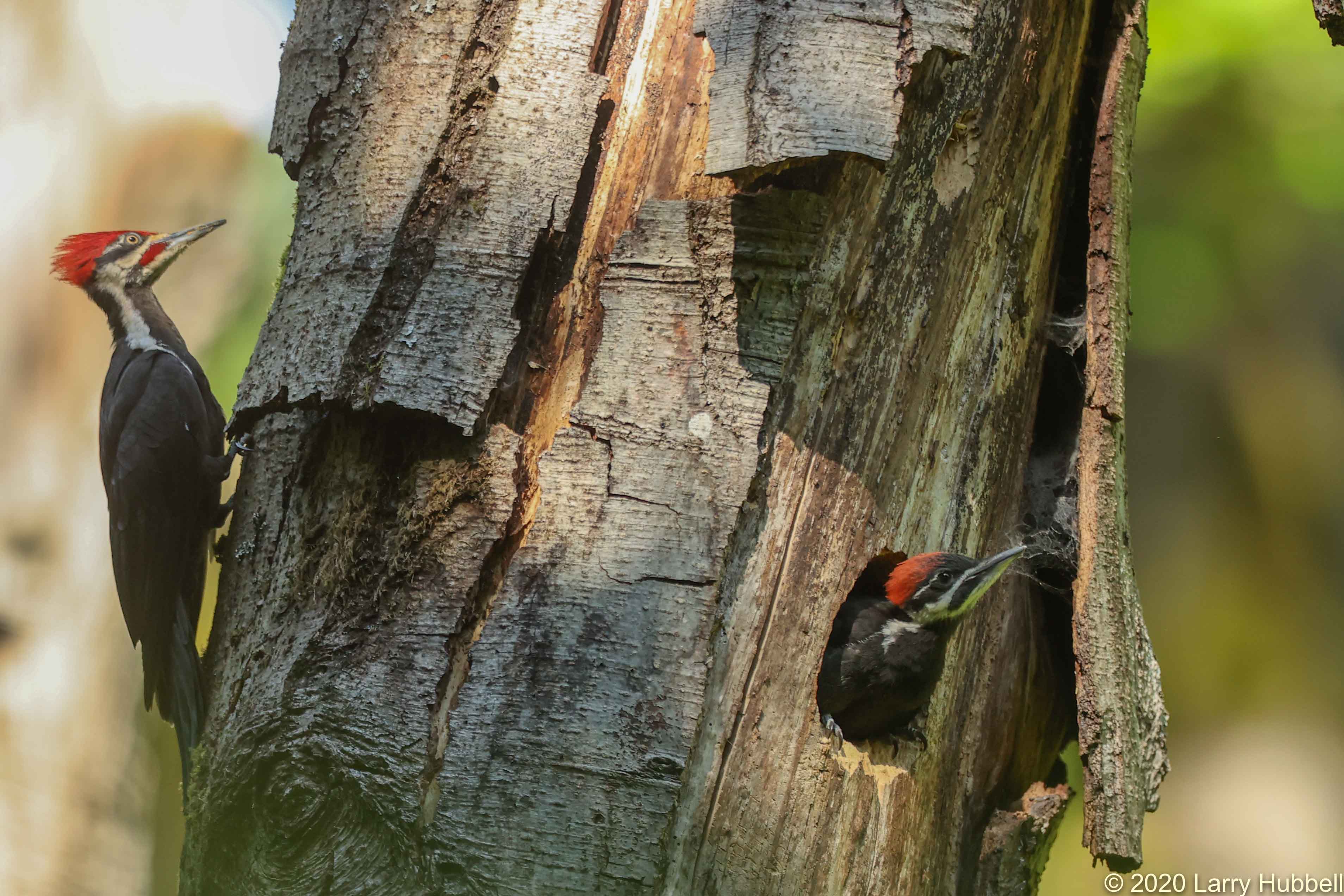
Last week, their curiosity about the outside world was obvious. 

Their time for sheltering-in-place was coming to an end.

They were nearly ready to make the leap into the unknown. At one point, I watched as Chip circled around the nest from one tree to the next, calling loudly. The young answered excitedly but choose not to leave the nest while I watched. 

However, I have not seen them since. I suspect they are somewhere in the greater Montlake area. Historically, during the first summer, the young follow the adults from one location to the next. During the process, they learn where to find food and I suspect the adults teach them about the various dangers they may encounter e.g. Barred Owls, Cooper's Hawks, and now Common Ravens.

The question is, Where are they now? Have they survived in the Raven's world? Have the parents led them to food and safety? I have searched high and low but I have not found any of the four during the last week. I doubt the Ravens could have caught them all. Plus, I have not seen any feathers that would indicate the demise of a Pileated Woodpecker. 

Hopefully, they are adapting to the new world and simply evading the Ravens (and me). I would appreciate it if you would keep your eyes open and let me know if you see any of them. 

In case you are luckier than me, here are some critical differences to help you identify them and their feathers. 

Chip is the only male in the family. As such he has a red stripe on his cheek and a red forehead. He is also the only one with yellow irises, which is more of an individual variation and not gender-related.

Goldie has a dark forehead with highlights of golden-brown, which explains her name. She has black stripes on her cheeks. Her irises have a hint of red. Over the years, I am starting to suspect they are slowly turning yellow.

The girls are of course both female with dark foreheads and dark malar stripes. Their irises generally appear dark at this age. However, in direct sunlight they sometimes reflect the light blue color of the sky. It also may be helpful to notice that their 'topknots' have a slightly orange cast and the feathers tend to be shorter, fluffier, and often more erect than the parents.
On occasion, the adults raise their crests as well.

The lower thirty percent of a Pileated Woodpecker's primary feathers are white which as far as I know is a unique pattern among local species. They are also much thinner than the dark primary feathers of a crow. 

Primary wing feathers are some of the longest feathers on most birds. They are also meatless and, in my mind, likely to be left where they fall by a predator. A single feather, like this one, was probably dropped during the process of being replaced. On the other hand, a clump of feathers generally indicates that the target bird has been consumed.

Thank you for following along and watching out for our local family of Pileated Woodpeckers.


******************


Tsuloss Watch:

The young eagle in Monty and Marsha's nest continues to grow. Sometime in the next month or so, I expect Tsuloss will leave the nest. A number of readers have now sent in their guess for when Tsuloss will fledge.

If you would like to play along send me your name and the date when you hope or expect Tsuloss will leave the nest. 

July 1st - Barry Saver
July 2nd - Tyler Mangum
July 4th - Larry Hubbell
July 6th - Joe Clancy
July 8th - Cynthia Jones
July 9th - Lynne Kelly
July 10th - Lynn Adams
July 15th - Jeff Graham
July 16th - Audrey Weitkamp

(By the way, the nestling period for Bald Eagles, as stated on All About Birds, can vary quite a bit. It is listed as 56 to 98 days. This implies to me that Tsuloss might just as well fledge in late July or even August.)


The only rules I can think of for this impromptu, prize-less contest are:

A) I plan to only publish the name associated with the first entry I receive for each date. I want to encourage the widest variety of dates as possible.

B) Practice hops do not count e.g. when the young eagle flaps, lifts up and then comes right back down in the nest.  Also branching - hopping from branch to branch - does not count. Tsuloss must leave the air space above the nest.

C) Falling does not count. Tsuloss must leave the nest and exhibit an ability to stay in the air. However, if you do see Tsuloss fall from the nest and land on the ground, especially if unable to fly, please call:

 Lynnwood PAWS at 425-787-2500

PAWS has rehabilitated and released 3 out of Tsuloss's 4 siblings during the last 2 years. (The fourth sibling did not require assistance.)

The following information may help you make a more accurate guess:

Eaglet Patrol - The post suggesting when Tsuloss might have hatched.

Tsuloss - The last eagle update.

By the way, Tsuloss is most easily seen with binoculars from the north side of Montlake Cut. The nest site is shown on this Union Bay Map.

My email address is: ldhubbell@comcast.net


************************


Have a great day on Union Bay...where Black Birders are always welcome!

Black Lives Matter,
Larry


Going Native:

Without a well-funded Environmental Protection Agency, it falls to each of us to be ever more vigilant in protecting our local environments. Native plants and trees encourage the largest diversity of lifeforms because of their long intertwined history with our local environment and native creatures. I have been told that even the microbes in the soil are native to each local landscape. I hope we can inspire ourselves, our neighbors, and local businesses to respect native flora and to support native wildlife at every opportunity. I have learned that our most logical approach to native trees and plants (in order of priority) should be to:

1) Learn and leave established native flora undisturbed.
2) Remove invasive species and then wait to see if native plants begin to grow without assistance. (If natives plants start on their own, then these plants or trees are likely the most appropriate flora for the habitat.)
3) Scatter seeds from nearby native plants in a similar habitat.
4) If you feel you must add a new plant then select a native plant while considering how the plant fits with the specific habitat and understanding the plant's logical place in the normal succession of native plants.

My intention in my weekly post is to include at least one photo each week and visually challenge us to know the difference between native and non-native lifeforms. 

By the way, my friend Tom Brown pointed out that the application named 'Wildflower Search' is extremely helpful. Click on the highlighted link to see for yourself.


What species is this? Is it native to Western Washington?
 
Note: These questions apply to both flora and fauna.


Scroll down for the answer.


***************


Rufous Hummingbird: Our original native hummingbird that annually migrates to Mexico and back.

Black Twinberry: It is a native plant and it attracts native hummingbirds!


***************


The Email Challenge:


Over the years I have had many readers tell me that Google is no longer sending them email announcements regarding my posts. Even more frustrating when they go to 're-sign-up', hoping that will enable them to once again start receiving the announcements, they get a message which says 'Sorry, you are already signed up.' Google has not responded to my requests for help with this issue. 

My functional workaround is to set up my own email list and each week I manually send out a new post announcement. If you are experiencing the issue and would like to be added to my personal email list please send me an email requesting to be added. Thank you for your patience!


My email address is: LDHubbell@Comcast.Net


***************


Here is another photo for those who read all the way to the end.
It is interesting to note that every Pileated Woodpecker nest site, that I have found in the PNW, has had an egg-shaped hole. The only one I have found on the east coast was round. I wonder where the shape change occurs?

Sunday, November 10, 2019

Goldie?


Spotting Chip, our local male Pileated Woodpecker, this week was like running into an old friend. The sight of him brought a smile to my face. My pulse quickened in anticipation. I was hoping to learn more about his behavior, to make sure he looked healthy and maybe even find out if he and his mate were still together. They mate for life, but life is dangerous, especially in a city full of fast-moving vehicles.

The first thing I noticed was the residential cavity he was excavating. The hole was shaped like an egg. In my experience, the Local Pileated Woodpeckers generally create this shape when building nests or roost sites. When prospecting for food, e.g. primarily carpenter ants or beetle larva, their holes are generally shaped quite differently.


Here is an example of a feeding hole in a fairly healthy tree. Since the exterior wood has not begun to decay, the rectangular shape of the hole is fairly precise.

This photo shows a well-used, flat-bottomed nesting hole. As the birds enter and exit the holes, the holes tend to open up and the shape may evolve, somewhat. Young resident birds will also pick at the edges in their apparent impatience with the confines of the nest. This 2018 nest hole had seen a lot of use by this point. The young were almost ready to fledge. 

Above the nest, you can also see a fresh feeding excavation. Notice the bright color of the unoxidized wood. Locally, all the Union Bay nesting trees I have seen, have been in dead or dying Red Alder trees. When the trees reach their last stages of decay they become quite soft and just right for nest building or easy feeding.

November seems way too early for Chip to be nest building, even though this is a dead Red Alder tree. However, I have seen a Pileated Woodpecker excavate a new roosting site at this time of year. I suspect when the rains come and the winds start blowing, the snags that contain existing roosting sites are more likely to fall. Most likely this drives the need for new nightly sanctuaries.

After a few minutes, Chip called out while he worked. Much to my surprise, his mate answered. Chip's mate has been generally silent in the past. Seldom have I heard her make a sound. When Chip heard her response, many of his feathers became erect and he stopped work. Notice how his top knot is still partially erect. It is more obvious when compared with the previous photo. He certainly appeared to be listening.

A new friend found and pointed out the location of his mate. She was much closer to the ground and searching for food.

Females have black malar stripes on their cheeks, unlike the red on males. They both continued their efforts for a while before taking off and flying away.

I was able to visually track Chip and notice that he landed on a telephone pole. I ran uphill and around the ravine to get in position to watch what happened next.

After a short while, his mate landed on the pole below him. She quickly began 'hitching' her way up the pole. A Pileated will momentarily balance on their tail while both feet reach up to grab the pole (or a tree) at a higher level. Then, they pull themselves higher, set their tail again and repeat the process. This must use less energy than just flying up to the desired height. (They will often use the same process to reach the top of a tree or snag just before taking off to fly to the next tree.)

Each time they move up, the head stretches out away from the pole before they pull themselves up and in again.

I never got close enough to see the detailed makeup of Chip's mate. I would have liked to determine if she was the same female from last year, whom I called Goldie. Her forehead seemed darker, her irises might have been lighter and she sounded more vocal, but I could not be certain as the daylight began to fade. The changes may have been the result of growing maturity, or she may have been replaced by a different female. My photos were not crisp enough to confirm my impressions.

I watched every day for the rest of the week, hoping to come across them again and get a better look. Sadly, luck did not smile on my endeavor.

On the other hand, as I was leaving I noticed and photographed a primary feather from a Pileated Woodpecker.

It looks to me like this is the third primary feather given the ratio of roughly 40% white versus 60% black coloring and the specific arrangement of the colors. Also, given that the leading edge of the primary feathers is often smaller than the trailing edge, I believe this feather is from a righthand wing.

I am always amazed that nature has given them the ability to grow so many unique two-toned feathers. It is also incredibly interesting that the white is generally only visible from below and only when a bird is in flight. I wonder if its primary value is as a mating display.


******************

You can double-check my conclusion about the primary feather location by comparing the photographed feather with the set of primary wing feathers shown in the Feather Atlas. Click on the following link:


In the search criteria enter is the word 'Pileated' after the third label, e.g. 'Common Name'.

Order: Piciformes
Family: Picidae
Common Name: Pileated Woodpecker
Scientific Name: Dryocopus pileatus

Finally, click on the button labeled: Search


******************


In the winter when the leaves have fallen, Pileated Woodpeckers are a bit easier to spot. However, given their rather large territories, it helps to be lucky.


Have a great day on Union Bay...where nature lives in the city!

Larry


Going Native:

Without a well-funded Environmental Protection Agency, it falls to each of us to be ever more vigilant in protecting our local environments. Native plants and trees encourage the largest diversity of lifeforms because of their long intertwined history with our local environment and native creatures. I have been told that even the microbes in the soil are native to each local landscape. I hope we can inspire ourselves, our neighbors and local businesses to respect native flora and to support native wildlife at every opportunity. I have learned that our most logical approach to native trees and plants (in order of priority) should be to:


1) Learn and leave established native flora undisturbed.

2) Remove invasive species and then wait to see if native plants begin to grow without assistance. (If natives plants start on their own, then these plants or trees are likely the most appropriate flora for the habitat.)
3) Scatter seeds from nearby native plants in a similar habitat.
4) If you feel you must add a new plant then select a native plant while considering how the plant fits with the specific habitat and understanding the plant's logical place in the normal succession of native plants.

My intention in my weekly post is to include at least one photo each week and visually challenge us to know the difference between native and non-native lifeforms. 


Is the tree which produced these leaves native to Union Bay?


Scroll down for the answer.


***************


Maidenhair Tree: It is not native to the Americas. However, it may be one of the oldest living tree species. It also may be more commonly known as Ginkgo biloba - which is also the scientific name. Clicking on the link will take you to the extensive Wikipedia write up, which I found very interesting.

Note: Reading about the Adverse Effects, as listed in Wikipedia, was enough to keep me from considering it as a dietary supplement.


***************


The Email Challenge:

Over the years I have had many readers tell me that Google is no longer sending them email announcements regarding my posts. Even more frustrating when they go to 're-sign-up', hoping that will enable them to once again start receiving the announcements, they get a message which says 'Sorry, you are already signed up.' Google has not responded to my requests for help with this issue. 

My functional workaround is to set up my own email list and each week I manually send out a new post announcement. If you are experiencing the issue and would like to be added to my personal email list please send me an email requesting to be added. Thank you for your patience!


My email address is LDHubbell@comcast.net


Saturday, January 12, 2019

Brilliance

Red-breasted Sapsuckers are brilliant and beautiful. They are also unique when compared with our other species of local woodpeckers. The others feed mostly on arthropods, e.g. ants, and fruit. Sapsuckers, as their name explains, have a preference for the sweet lifeblood of trees. Although, they also eat ants, spiders, and fruit, especially during breeding season. 

Birds of North America says, they will even dip ants in sap before feeding them to their young. The young need the protein, and apparently, the adults want to make sure that the little ones also develop a taste for their primary winter food.

Their deeper sap wells are usually aligned in horizontal rows which make it easy for them to reach to their left or right without significantly relocating. 

Their long stiff tails help to support their weight while they work. In the winter, sapsuckers, often pick a tree or two and continually return to the same sets of wells. At a casual glance, one might consider them the couch potatoes of the woodpecker world.

Actually, I see them as hard working and industrious, maybe even wise and efficient. Their wells require an initial investment in excavation, plus ongoing maintenance to keep the sugary sap flowing. By working the same sites repeatedly, day after day, they are maximizing their ROI, e.g. the return on their investment.

While Red-breasted Sapsuckers are fairly unique among local woodpeckers, there are two closely related species farther to the east.

Red-naped Sapsuckers, like the one in this photo, are usually seen east of the Cascade crest. East of the Rockies, Yellow-bellied Sapsuckers are more common. These three species are similar enough that interbreeding occurs in places where the three species converge - like British Columbia. Historically, they were even considered a single species.

In the Southwest, the Red-breasted Sapsuckers often have more of a white malar stripe. I believe the stripe is similar to the one seen on this Sapsucker. The stripe looks like an extension of the white spot just in front of the eye. I wonder if the stripe might be an artifact of interbreeding between the Red-breasted and the Red-naped Sapsuckers. 

From what I have read, juvenile sapsuckers of all species are darker in color and initially lack any red feathers. I am looking forward to someday getting the chance to photograph one of the young birds.

Similar to a Pileated Woodpecker, when a sapsucker spots a potentially dangerous creature the bird will generally move to the far side of the trunk and freeze. Sometimes, they peak around the tree to keep an eye on the intruder, but they seldom resume any noisy excavations until after they decide the threat is passed.

Compared to our Flickers, Pileated or Downy Woodpeckers, Red-breasted Sapsuckers have a higher percentage of bright red feathers. Our local red-shafted, Northern Flickers do have more orange-red feathers. However, the Red-breasted Sapsuckers have more distinctly red feathers. 

In spite of their brilliant color, I find the sapsuckers harder to spot than the previous three woodpecker species. I think this is because they generally work in the shadows, next to the trunk of the tree, Maybe also because they spend less time flying about from one location to the next

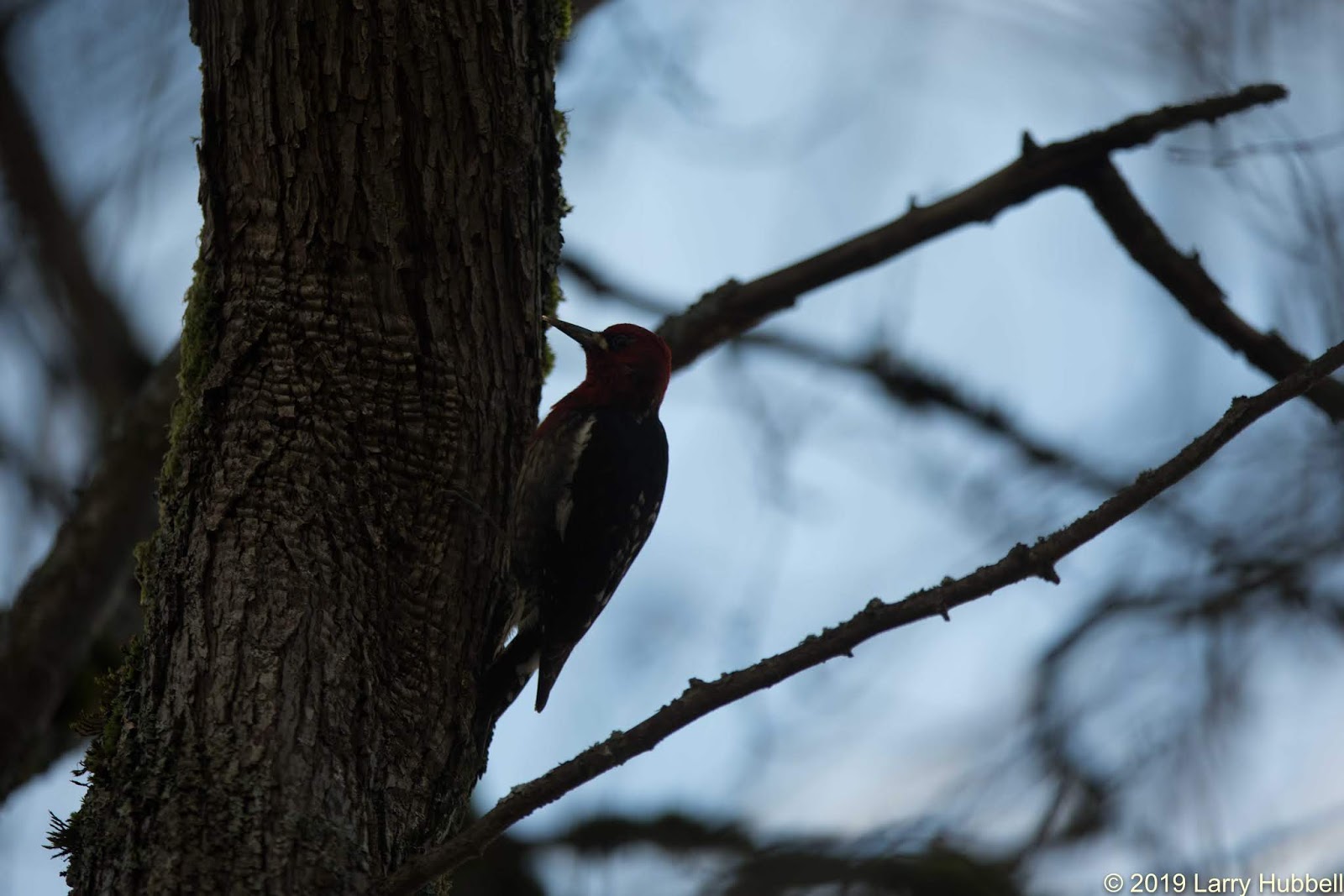
Here is a fairly common winter view of a Red-breasted sapsucker. In fact, they are often more distant than this photo implies and usually not outlined against the sky. 

Only with a careful adjustment of exposure does the beauty of the bird emerge. 

One of the most intriguing things about this species is the translucent tip to the bill. It is not always visible but I normally see it in at least a few photos from every encounter. I suspect it a matter of catching the light just right. Maybe it is similar to shining a flashlight through your fingernails. The luminous glow and its obvious strength on impact remind me more of ivory than fingernails.

Another interesting item of note is how they can adjust their wings to hide their bright white wing stripe. If you look back through the photos you will see that it is sometimes displayed and sometimes not. I wonder if hiding the stripe is intentional or accidental?

Speaking of catching the light just right, I feel very lucky whenever a Red-breasted Sapsucker peeks out of the shadows and catches one of our occasional shafts of sunlight. The result is a flaming explosion of brilliance.

Have a great day on Union Bay...where nature lives in the city!

Larry


Going Native:

Without a well-funded Environmental Protection Agency, it falls to each of us to be ever more vigilant in protecting our local environments. Native plants and trees encourage the largest diversity of lifeforms because of their long intertwined history with our local environment and native creatures. I have been told that even the microbes in the soil are native to each local landscape. My hope is that we can inspire ourselves, our neighbors and local businesses to respect native flora and to support native wildlife at every opportunity. I have learned that our most logical approach to native trees and plants (in order of priority) should be to:

1) Learn and leave established native flora undisturbed.
2) Remove invasive species and then wait to see if native plants begin to grow without assistance. (If natives plants start on their own, then these plants or trees are likely the most appropriate flora for the habitat.)
3) Scatter seeds from nearby native plants in a similar habitat.
4) If you feel you must add a new plant then select a native plant while considering how the plant fits with the specific habitat and understanding the plant's logical place in the normal succession of native plants.

My intention in my weekly post is to include at least one photo each week and visually challenge us to know the difference between native and non-native lifeforms.


What species is this? Is it native to Union Bay?


Scroll down for the answer.


***************


Pacific Wren: Often hidden and small but definitely native to Union Bay.


***************


The Email Challenge:

Over the years I have had many readers tell me that Google is no longer sending them email announcements regarding my posts. Even more frustrating when they go to 're-sign-up', hoping that will enable them to once again start receiving the announcements, they get a message which says 'Sorry, you are already signed up.' Google has not responded to my requests for help with this issue. 

My functional workaround is to set up my own email list and each week I manually send out a new post announcement. If you are experiencing the issue and would like to be added to my personal email list please send me an email requesting to be added. Thank you for your patience!


My email address is LDHubbell@comcast.net


*********************


Recommended Citation

Walters, E. L., E. H. Miller, and P. E. Lowther (2014). Red-breasted Sapsucker (Sphyrapicus ruber), version 2.0. In The Birds of North America (A. F. Poole, Editor). Cornell Lab of Ornithology, Ithaca, NY, USA. Retrieved from Birds of North America: https://birdsna.org/Species-Account/bna/species/rebsap