

What bird posed for this silhouette? The lack of color limits the clues to just form and function. The stark contrast makes the head and bill seem surprisingly large, while the downward focus speaks to the bird's behavior.
Birding by Shape was a concept taught in Seattle Audubon's Master Birder Class - Thank You!

It is amazing how adding color can make some information seem less obvious.

Northern Flickers are a unique type of woodpecker. Similar to other woodpeckers they can be seen on tree trunks and quite often sitting on the tops of trees. Occasionally, you may even see them on housetops, where they will often hammer on the metallic covers to chimneys. (The metal amplifies their territorial and mating communiques.)
However, unlike their relatives, when feeding they are usually found on the ground. This makes sense because their favorite food is ants. Not the large carpenter ants, that can be found in deadwood, but the smaller ones which create tiny ant hills while excavating their subterranean homes.

They are perfectly at ease in our lawns...

...and often seen probing the cracks in a sidewalk or...

...checking out crevices and gaps around rocks, while silently searching for ants and their larva.
In our area, the males generally have a distinctive red mustache while the females, see the second photo in this post, lack that bright distinction.

In Spring, when a male Northern Flicker is spotted excavating wood from a dead tree, nest building is a logical conclusion. For a split second, the wood chips are held in the bill.

Then, with a flick of his head, the chips fly.
One might assume that this flicking motion is what gives the Flicker its name. However, it is the same motion used by Pileated Woodpeckers, so it would not be fair for Flickers to get all the credit.
In either case, the chips fall where they may. Some smaller excavating birds carry the chips away from their nest sites, apparently, not wanting to give away the location.

In Spring, Flickers will also bob their heads and make a 'wicka, wicka, wicka' sound. This is often associated with a display of the colored feathers under their tails and wings. One website
(https://www.scienceworld.ca/stories/ever-wonder-about-flickers/) implies that since the term 'wicka' sounds kind of similar to Flicker it may have been the inspiration for the name.
(https://www.scienceworld.ca/stories/ever-wonder-about-flickers/) implies that since the term 'wicka' sounds kind of similar to Flicker it may have been the inspiration for the name.

Another website (https://animals.mom.me/difference-between-woodpecker-flicker-7810.html) states, "They are named for the brilliant yellow or red undersides of their wings and tails that cause the birds to resemble flickering flames when they fly."

Whether this idea is true or not is almost irrelevant. The concept of flickering flames is such an excellent memory aid it should be commonly used to burn the name into the minds of new birders.

By the way, we seldom see the eastern, 'Yellow-shafted' version of the Northern Flicker around Union Bay. In addition to the yellow versus orange coloring, can you spot two more differences between this male bird and...

...our local 'Red-shafted' variety?

The next day, after watching the male flicking chips out of the prospective nest site, I spotted a female looking out of the same hole.

A week later, I saw the female perched at the opening. Nesting certainly seemed to be in process.

By the way, Flicker eggs are all white. Possibly this is because there is no need for camouflage inside the nesting cavity. Another reason could be to reflect light and help the adults move about the nest without mishaps. (Thank you to the Burke Museum for allowing this photo.)


The white gape, where the upper and lower bills meet, is also thought to be helpful for the hurried adults.

It is interesting to compare the mother's bill and gape with that of the young bird. The adult's visual priority is the opposite of the young. They prefer to fade into the background rather than be easily seen.

Three is the maximum number of young photographed in this nest. Although, All About Birds states brood sizes are usually between 5 and 8. It is difficult to imagine how two adults could supply enough food to keep themselves and eight young adequately fed.
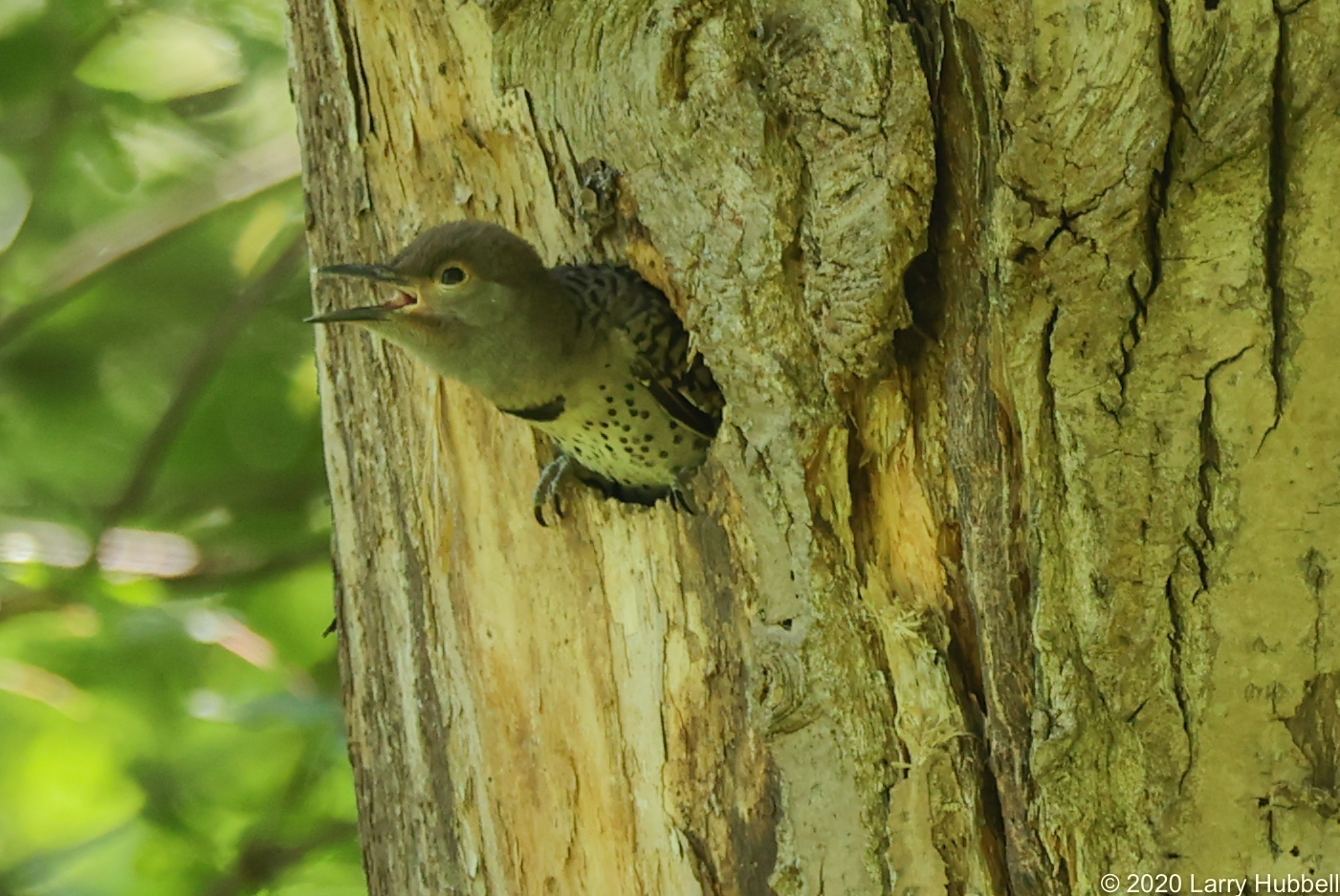

Sometimes, a parent will sit nearby and return the call. It seems as if they are saying, "Dinnertime, come and get it!"

Apparently, leaving the nest is a process and occasionally the parents will still bring food to the young even when they are nearly ready to fledge. In this mid-June photo, the small red fruits falling from the feeding operation are elderberries. Both Pileated Woodpeckers and Northern Flickers will feed their young elderberries when the ripe berries are near the nest site.

When the parents are away, the rapidly maturing young will extend their tongues to explore the outside world.

Their tongues are uniquely suited to investigating and harvesting tiny ants from their tunnels.

In this case, I suspect the white food falling during this exchange is ant larva.

Sometimes, the young appear to share the view in a remarkably civil fashion.

Sometimes, it looks a bit more like sibling rivalry.

This aggressive young male appeared to 'win' the rivalry and left the nest before his sisters. Notice the difference in the red mustache color between the mature male and the juvenile.
By the way, the two other obvious differences between the Yellow and Red-shafted male Northern Flickers (excluding their flames) are:
A) Red-shafted have red mustaches while Yellow-shafted have black mustaches,
B) the Yellow-shafted have red chevrons on the back of their heads.
It should be noted that in our area we also have male Flickers with a mixed genetic heritage. Looking for these birds can add a lot of 'spice' to your daily birding expeditions.

For example, this bird has the red chevron like a Yellow-shafted Northern Flicker and some black mixed into its mustache. On the other hand, it has the flaming orange feathering of a Red-shafted Northern flicker along with a hint of red mixed in the mustache.
 When the last of the young left the nest I suspect the parents did not have time to experience an 'empty nest syndrome'.
As soon as the young birds can fly they follow the parents everywhere begging for food. The intensity of the parenting experience only increases. On the plus side, this process will ultimately teach the young where and how to find food. Slowly at first, the juvenile birds will begin to find food faster than the parents can supply it. Before Fall, the elder birds will finally earn their freedom!
******************
Tsuloss Watch:

By July 3rd, Tsuloss had barely begun 'branching'. Sometime in the next month or so, I hope Tsuloss will learn to fly. Several readers have now sent in their guesses for when Tsuloss will fledge.
If you would like to play along send me your name and the date when you hope or expect Tsuloss will leave the nest. July is just around the corner!
July 1st - Barry Saver
July 4th - Larry Hubbell
July 6th - Joe Clancy
July 6th - Joe Clancy
July 8th - Cynthia Jones
July 9th - Lynne Kelly
July 10th - Lynn Adams
July 14th - Helen Spiro
July 15th - Jeff Graham
July 16th - Audrey Weitkamp
August 2nd - Tyler Mangum
(By the way, the nestling period for Bald Eagles, as stated on All About Birds, can vary quite a bit. It is listed as 56 to 98 days. This implies to me that Tsuloss might just as well fledge in late July or even August.)
The only rules I can think of for this impromptu, prize-less contest are:
A) I plan to only publish the name associated with the first entry I receive for each date. I want to encourage the widest variety of dates as possible.
B) Practice hops do not count e.g. when the young eagle flaps, lifts up and then comes right back down in the nest. Also branching - hopping from branch to branch - does not count. Tsuloss must leave the air space above the nest.
C) Falling does not count. Tsuloss must leave the nest and exhibit an ability to stay in the air. However, if you do see Tsuloss fall from the nest and land on the ground, especially if unable to fly, please call:
Lynnwood PAWS at 425-787-2500
PAWS has rehabilitated and released 3 out of Tsuloss's 4 siblings during the last 2 years. (The fourth sibling did not require assistance.)
The following information may help you make a more accurate guess:
Eaglet Patrol - The post suggesting when Tsuloss might have hatched.
Tsuloss - The last eagle update.
By the way, Tsuloss is most easily seen with binoculars from the north side of Montlake Cut. The nest site is shown on this Union Bay Map.
My email address is: ldhubbell@comcast.net
Naming Update:
Apparently, there is more than one way to pronounce the number five in the Lushootseed language. Aaron Peterson sent in this interesting update.
Clicking Here will enable you to find the word for five and the link to the pronunciation guide, which I originally used.
************************
Have a great day on Union Bay...where Black Birders are always welcome!
Black Lives Matter,
Larry
Going Native:
Without a well-funded Environmental Protection Agency, it falls to each of us to be ever more vigilant in protecting our local environments. Native plants and trees encourage the largest diversity of lifeforms because of their long intertwined history with our local environment and native creatures. I have been told that even the microbes in the soil are native to each local landscape. I hope we can inspire ourselves, our neighbors, and local businesses to respect native flora and to support native wildlife at every opportunity. I have learned that our most logical approach to native trees and plants (in order of priority) should be to:
1) Learn and leave established native flora undisturbed.
2) Remove invasive species and then wait to see if native plants begin to grow without assistance. (If natives plants start on their own, then these plants or trees are likely the most appropriate flora for the habitat.)
3) Scatter seeds from nearby native plants in a similar habitat.
4) If you feel you must add a new plant then select a native plant while considering how the plant fits with the specific habitat and understanding the plant's logical place in the normal succession of native plants.
My intention in my weekly post is to include at least one photo each week and visually challenge us to know the difference between native and non-native lifeforms.
By the way, my friend Tom Brown pointed out that the application named 'Wildflower Search' is extremely helpful. Click on the highlighted link to see for yourself.
By the way, my friend Tom Brown pointed out that the application named 'Wildflower Search' is extremely helpful. Click on the highlighted link to see for yourself.

Scroll down for the answer.
***************
All of the following Dragonflies are native to Western Washington. Due to their somewhat similar look, I have included two different species and both genders. However, I have not included Twelve-spotted Skimmers.


Dennis Paulson's book, "Dragonflies and Damselfies of the West" covers all three species and provides many more interesting details about their variations e.g. sometimes white wing-spots are optional.
***************
The Email Challenge:
Over the years I have had many readers tell me that Google is no longer sending them email announcements regarding my posts. Even more frustrating when they go to 're-sign-up', hoping that will enable them to once again start receiving the announcements, they get a message which says 'Sorry, you are already signed up.' Google has not responded to my requests for help with this issue.
My functional workaround is to set up my own email list and each week I manually send out a new post announcement. If you are experiencing the issue and would like to be added to my personal email list please send me an email requesting to be added. Thank you for your patience!
My email address is: LDHubbell@Comcast.Net
***************
Here is one more photo for those who read all the way to the end.

Did you notice the black tips to the tail feathers?

Since woodpeckers use their tail feathers for support, like a third leg when hitching their way up a tree, the tips wear down to a point around the relatively strong central rachis.


