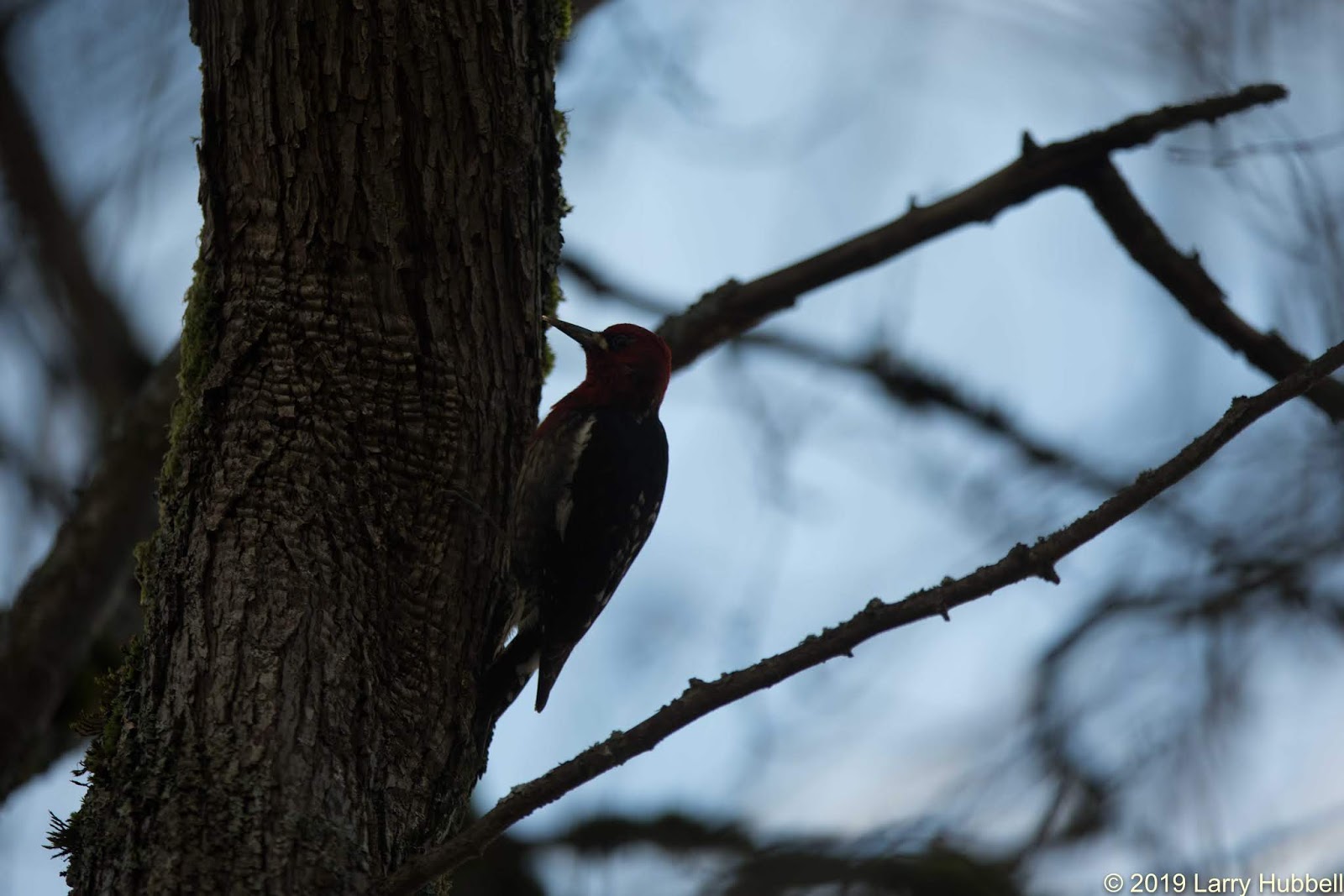
On Christmas Eve, this Sapsucker was feasting on a Willow tree next to Duck Bay, at the northern end of the Arboretum.
Learning to identify the life forms around us is certainly one of the first steps to appreciating our urban web of life. Since we are the dominant species on the planet, everything we do impacts our fellow creatures. Where we live, what we eat, drive and buy. The undisturbed habitat we leave in our yards, as well as the native seeds and fruits we allow to mature, can have a huge impact on our neighboring lifeforms. Understanding their needs will not only make our lives richer and healthier it is a critical step to a flourishing future for life on earth.
Take a closer look at the sapsucker (above), its holiday meal, and its surprising impact on the web of life.

To help with identification, let's compare this 2015 photo of a locally common Red-breasted Sapsucker. Does it look like the sapsucker in the first photo? What differences do you see?
Most obvious is the redbreast on the 2015 bird. It is clearly what inspired its name. On the other hand, there is virtually no red on the chest of the 2019 sapsucker.

This photo shows the only other species of sapsucker I have ever seen in Seattle. It is a, locally rare, Red-naped Sapsucker, also photographed in 2015. A third sapsucker, the Yellow-bellied, is even less likely in our area. Both of these species are known to interbreed with Red-breasted Sapsuckers and neither have red on their breasts.

It seems to me that this 2019 bird is most likely a hybrid between a Red-breasted and a Red-naped Sapsucker. However, the black mask surrounding the eye is rather puzzling. None of the four species of sapsuckers in North America have such a complete mask of black around the eyes. Three of the four have a black eye stripe running between white highlights, similar to the Red-naped Sapsucker. The Red-breasted Sapsucker is the exception.
This 2019 bird appears to be a unique individual. The black mask around the eye appears to be personal variation. Maybe this is how a new species begins. If this bird's unique DNA is passed on maybe someday its progeny will form another species. They might even be called, Black-masked Sapsuckers.

In any case, all the Sapsuckers have the ability to drill sap wells. They drill just deep enough to cause sap to flow out of the trees. Other creatures, like this Anna's Hummingbird, are wise enough to stop by and share in the meal, even though they lack the ability to create sap wells for themselves.

While hovering the hummingbird uses its tongue to lap up the sap. For the most part, the sap will only flow out of the tree while the sapsucker is keeping the wells open and functional. (Although, after this Sapsucker left the Hummingbird was seen a couple of days later checking for additional sap and/or insects.)

This photo shows that the two birds were aware of each other, neither one appeared particularly intimidated and both were perfectly willing to share their holiday meal.

Later, a Black-capped Chickadee stopped by to check out the possibilities. Chickadees do like insects and it is possible that a very small creature, trapped in the sap, may actually have been what attracted the Chickadee.

During these visits the Sapsucker had remained undisturbed. Its body was virtually stationary while feeding just below this branch. However, when it began turning its head and looking around I figured something was up.

As it moved away from its favorite set of wells I suspected a nearby predator.

With its head and neck extended the Sapsucker was clearly on alert.

A moment later, I noticed the Eastern Gray Squirrel.

The Sapsucker, with its small crest erect, moved to a nearby perch. The Squirrel moved on up the trunk. Squirrels in the area can often be seen eating acorns but apparently, sap makes a nice dessert.

The Sapsucker moved again to a more extensively used location on a nearby portion of the tree. It appears the bark of the tree actually split apart along the vertical lines of previous sap wells. I believe this willow is a Salix Alba or White Willow, an Old World native, which helps explain why the sapsucker damage is so extensive.


After the Eastern Gray Squirrel moved on the Sapsucker moved back to its preferred location.

Moments later a male Belted Kingfisher stopped in. I suspect all the commotion was just a bit much for the Kingfisher and it quickly flew. It chattered loudly and sounded a bit perturbed. I have never seen a Kingfisher eat anything but small fish so I suspect it was just looking for a quiet perch above the water and did not really want to share in the sap.

As the Kingfisher flew away, another surprise became apparent. This particular Willow Tree was obviously different from its neighbors. It still had some leaves on December 24th.

A couple of days later, when the sun came out for a moment, I caught this photo of the same tree. All the neighboring willows are bare. Their leaves have fallen and their sap has presumably stopped. This old fallen willow, with fresh sprouts, appears to be the only one in the area with leaves and sap still flowing.
I have not seen the Sapsucker since the initial encounter. I suspect it was on its way south and when it saw the deciduous leaves and decided to stop for a holiday feast. In the winter, once all the deciduous leaves have dropped the Sapsuckers will switch to coniferous trees. I suspect that since deciduous trees have a smaller window for growth their summer sap flows faster. Maybe, this is why the Sapsuckers prefer deciduous trees during warm weather.
By the way, while Red-breasted Sapsuckers can be found in our area year-round it does not mean that the individual birds are year-round residents. The Range maps show that all Sapsuckers migrate. Since we are in the middle of the Red-breasted Sapsucker range must likely our summer Sapsuckers winter in California and our winter Sapsuckers breed in British Columbia.
I am amazed by the variety of life that the sap wells feed as well as the unique characteristics of both the individual Sapsucker and this specific White Willow tree. Back in 2015, I remember seeing raccoons sniffing around the bottom of a tree with active sap wells. I did not see them feeding at the wells but they sure looked like they were considering the idea. Nature is amazing!
Have a great day on Union Bay...where nature lives in the city!
Larry
PS: For more about Sapsuckers you can read last winter's post titled, 'Brilliance'.
Going Native:
Without a well-funded Environmental Protection Agency, it falls to each of us to be ever more vigilant in protecting our local environments. Native plants and trees encourage the largest diversity of lifeforms because of their long intertwined history with our local environment and native creatures. I have been told that even the microbes in the soil are native to each local landscape. I hope we can inspire ourselves, our neighbors and local businesses to respect native flora and to support native wildlife at every opportunity. I have learned that our most logical approach to native trees and plants (in order of priority) should be to:
1) Learn and leave established native flora undisturbed.
2) Remove invasive species and then wait to see if native plants begin to grow without assistance. (If natives plants start on their own, then these plants or trees are likely the most appropriate flora for the habitat.)
3) Scatter seeds from nearby native plants in a similar habitat.
4) If you feel you must add a new plant then select a native plant while considering how the plant fits with the specific habitat and understanding the plant's logical place in the normal succession of native plants.
My intention in my weekly post is to include at least one photo each week and visually challenge us to know the difference between native and non-native lifeforms.

A) Is this tree native to Union Bay? What species is it?

Scroll down for the answer.
***************
B) Douglas Fir
Yes, both of these species are native to Union Bay and therefore better able to handle Sapsuckers than most Old World Trees.
***************
The Email Challenge:
Over the years I have had many readers tell me that Google is no longer sending them email announcements regarding my posts. Even more frustrating when they go to 're-sign-up', hoping that will enable them to once again start receiving the announcements, they get a message which says 'Sorry, you are already signed up.' Google has not responded to my requests for help with this issue.
My functional workaround is to set up my own email list and each week I manually send out a new post announcement. If you are experiencing the issue and would like to be added to my personal email list please send me an email requesting to be added. Thank you for your patience!
My email address is: LDHubbell@Comcast.Net