Mission: To promote the appreciation of wildlife and increase harmony between humanity and nature.

On Instagram: @unionbaywatch
Showing posts with label Nesting. Show all posts

Sunday, April 19, 2020

Hope Returns

This is Hope. She and her mate, Stewart, successfully incubated, hatched out and raised one young osprey in 2019. We named it, Rama. This all took place in their nest just south of the QFC at University Village. Specifically, the nest is on the south side of 45th Street on top of the northern light pole above the intramural activities (IMA) soccer field. I suspect Rama was their first offspring.

This belief is base on the fact that in 2018 they only half-finished their nest and they did not appear to do any actual egg-laying or incubating. Stewart is on the right. (Mature males generally have pure white chests.)

In 2019, about a quarter-mile to the south our older osprey pair, Chester and Lacey, appeared to be on course to lay eggs for the fourth year. Their nest is on the osprey platform at the Union Bay Natural Area (UBNA). This photo shows Lacey, the female of the pair at the nest site begging Chester for food in early May of 2019. 

It is interesting to compare the faintly brown smudge of coloring on her chest with the crisp dark brown spots on Hope's chest (in the first photo above). The difference is distinctive.

Sadly, Lacey did not settle on eggs in mid-May, as she has done in previous years. This might be related to the fact that in 2018 her young did not survive the summer. 

So far, this photo, taken above the UW Baseball field in June of 2019, is my last photo of Lacey. I believe she apparently left the Union Bay area in mid-summer in 2019.

Chester seemed to hang around longer. However, in early fall, when the weather begins to turn cold, fish move to deeper water which makes it harder for osprey to catch them. So, the osprey fly south and generally do not return to our area until April of the following year. This leaves us with some major mysteries for 2020.
  • Will both pairs return to the Union Bay area?
  • Will both pairs produce offspring?
  • Will their offspring successfully fledge?
It may be a big advantage for Hope and Stewart that their nest site is not located near the Union Bay shore. Bald eagles love to hunt along the water's edge and they also enjoy being apex predators, which includes stealing fish from the osprey.

As a matter of fact, Friday morning, this immature Bald Eagle was in a tree just north of the UBNA osprey platform. In contrast, I do not ever remember seeing a bald eagle perched this close to Hope and Stewart's nest, even though it is fairly close.

Click Here to visit my Union Bay map that displays these nesting locations. The osprey nest sites are shown with yellow stars.


On April 8th, I saw my first osprey of 2020. It flew east above the UBNA. As my friend, Jeff later pointed out it was carrying a fish. I did not get a close look at the osprey. However, since it did not stop to feed near either of our two local nest sites, I suspect it did not belong to either of our established Union Bay pairs of osprey.

Last Sunday at dawn, I happened to stop within sight of the osprey platform at the UBNA. I watched a female dive into the water twice. The second time she came up with a fish. She flew north. I followed. She stopped and ate the fish on top of a light pole immediately southeast of Hope and Stewart's nest. This made me suspect she was Hope. Osprey have a high level of site fidelity. They may travel thousands of miles during migration but in the Spring the same two ospreys generally return to the exact same nest they used the year before.

On Tuesday, for the first time this year, I photographed Hope and Stewart back at their nest, just south of QFC. I cannot be absolutely positive they are the same two ospreys, but their timely return to the same site increases my confidence. Plus, Hope's dark bib on her chest fits perfectly with her photos from previous years.

Friday morning, they were both still there. Sadly, with the field closure, my photo is rather distant.

I finally decided to approach the nest from the sidewalk on the south side of 45th Street. The angle is not optimal but it was the best I could do. 

As I watched a maintenance person drove up and stopped below the nest. He picked up an armful of sticks, loaded them into his vehicle and carried them away. I felt a little bad for the osprey. I was sad to see them drop so many sticks. I wondered if the removal of the sticks would make their nest rebuilding more challenging. However, they normally take dead branches from nearby treetops - instead of retrieving them from the ground.

(Afterwards, I learned that the maintenance person has been picking up an daily armload of sticks from below the nest.) 

Almost immediately, Stewart lifted off from the nest. If you look closely you can see little pieces of grass falling away from his talons. I wonder if this pair is already bringing in soft nest-lining material. If the grass was leftover from last year I am thinking it should have decomposed by now.


I could not resist zooming in on his talons to show how curved, sharp and perfectly adapted they are for catching fish.

Stewart put my mind at ease. He hardly even slowed down as he broke a branch off the top of a nearby tree.


As he carried the stick back toward the nest my hope for their future steadily increased.

Emotions are funny things. Watching him approach the nest was like seeing a plan in action. Noticing how capable he is, observing his direct and purposeful approach made my hope grow.

I breathed a sigh of relief as my concern for this pair of osprey diminished. My shoulders relaxed a bit and a smile crossed my face.

Without any effort on my part, my hope for their 2020 reproductive effort transformed into faith. 

Barring any unforeseen circumstances, I believe they will successfully nest again this year. 

On the other hand, I have seen no sign of Chester or Lacey. My hope for their nesting success continues to fade with each passing day. When and if they return, I would expect to see them resting in the trees north of the UBNA nesting platform, catching fish, eating on the light poles above the UW Baseball Facility (or in the trees), mating with each other and bringing sticks to the nesting platform. 

Stewart and Hope might do a few of these things in the same area. However, the key is where do they go when they are done. Tentatively identifying osprey requires paying attention to their site fidelity. Where do they go to eat? Where do they sit when they are full? Do they bring sticks to a particular nest? Where are they sitting at the end of the day?

During the next couple of weeks, feel free to send me an email, with the time, location and activity, if you see any sign of Chester or Lacey near the UBNA nest site.


Have a great day on Union Bay...where nature lives in the city!

Larry

Going Native:

Without a well-funded Environmental Protection Agency, it falls to each of us to be ever more vigilant in protecting our local environments. Native plants and trees encourage the largest diversity of lifeforms because of their long intertwined history with our local environment and native creatures. I have been told that even the microbes in the soil are native to each local landscape. I hope we can inspire ourselves, our neighbors and local businesses to respect native flora and to support native wildlife at every opportunity. I have learned that our most logical approach to native trees and plants (in order of priority) should be to:

1) Learn and leave established native flora undisturbed.
2) Remove invasive species and then wait to see if native plants begin to grow without assistance. (If natives plants start on their own, then these plants or trees are likely the most appropriate flora for the habitat.)
3) Scatter seeds from nearby native plants in a similar habitat.
4) If you feel you must add a new plant then select a native plant while considering how the plant fits with the specific habitat and understanding the plant's logical place in the normal succession of native plants.

My intention in my weekly post is to include at least one photo each week and visually challenge us to know the difference between native and non-native lifeforms. 


What species is this? Is it native to Western Washington?


Scroll down for the answer.


***************


Scotch Broom: This invasive, stinky, non-native plant is on the Washington State plant quarantine list. Click on the highlighted name to learn more.


***************


The Email Challenge:

Over the years I have had many readers tell me that Google is no longer sending them email announcements regarding my posts. Even more frustrating when they go to 're-sign-up', hoping that will enable them to once again start receiving the announcements, they get a message which says 'Sorry, you are already signed up.' Google has not responded to my requests for help with this issue. 

My functional workaround is to set up my own email list and each week I manually send out a new post announcement. If you are experiencing the issue and would like to be added to my personal email list please send me an email requesting to be added. Thank you for your patience!


My email address is: LDHubbell@Comcast.Net


For those who read this far here is a photo of Hope at the nest in July of 2019.

Sunday, June 16, 2019

Osprey - Hope

Three young Osprey preparing for their first flights from the nesting platform in 2016.


The osprey pair nesting on the platform at the Union Bay Natural Area (UBNA) has had seven young between 2016 and 2018. Five of their young successfully learned to fly and left the nest. Sadly, the two from 2018 did not survive.

This Spring has been filled with equal measures of anxiety and hope. Would the adults return? Will they successfully raise young in 2019? Will the young learn to fly e.g. fledge? It has been a bit of an emotional roller coaster. Happily, the adults Chester and Lacey have returned. By early May, their preparations for nesting certainly appeared to be headed in the right direction.

You can read about their April efforts and find a link to last year's story by Clicking Here.


On May 9th, the female, Lacey, was sitting on the nesting platform and loudly begging her mate, Chester, for food. A male Osprey often brings food to its mate, especially when they think the female may be interested in mating or is incubating eggs. When the eggs hatch this responsibility grows dramatically. The males must then supply the bulk of the food to feed the young. 

During the previous three years, by May 15th, Lacey has settled lower in the nest and appeared to begin the incubation process. Given this perspective, it was not a surprise to see Lacey at the nest site and still not incubating on May 9th. Maybe her 'early' begging was an attempt to reacquaint Chester with his future responsibilities.

Chester who was sitting right overhead ignored her calls for almost ten minutes.

Finally, after a shivering shake, Chester appeared to come awake to Lacey's expectations. A few moments later he flew out over the bay and began searching the water for fish.

Sadly, May15th has arrived and passed and I have seen no sign of incubation at the nesting platform. However, there have been a number of interesting Osprey developments. Curiously, Chester and Lacey do not appear to have abandoned the area. As of earlier this week, they are still hanging around their traditional Union Bay territory. If they are constructing a new nest somewhere nearby I have not seen it. On the positive side, another pair of Osprey have established a new territory just a quarter of a mile to the north.

This part of the story started with a new nest being built above the Intramural Activities (IMA) field in 2018. In this July 2018 photo, the new pair's initial nesting attempt was evident. However, the new nest was not complete in time to lay eggs last year.


By May 8th, 2019, the new nest was much larger and both Osprey were actively involved. Here, the male is landing and the female is mostly hidden behind the crossbar. They traded off sitting in the nest, almost as if they were already on eggs, and the male brought the female food! (If I had the skill to accompany my posts with music, this is where I would cue in Handel's Hallelujah Chorus.)

One of the challenges, when watching four unique, and occasionally interacting Osprey, in close proximity, is trying to keep them straight. The brown necklaces on the females versus the pure white chests on the males helps distinguish them. Knowledge of their respective territories also helps but they do not always respect the invisible boundaries. 

Luckily, the markings on their foreheads are unique. Here we can see that the markings on this male's head are distinctive from the markings on Chester's head (in the following photo).

Since the male Osprey is primarily in charge of providing food for the family, and since the Steward on a ship is the officer in charge of provisions, I am suggesting we call this particular Osprey, Stewart. I certainly hope he can live up to his name and provide his mate and their future young with all the fish they require.

Chester completing his meal above UW Baseball Field - June 8th, 2019.

After Stewart landed at the IMA nest the female picked up her food and retired to a nearby tree to eat.


Luckily, the necklace on her chest has larger and darker spots when compared with Lacey's. In addition, her forehead, specifically the area between her eyes, is much lighter. The photo below helps to at least partially display these distinctions. You will find the differences are reinforced further in future photos.

Given that this female is now the only female Osprey near Union Bay who is currently incubating eggs naming her, Hope, seems like an obvious choice.

Lacey on the UBNA platform - May 9th, 2019.

Last year, occasionally a third Osprey would visit Chester and Lacey's nest. Prior to 2018, whenever an Osprey flew anywhere close to their nest it was rapidly chased away. I suspected the third Osprey was more acceptable because it may have been one of their offspring - possibly one of the three in the first photo above from 2016. 

Theoretically, it takes young Osprey two years, after their initial, first-year migration south, to mature and then return north to establish a breeding territory. I am wondering if the third Osprey, from 2018, might also be one of the new pair of Osprey who are nesting on the IMA light pole.


Last week, I saw two interactions that seemed to reinforce this idea of a family relationship. One example was when a second female approached the pair sitting on the IMA light pole. The response from the two resident Osprey was not particularly aggressive.

As the second female (I suspect it was Lacey) attempted to land on the light pole the male, somewhat reluctantly, hopped over and escorted her away from the nest. During the chase which followed it seemed like Stewart was going through the motions but not very concerned about the situation. This was all seen from a great distance so I was not able to establish the identity of the individual birds with great certainty.

Later, while Chester was eating on the northwest light pole above the UW Baseball Field (see the last Chester photo above), Hope (above) could be seen and heard begging from the northeast light pole above the same field.

This attracted the attention of Lacey, who suddenly appeared and bumped, Hope, off the light pole. Like the previous example, this interaction did not appear to be highly aggressive. It seemed more like a point was made without anyone getting hurt.

I have no doubt about the bumped female being, Hope, because of the obvious darker marks on her necklace. Lacey's motivation seemed fairly obvious. I suspect she did not want another female begging for food from her mate, especially while sitting in Lacey's territory. (Food deliveries among breeding birds are often consummated with mating.)

Finally, this photo of Lacey, immediately after the bump, clearly displays her more delicate necklace and helps to reinforce my identity assumptions. 

I find the interactions between the two pairs of birds extremely interesting. Also, I wonder why Chester and Lacey have chosen not to incubate eggs this year. If Bald Eagle harassment was the motivating factor then I would expect Chester and Lacey would relocate to a safer place and establish a new nest. However, they appear to be staying on in their UBNA territory, and apparently are defending it, at least from other Osprey. It makes me question whether the local Bald Eagles are truly the issue.

I am very curious to see if young Osprey will successfully fledge from the new IMA nest. I am excited by the prospect of Stewart providing a sufficient supply of food and I am also enthused that Chester and Lacey may provide a buffer between the new nest and the Bald Eagles who traditionally hunt above Union Bay. I also wonder if and how Chester and Lacey may interact with new youngsters from the IMA nest. I wonder if the Ospreys comprehend the concept of grandkids. Will they all be one big happy family? I sure hope so!


******************


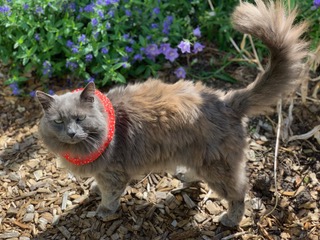
Last week, one of my neighbors sent in a suggestion for a product called Birdsbesafe. It is a brightly colored cat collar which visually alerts birds to the presence of an approaching feline.

Hi Larry!

PAWS Cat City of Roosevelt in the U-District will start carrying the Birds be safe collars very soon. (Nice to buy from them. :)

Here is the link to their website: https://www.birdsbesafe.com

And I can't help but include some pics of my cats modeling them. 


Thanks!
Lynn


******************


Have a great day on Union Bay...where nature lives in the city!

Larry


Going Native:

Without a well-funded Environmental Protection Agency, it falls to each of us to be ever more vigilant in protecting our local environments. Native plants and trees encourage the largest diversity of lifeforms because of their long intertwined history with our local environment and native creatures. I have been told that even the microbes in the soil are native to each local landscape. My hope is that we can inspire ourselves, our neighbors and local businesses to respect native flora and to support native wildlife at every opportunity. I have learned that our most logical approach to native trees and plants (in order of priority) should be to:

1) Learn and leave established native flora undisturbed.
2) Remove invasive species and then wait to see if native plants begin to grow without assistance. (If natives plants start on their own, then these plants or trees are likely the most appropriate flora for the habitat.)
3) Scatter seeds from nearby native plants in a similar habitat.
4) If you feel you must add a new plant then select a native plant while considering how the plant fits with the specific habitat and understanding the plant's logical place in the normal succession of native plants.

My intention in my weekly post is to include at least one photo each week and visually challenge us to know the difference between native and non-native lifeforms.


Is this a native or non-native plant?


Scroll down for the answer.


***************


Pacific Ninebark: You can read more about this native plant by clicking on the highlighted link.


***************


The Email Challenge:

Over the years I have had many readers tell me that Google is no longer sending them email announcements regarding my posts. Even more frustrating when they go to 're-sign-up', hoping that will enable them to once again start receiving the announcements, they get a message which says 'Sorry, you are already signed up.' Google has not responded to my requests for help with this issue. 

My functional workaround is to set up my own email list and each week I manually send out a new post announcement. If you are experiencing the issue and would like to be added to my personal email list please send me an email requesting to be added. Thank you for your patience!


My email address is LDHubbell@comcast.net


Sunday, April 7, 2019

The Hidden Lives of Herons

Great Blue Herons are not particularly shy. They often hunt while simply standing quietly in full view. Even when strolling slowly through the water they generally make no pretense of hiding. However, when it comes to nesting and reproduction they manage to maintain a surprising level of secrecy.

This is especially amazing for birds with wingspans which can exceed six feet and urban nesting colonies which can include dozens, or sometimes even hundreds, of nests.

Our local Union Bay colony has only a couple dozen nests. Hopefully, when the 520 runoff is ultimately excluded from Union Bay, our local supply of fish will flourish and the Great Blue Herons will stage an epic comeback - not to mention the Osprey.

Most of the Heron's current nests are hidden away near the tops of Big Leaf Maple trees on the UW campus. In the photo above you can barely see a heron standing in her nest. She is the upper half of the small roundish dot, visible between the trees, and up to the left from the lamp.

Here is a close up of the same bird in the nest. According to what I have read the female Great Blue Herons generally, do the incubation. This assumption is my only basis for determining the gender of the bird. I am not aware of any plumage differences between males and females.

Note: I do not believe there are any twigs in the nest which are larger than the diameter of the heron's leg.

Here she is leaning out to secure another twig for the nest. The long neck is clearly useful for more than just snatching frogs and fish out of the water.

Nests are often reused from one year to the next. It appears that the males supply the bulk of the supplemental nesting materials.

The contrast between the materials used by Great Blue Herons versus... 

...Bald Eagles is dramatic. A Bald Eagle will occasionally break a cottonwood branch by striking it with their chest while flying at full speed. They will also try hanging upside down by their feet and swinging from a branch until it breaks.

Heron nesting material appears to be consistently smaller and lighter.

In addition, the native trees involved in their respective processes are different. Locally, Bald Eagles, usually nest in Black Cottonwoods while the Great Blue Herons seem to prefer Big Leaf Maples. For nesting materials, Bald Eagles prefer the upper branches from nearby Cottonwood trees.

On Tuesday, I watched numerous retrievals of twigs by Great Blue Herons. 

They would consistently land on the outer tips of an upper branch in a nearby Douglas Fir tree. Then with great care and precision, they would slowly walk down the branch.

Once the males were inside the bulk of the green foliage they would carefully extend their necks and slowly break off small dry twigs from inside the central, highly-shaded portion of the tree. I never saw a Great Blue Heron use its feet to remove or carry even the smallest twig.

Another surprise was watching a heron slowly and delicately extend his neck down from an overhead branch towards his mate. She stood and extended her neck up and out of the nest in order to meet the male halfway. At which point they carefully made the 'handoff' of the dry little twig.

By comparison, I have watched eagles land in the nest with a large branch and smack their mate in the head with a wing while attempting to retain their balance. Often eagles will lose control of the branch and simply watch it drop to the ground. The pile of new branches below the Montlake Cut eagle's nest is large enough to make a good start a second nest. The difference, in the nesting behaviors of the respective species, is striking. 

Yesterday afternoon, during the brilliant sunshine, I returned to the heron colony hoping to secure a brighter set of photos. I watched for a couple of hours, while the clouds slowly moved north. All I could see where tops of the female's heads as they sat in their nests.

Finally, as the sunlight diminished the female in this nest sat up and stretched.

Later still, her mate returned and perched just above the nest. At the time, I thought their extended feathers might have been evidence of wind in the treetops, even though I did not notice any wind at ground level.

Soon the male left his perch and headed towards a nearby Douglas Fir tree. I thought he was going to pluck off another one of those small dry twigs. My assumption was wrong.

Maybe I should get half-credit, at least he landed in the fir tree. 

However, when he returned to the nest he was carrying a short tip of green needles in the well-known, 'bottle-brush' arrangement.

Leaning forward the male carefully added the greenery to the nest.

Immediately, the herons began mating. The flurry of grey-blue feathers made the process discreet, although the concept of modesty seems to be a wholly human invention. 

It was only later while reviewing the photos that I remembered having seen two herons with all their plumes extended on their backs and chests. This photo, from 2016, shows a pair doing their mating dance on Union Bay. I suspect that instead of the wind-blowing what I saw yesterday was the herons raising their plumes and signaling their readiness to mate.

The next activity was the male securing the fresh tip of a Douglas Fir bough, which was immediately followed by mating. Could the gift of needles be part of the process? Would a dry twig have worked as well? I do not know.

Afterward, the male made four more round trips to the Douglas Fir tree. He secured another mouthful of green needles each time. The female apparently decided that once a day was plenty. She sat calmly in the middle of the nest, with her plumes laying low and did not provide him with any further opportunities.

In these photos, you can see that the catkins on the Big Leaf Maples are already out and the leaves are beginning to sprout and extend. In the near future, the reproductive lives of herons will once again be hidden from view. At which point, additional observations will have to wait until next year.

Have a great day on Union Bay...where nature lives in the city!

Larry


Going Native:

Without a well-funded Environmental Protection Agency, it falls to each of us to be ever more vigilant in protecting our local environments. Native plants and trees encourage the largest diversity of lifeforms because of their long intertwined history with our local environment and native creatures. I have been told that even the microbes in the soil are native to each local landscape. My hope is that we can inspire ourselves, our neighbors and local businesses to respect native flora and to support native wildlife at every opportunity. I have learned that our most logical approach to native trees and plants (in order of priority) should be to:

1) Learn and leave established native flora undisturbed.
2) Remove invasive species and then wait to see if native plants begin to grow without assistance. (If natives plants start on their own, then these plants or trees are likely the most appropriate flora for the habitat.)
3) Scatter seeds from nearby native plants in a similar habitat.
4) If you feel you must add a new plant then select a native plant while considering how the plant fits with the specific habitat and understanding the plant's logical place in the normal succession of native plants.

My intention in my weekly post is to include at least one photo each week and visually challenge us to know the difference between native and non-native lifeforms.


This wonderful native plant with leaves only a half an inch long and tiny white 'urn-like' flowers is currently blooming. What is it called? 

Note: In case it helps, this photo was taken just west of the UW Great Blue Heron colony.


Scroll down for the answer.


***************


For an additional definition of the word, Click Here

By the way, I ran into a student, Nicholas I believe, who told me that an environmentally-oriented group at UW intends to remove the ivy below the heron's nests. After the nesting is finished, of course. Their intention is to enable the native seeds, still in the ground, to return to productivity. They believe this small patch of earth may be the only undisturbed topsoil on the campus. Hopefully, it will function as a seed bank replenishing the assorted diversity of flora that originally existed at this location. What a thoughtful and delightful idea!


***************


The Email Challenge:

Over the years I have had many readers tell me that Google is no longer sending them email announcements regarding my posts. Even more frustrating when they go to 're-sign-up', hoping that will enable them to once again start receiving the announcements, they get a message which says 'Sorry, you are already signed up.' Google has not responded to my requests for help with this issue. 

My functional workaround is to set up my own email list and each week I manually send out a new post announcement. If you are experiencing the issue and would like to be added to my personal email list please send me an email requesting to be added. Thank you for your patience!


My email address is LDHubbell@comcast.net