There are very few birds as confident (and competent) as a Barred Owl.

A Bald Eagle is far larger and stronger but they will seldom sit and look you in the eye. (The post, Tsuloss, from two weeks ago provides an excellent example of how quickly a Bald Eagle retires from close proximity.)

I have no doubt that Barred Owls know humans cannot fly. They must also know humans can be dangerous, otherwise, they would just completely ignore us. To be honest, for the most part, this owl did ignore me. It flew my direction, landed, and checked me out, watched some smaller birds, and then headed back towards the family unit.
By the way, I do not believe its raised right 'eyebrow' is a look of curiosity. I have yet to see a Barred Owl photo where the right upper portion of the facial disk was not higher than the left. I suspect the lack of symmetry is correlated to their offset ear holes and a species-wide attribute. Hearing sounds from different heights enables them to pinpoint prey positions by sound as well as sight.

If I had not seen the owl's return flight, I might never have noticed its mate and one of their young in the top of a Big Leaf Maple tree.

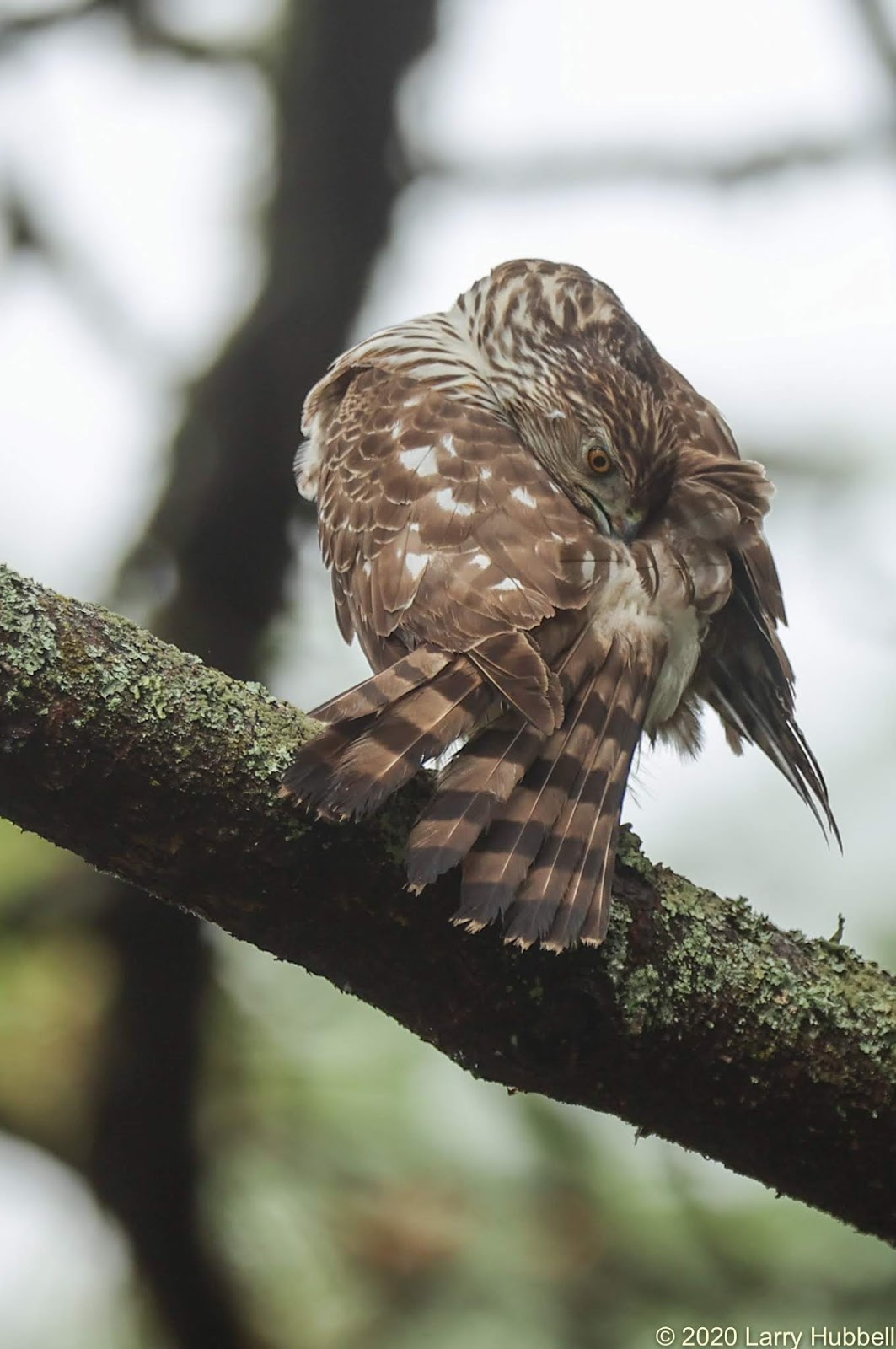
During the first month or two after a young owl leaves the nest, their primary occupation appears to be feather maintenance. This young owl still has bushy tufts of down around its tail and a partial covering on its back and head. Over time, one way or another, the down must go - whether it is pulled, plucked, or pushed out by more durable feathers.
These first few photos were taken last month in Interlaken Park.

When we think of feathers this is the first shape that comes to mind. In this case, this is a flight feather from an American Coot. Flight feathers (and tail feathers) are the largest and most easily recognized feathers on a bird's body. However, they are not the most common way in which we encounter feathers. We are far more likely to sleep with our heads on a pillow filled with down while warming ourselves with a down comforter.

While this owl feather resembles down near the base, overall it is more similar to a contour feather e.g. the feathers we see covering a bird's body. The ends of contour feathers are exposed to the elements while the 'downy', insulating portion is covered by the tip of another contour feather. I spotted this feather near a young Barred Owl which explains why even the outer portion does not bind tightly together. A young owl's initial feathers are more about growing in quickly and providing warmth, e.g. loose and downy, rather than maximum protection from the elements.
By the way, in addition to legal requirements, Why should we leave feathers where we find them? Because every feather left outdoors may become the critical lining in another bird's nest. On a cold stormy day, a single feather could be the difference between a young nestling expiring due to exposure or retaining adequate heat to survive.

When a young Barred Owl leaves the nest they are still covered with downy feathers, their flight feathers are only partially developed and from what I have seen they are unable to fly.

I suspect this young owl, spotted last week in the Arboretum, has been out of the nest for a few weeks. One hint to its age is the length of its tail. (Another hint was watching it take flight.)

This photo from 2018 shows an upside-down owlet on the day it left the nest. I realize it is difficult to make out, it is clinging to a branch with one talon and grasping wildly with the closer one, while its fuzzy little 'tail' is pointed to the left. At this point, it has no normal-looking brown and white striped tail feathers.

When this young Barred Owl stretched, it exposed significant tail feather growth. You can also see it still has a clump of downy feathers on the leading edge of each wing.
 When we zoom in you can see some skinny almost 'wet-looking' feathers just below the downy clumps. These are new feathers that have only partially emerged from their sheaths. I suspect these will become coverts. Coverts are feathers that cover the attaching base portion of other, generally-larger feathers. If so, in this case, they will cover the base of the flight feathers and help create smooth, aerodynamic wings.


I never grow tired of watching an owlet stretch. The display of symmetrical feathering is always impressive even if not yet fully developed
I do not understand is why the doors on cars, that open in an upward direction, are called gull-wing doors. I am sure gulls can raise their wings in a similar fashion, however, their wings are long and thin and do not resemble automobile doors. I guess from a marketing perspective the phrase 'owl-wing doors' does not have the right ring to it.

This young owl may not yet be able to catch its own prey but its predatory heritage is not in doubt. This close up also provides an interesting view of the downy-looking feathers.

The owl is stretching its leg while preening, which shows off its talon development.
When the young owl leaves the nest, even though it cannot fly, it can climb trees using its strong talons and its bill to hitch its way up. This is critical because if they were stuck on the ground raccoons, coyotes, and even family dogs could be threats.

Here, if you look closely, you can see a feather sliding through its bill. Even though I saw the owl preening and pulling at its feathers I did not see clouds of small feathers drifting to the ground. It would certainly be interesting to have a non-stop video of an owlet's first few months just to determine at what point(s) they lose these downy feathers.

The only thing cuter than a young Barred Owl is...

...two of them.

Once the tail feathers have begun to fill in the young owls start to look more mature, at least from the backside. Here the bird on the right is facing away from the camera while straightening some of its new tail feathers.

When the feather slides out of its bill the tail 'pops' back into position.
When I first saw these two owls they were not sitting side by side. One was facing me and the other was overhead with its tail feathers hanging down below the branch. Based on just the tail feathers, I initially thought the second owlet was an adult. However, when viewed side by side and facing me it was obvious they were both quite young.
When I first saw these two owls they were not sitting side by side. One was facing me and the other was overhead with its tail feathers hanging down below the branch. Based on just the tail feathers, I initially thought the second owlet was an adult. However, when viewed side by side and facing me it was obvious they were both quite young.

Allopreening is when one bird cleans or preens the feathers of another. It is typically done around the head or neck - in areas the other bird cannot easily reach. Online information suggests allopreening may help strengthen the bond between mated pairs, reinforce the dominance of one bird over another, reduce stress between two birds, and of course improve cleanliness.
Since Barred Owls are known to reuse the same nest site for multiple years infestations of feather lice, etc could potentially be an issue. Allopreening may be an evolutionary technique for removing parasites and helping to maintain their good health.
Pileated Woodpeckers take an opposite approach. They appear to never reuse a nest and never do allopreening. Bald Eagles, on the other hand, use nest sites for multiple years. However, they annually add a significant amount of material which may have a positive impact.

I have seen siblings doing this before and I have also watched adults preening their offspring. Barred Owls seem surprisingly social and caring within their family structures. One thing is for sure young Barred Owls have not heard about social distancing.
******************
A special Thank You to Kristen and Sarah. Both of you have provided me with multiple updates about our local Barred Owls which helped to make this post possible. Your love and affection for these creatures is not just commendable - it is highly inspiring. My most sincere, Thanks!
******************
Tsuloss Watch:
The young eagle in Monty and Marsha's nest continues to grow. Sometime in the next month or two, I expect Tsuloss will leave the nest. A number of readers have now sent in their guess for when Tsuloss will fledge.
If you would like to play along send me your name and the date when you hope or expect Tsuloss will leave the nest.
July 1st - Barry Saver
July 2nd - Tyler Mangum
July 4th - Larry Hubbell
July 6th - Joe Clancy
July 6th - Joe Clancy
July 8th - Cynthia Jones
July 9th - Lynne Kelly
July 10th - Lynn Adams
July 15th - Jeff Graham
July 16th - Audrey Weitkamp
(By the way, the nestling period for Bald Eagles, as stated on All About Birds, can vary quite a bit. It is listed as 56 to 98 days. This implies to me that Tsuloss might just as well fledge in late July or even August.)
The only rules I can think of for this impromptu, prize-less contest are:
A) I plan to only publish the first name I receive for each date. I want to encourage the widest variety of dates possible.
B) Practice hops do not count e.g. when the young eagle flaps, lifts up and then comes right back down in the nest. Also branching - hopping from branch to branch - does not count. Tsuloss must leave the air space above the nest.
C) Falling does not count. Tsuloss must leave the nest and exhibit an ability to stay in the air. However, if you do see Tsuloss fall from the nest and land on the ground, especially if unable to fly, please call:
Lynnwood PAWS at 425-787-2500
PAWS has rehabilitated and released 3 out of Tsuloss's 4 siblings during the last 2 years. (The fourth sibling did not require assistance.)
The following information may help you make a more accurate guess:
By the way, Tsuloss is most easily seen with binoculars from the north side of Montlake Cut. The nest site is shown on this Union Bay Map.
My email address is: ldhubbell@comcast.net
************************
I sincerely wish good health, happiness, and peace to everyone around Union Bay. However, in particular, lets all work together to make sure Black Birders know they are always welcome in the Union Bay neighborhood.
Black Lives Matter,
Larry
Going Native:
Without a well-funded Environmental Protection Agency, it falls to each of us to be ever more vigilant in protecting our local environments. Native plants and trees encourage the largest diversity of lifeforms because of their long intertwined history with our local environment and native creatures. I have been told that even the microbes in the soil are native to each local landscape. I hope we can inspire ourselves, our neighbors, and local businesses to respect native flora and to support native wildlife at every opportunity. I have learned that our most logical approach to native trees and plants (in order of priority) should be to:
1) Learn and leave established native flora undisturbed.
2) Remove invasive species and then wait to see if native plants begin to grow without assistance. (If natives plants start on their own, then these plants or trees are likely the most appropriate flora for the habitat.)
3) Scatter seeds from nearby native plants in a similar habitat.
4) If you feel you must add a new plant then select a native plant while considering how the plant fits with the specific habitat and understanding the plant's logical place in the normal succession of native plants.
My intention in my weekly post is to include at least one photo each week and visually challenge us to know the difference between native and non-native lifeforms.
By the way, my friend Tom Brown pointed out that the application named 'Wildflower Search' is extremely helpful. Click on the highlighted link to see for yourself.
By the way, my friend Tom Brown pointed out that the application named 'Wildflower Search' is extremely helpful. Click on the highlighted link to see for yourself.

Scroll down for the answer.
***************

Western Hemlock: It is native to the PNW and is in fact our state tree. The open cones are from a previous year while the closed green cones and the bright green needles, at the end of the branchlet, are from this year.
***************
The Email Challenge:
Over the years I have had many readers tell me that Google is no longer sending them email announcements regarding my posts. Even more frustrating when they go to 're-sign-up', hoping that will enable them to once again start receiving the announcements, they get a message which says 'Sorry, you are already signed up.' Google has not responded to my requests for help with this issue.
My functional workaround is to set up my own email list and each week I manually send out a new post announcement. If you are experiencing the issue and would like to be added to my personal email list please send me an email requesting to be added. Thank you for your patience!
My email address is: LDHubbell@Comcast.Net
***************
Here are a few more owlet photos...


Thank you!