This is Wanda. On March 25th, I found her sitting in a brightly budding Red Maple tree. At the time, I had not yet thought of the name Wanda. I most likely did not realize she was a female. However, the bold, vertical striping on her chest clearly indicates her youth. She hatched out during 2019. She was not yet one year old. Our local raptor experts, at the Urban Raptor Conservancy, have taught me to call birds like Wanda a second year (SY) bird - because she has entered her second calendar year.
SY females often lay eggs and raise young. However, SY males are seldom successful at participating in the process. Males are responsible for providing enough food to feed themselves, their mate, and their offspring. It generally takes a couple of years to acquire adequate hunting skills. (Although, Percy, the young male at the Union Bay Natural Area, succeeded as a SY father in 2019.)

This is Walter on April 9th. He appears to be sitting in the same Red Maple tree. Walter is older than Wanda. The rusty-orange horizontal barring on his chest indicates he is a fully mature Cooper's Hawk. His exact age is unknown. However, All About Birds, indicates that the oldest know Cooper's Hawk, which was found in Washington, was over twenty years old.
Disclaimer: I must admit that I am assuming these are the same two birds throughout this post, primarily because they consistently showed up in the same small area over an extended time. Also, their plumage (and behavior) was very consistent.

The next day I spotted Wanda again. She was alert, active, and aware. She does seem to radiate energy and youthfulness.

On the 13th, I saw them both again. Walter was back in the Red Maple.

From the backside, young Cooper's Hawks generally display light spots.

Mature Cooper's Hawks have a more uniform gray-brown on their backs. Plus, their irises are often considerably more colorful.

It can be almost like they have a fire in their eyes.
Walter ended up on a nearby branch while Wanda occasionally called out. During breeding season female Cooper's Hawks often give a 'wah' call. My friends from the URC have taught me that this indicates the female is looking at her mate and asking him to go get her food. Wanda called several times. Walter ignored her.

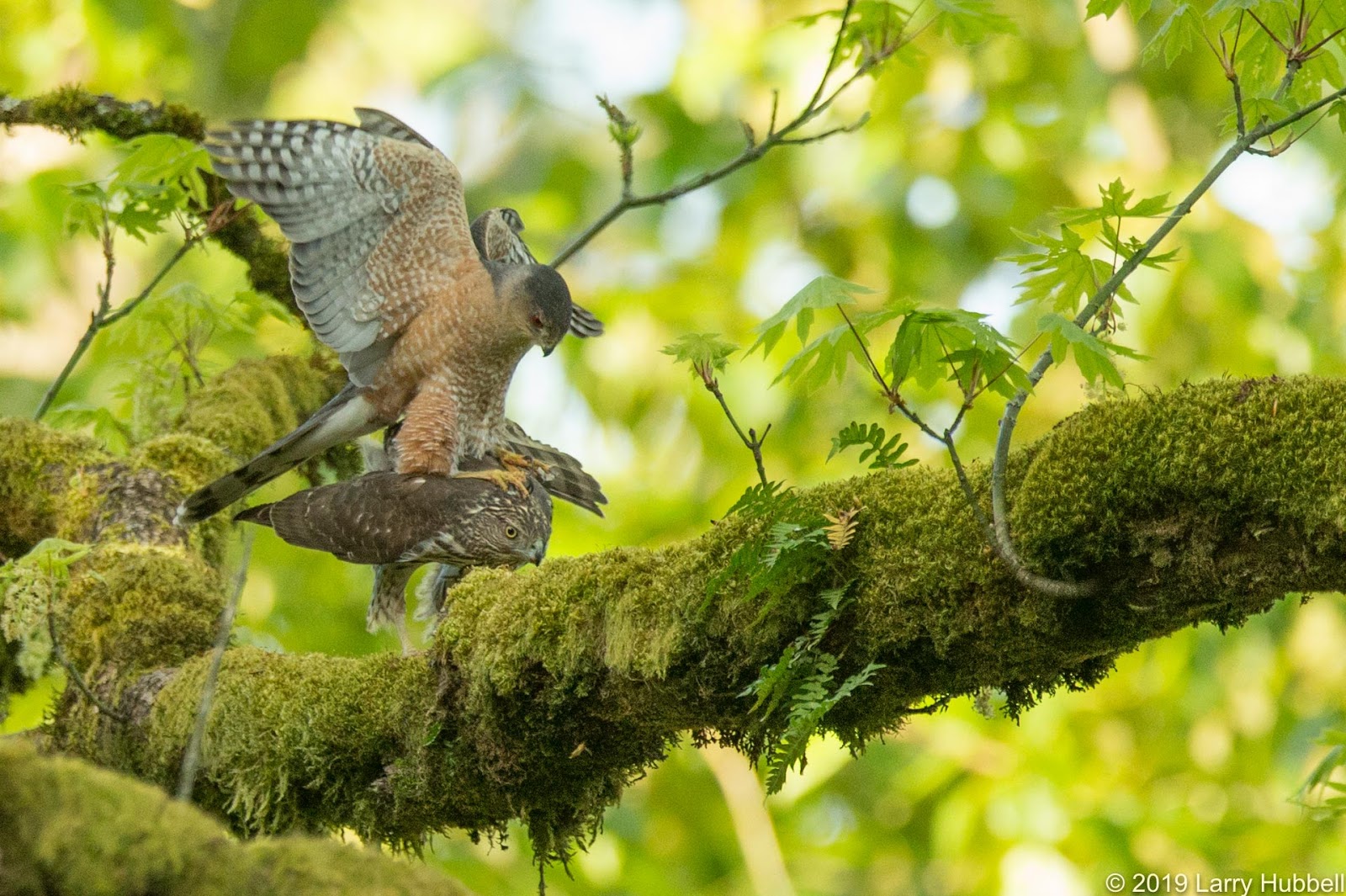
Finally, Wanda came down and landed on the same branch as Walter. He quickly walked away. (The word scurried came to mind.)

Wanda hopped up and attempted to break off a branch. Apparently, hoping to add it to the nest. It almost seemed like she was showing Walter what she wanted.

Later, back on the shared branch, she assumed an inviting position. For a moment, Walter came closer. I thought it was an encouraging sign until Walter turned and flew away. Females are normally larger than males. Males do need to be respectful. Nonetheless, avoiding females is not a successful reproductive strategy.

Two days later, I watched Wanda as she made multiple trips to the nest. She was securing brittle branches from the inside of a nearby pine tree.

Walter sat stoically, just a few feet away, while looking the opposite direction.

Finally, after Wanda had made at least a half a dozen trips, Walter broke off a single twig and flew towards the nest. I felt a faint flutter of hope.

The next day I heard and finally located Wanda sitting in a Cottonwood tree repetitively making the "wah' call. While listening to her many thoughts crossed my mind. I may have even wished for wings so I could catch food for her - while eating females are usually fairly quiet. This was the day the constant 'wah' calls inspired the name "Wah-nda'.
Finally, I remembered Martin Muller's comments about females tending to do the 'wah' call only when they have their mate in sight. Since Wanda was looking almost directly at me, I started a careful visual inspection of the foliage between us.

Sure enough, Walter was half-hidden between two well-shaded branches.

At times his eyes would close. I wondered, Could he sleep through Wanda's wailing.

I finally noticed he was only closing the eye in the sunlight.


When he leaned over to stretch I thought, 'Ah, finally he is going to get some food for her.'

But, no - he just settled back in and continued his waiting game. After about 45 minutes, Wanda grew tired. She took to the air and left. No doubt she went to find food for herself.

During the next month, while most Cooper's Hawks were incubating eggs, I do not remember seeing any sign of nesting or incubation from Wanda.

Last Sunday, after more than an inch of rain on Saturday, I found Wanda sitting just east of the nest tree. She was as alert as usual. It is interesting to note that her iris appears to be changing to a slightly darker shade of orange.

She was actively involved with feather maintenance. By gently pulling a feather between her mandibles she realigned the barbules and removed any water.

She rearranged feathers on the back of her head.

She stretched her tail. No doubt, making sure every feather fell into the proper place.
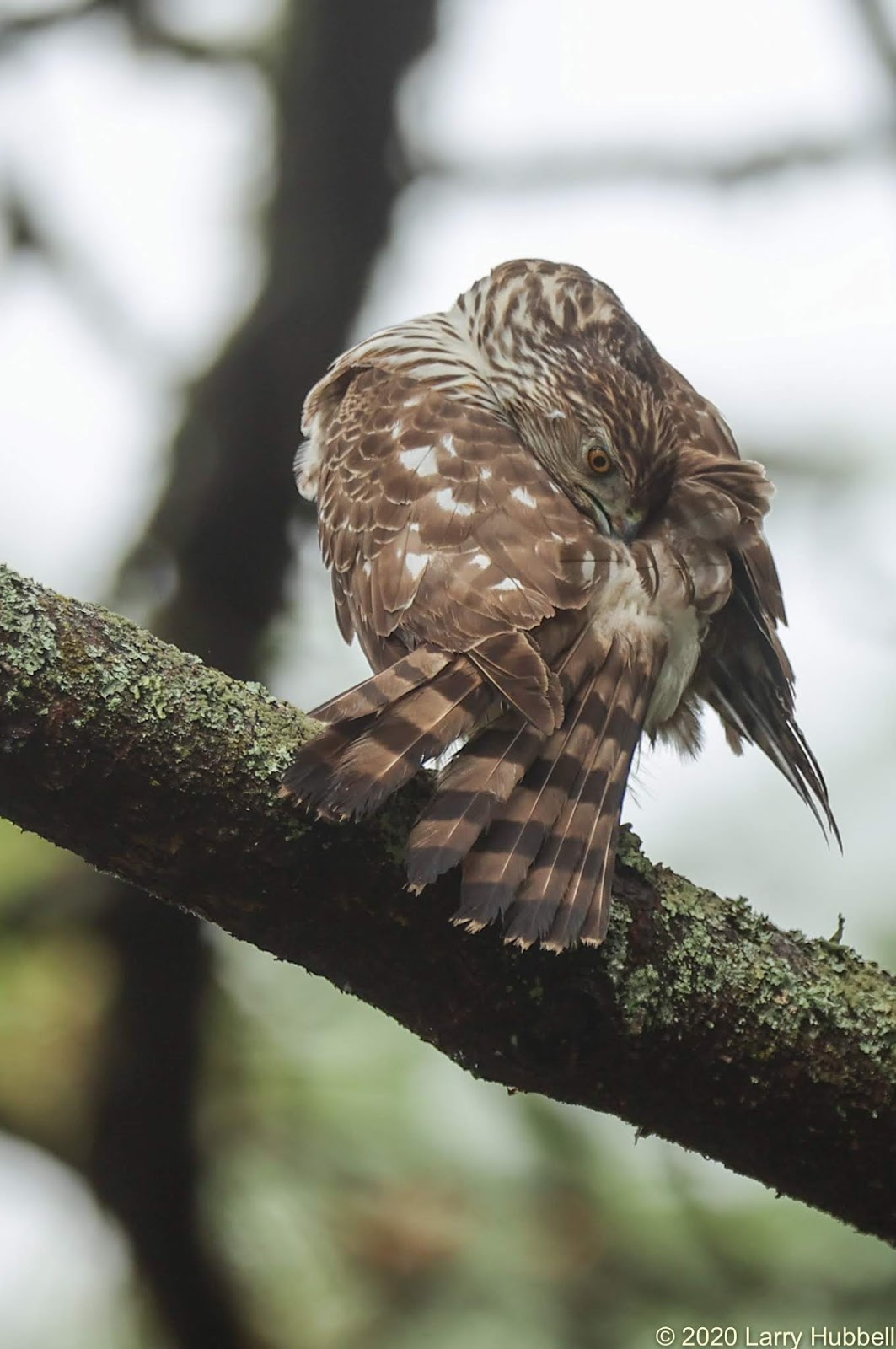
When needed she took a closer look.

Occasionally, she called out before stretching her wings and flying. I followed.

Nearby, I found Walter.

It was obvious, he wasn't worried about his appearance.

Although, he did not seem impressed with my appearance either.

Finally, after an extended period of silent sitting, Walter straightened a single, tiny feather.

His eyes went closed in the process.

This time the one-eyed squint was not due to the sunlight.

I am not certain about the story behind Walter's lackadaisical lifestyle. Maybe, he is simply getting too old. Maybe, he has eaten too many rats laced with rodenticide. Maybe, he is deaf, or maybe he has cloudy vision in one eye. Closing it may help him to see the world more clearly. I suspect we would have to fly a mile in his wings to truly understand.
One thing does seem certain. I doubt the Wanda-Walter, May-December relationship is going to bear fruit in 2020. Nonetheless, it has been entertaining to observe the evolving dynamics of a somewhat unconventional relationship. I suspect Wanda wonders what might have been.
******************
Tsuloss Watch:
The young eagle in Monty and Marsha's nest continues to grow. Sometime in the next month or two I expect Tsuloss will leave the nest. My friend Jeff and I have picked the dates when we are hoping Tsuloss will fledge.
I picked July 4th, primarily, because Independence Day seems like such a fitting time for a young Bald Eagle's first flight. If you would like to play along send me your name and the date when you hope or expect Tsuloss will leave the nest.
July 4th - Larry Hubbell
July 15th - Jeff Graham
The only rules I can think of for this impromptu, prize-less contest are:
A) I plan to only publish the first name I receive for each date. I want to encourage the widest variety of dates possible.
B) Practice hops do not count e.g. when the young eagle flaps, lifts up and then comes right back down in the nest. Also branching - hopping from branch to branch - does not count. Tsuloss must leave the air space above the nest.
C) Falling does not count. Tsuloss must leave the nest and exhibit an ability to stay in the air. However, if you do see Tsuloss fall from the nest and land on the ground, especially if unable to fly, please call:
Lynnwood PAWS at 425-787-2500.
PAWS has rehabilitated and released 3 out of Tsuloss's 4 siblings during the last 2 years. (The fourth sibling did not require assistance.)
The following information may help you make a more accurate guess.
Eaglet Patrol - The post suggesting when Tsuloss might have hatched.
All About Birds - Contains the nestling period e.g. The range of time during which young eagles stay in the nest before learning to fly.
Tsuloss - The last eagle update.
By the way, Tsuloss is most easily seen with binoculars from the north side of Montlake Cut. The nest site is shown on this Union Bay Map.
************************
I sincerely wish good health, happiness, and peace to everyone around Union Bay. However, in particular, lets all work together to make sure Black Birders know they are always welcome in the Union Bay neighborhood.
Black Lives Matter,
Larry
Going Native:
Without a well-funded Environmental Protection Agency, it falls to each of us to be ever more vigilant in protecting our local environments. Native plants and trees encourage the largest diversity of lifeforms because of their long intertwined history with our local environment and native creatures. I have been told that even the microbes in the soil are native to each local landscape. I hope we can inspire ourselves, our neighbors and local businesses to respect native flora and to support native wildlife at every opportunity. I have learned that our most logical approach to native trees and plants (in order of priority) should be to:
1) Learn and leave established native flora undisturbed.
2) Remove invasive species and then wait to see if native plants begin to grow without assistance. (If natives plants start on their own, then these plants or trees are likely the most appropriate flora for the habitat.)
3) Scatter seeds from nearby native plants in a similar habitat.
4) If you feel you must add a new plant then select a native plant while considering how the plant fits with the specific habitat and understanding the plant's logical place in the normal succession of native plants.
My intention in my weekly post is to include at least one photo each week and visually challenge us to know the difference between native and non-native lifeforms.
By the way, my friend Tom Brown pointed out that the application named 'Wildflower Search' is extremely helpful. Click on the highlighted link to see for yourself.
By the way, my friend Tom Brown pointed out that the application named 'Wildflower Search' is extremely helpful. Click on the highlighted link to see for yourself.

Scroll down for the answer.
***************
Western Starflower: I spotted it about one month ago in the Arboretum. I have a lot to learn about plants, so feel free to chime in if you have a better identification. However, this is the only flower I could find that appears to fit the bill. Western Starflower is a native plant. In any case, it is certainly a delicate and beautiful little flower.
***************
Over the years I have had many readers tell me that Google is no longer sending them email announcements regarding my posts. Even more frustrating when they go to 're-sign-up', hoping that will enable them to once again start receiving the announcements, they get a message which says 'Sorry, you are already signed up.' Google has not responded to my requests for help with this issue.
My functional workaround is to set up my own email list and each week I manually send out a new post announcement. If you are experiencing the issue and would like to be added to my personal email list please send me an email requesting to be added. Thank you for your patience!
My email address is: LDHubbell@Comcast.Net
***************
Here is a little reward for those who read to the end.

One of the Ravens in Interlaken Park this week. The whole family appears to be spending less and less time in the Arboretum and more time in Interlaken Park.
By the way, I met a woman this week who said the ravens followed her as she traveled through Interlaken. It made me wonder if someone might have been feeding the ravens. Feeding ravens would be a bad idea. They are about four times larger than a crow. We want them to keep their distance and fear humans. Fearless ravens might rightfully be perceived as a threat. We do not want them to become a problem. They are a joy to watch and they provide a new active predator for rats, rabbits, and crows - all of which are populations in need of some predatory balance.