Mission: To promote the appreciation of wildlife and increase harmony between humanity and nature.

On Instagram: @unionbaywatch
Showing posts with label Montlake Cut. Show all posts

Saturday, May 30, 2020

Tsuloss

Marsha with a fresh fish. Notice how her eyebrow obscures the upper portion of her iris.

On Wednesday morning, not long after dawn, I was directly offshore from the University of Washington Waterfront Activities Center (WAC). My kayak was bobbing gently as I glanced at the tops of the cedars just north of the WAC. I was looking for one the adult Bald Eagles, either Monty or Marsha, from our local Montlake Cut pair.

Moments earlier, I checked out their nest high above The Cut. One of the two was visible in the nest. In spite of the help from my camera, I could not tell which one. It made sense to search for the other eagle in the trees north of the WAC, since that is their favorite hunting roost.

Suddenly, there was a flurry of dark wings and a Bald Eagle was heading directly at me. If I was a duck, I would have dived. Technically, I am sure I wasn't in danger but that was not the way it felt. I grabbed at my camera and fumbled with the focus. With every wing beat the eagle was getting larger. Neither I nor the camera was capable of focusing with the speed required. I felt quite lucky when Marsha landed on the off-shore dock directly in front of me.

Mentally, I struggled to comprehend what had just happened. In retrospect, as Marsha flew straight at me she descended to the surface of the water and apparently she reached down and grabbed a fish. The offshore dock, between us, obscured my view which explains how I totally missed the moment. The wet feathers on her legs and the fresh fish in her mouth provide obvious evidence to support this theory. Most likely, she rapidly transferred the fish to her mouth so she could land on her feet.

This is not the first time I have seen her carry a fish in her mouth, but so far she is the only Bald Eagle I have ever seen do it in flight. In my experience, most Bald Eagles carry fish with their talons. 

Marsha had obviously been focused on catching the fish and coming face to face with me may have been somewhat of a surprise. She quickly took to the air and headed north, just above the water.

As she lifted off I got a fairly good look at her talons. Based on eagle talons I have handled in museums, hers are probably at least an inch and a half long, exceedingly sharp, hard and durable. I suspect the curvature helps eagles to close their talons into a ball shape, which is much safer when moving eggs in a nest.

Marsha flew a short distance and landed next to this log or islet. I missed where she placed the fish, but she did not have time to eat it.

A moment later, she took to the air again. This time she flew back towards her favorite hunting perch. There was no fish in her mouth or talons.

Another closeup of her talons helps prove they were empty.

After she landed back in the cedars, she threw up her head and then called out - apparently to Monty.

Within moments, Monty was coming in low from the direction of the nest. From my location I could not see Monty's initial response, but apparently when Marsha called, he dove out of the nest and then headed north just above the water's surface.

The mental image of his descent from the nest reminded me of an incident two weeks earlier. In mid-May, I was on the south side of The Cut attempting to document the growth of their newest eaglet, when Marsha left the nest tree and swooped down to the water.

She did not execute the classical Bald Eagle catch off the surface. Instead, Marsha ended up in the drink.

Once an eagle's feathers are waterlogged it must become difficult for them to get airborne. Ospreys produce an oil to help their feathers resist water, apparently, eagles do not.

Marsha turned, struggled, and fought her way through the water.

She repeated these strokes dozens of times as she slowly 'rowed' her way to safety.

Finally, she reached shallow water where she was able to scramble out onto the shore and shed the weight of the water. After a few minutes, she flew back to the nest.

I never got a clear view of what she caught. I suspect it was a fish. She must have carried it in her talons with it hidden beneath her tail. When she reached the nest, she began feeding the young eaglet. At this point, I am guessing the eaglet was about one month old.

On Wednesday, Monty continued north. Surprisingly, he went directly to the same small island where Marsha had been. Notice how his 'eyebrow' usually does not cover his iris.

Once there he immediately began eating a fish. Again, I began to question what I had just seen. The following options came to mind.

A) Marsha left the fish for Monty, at a location out of his sight. Then called and told him where to find it.

B) Marsha left the fish for Monty, at a location out of his sight. Then called and told him to look for food. Even though he was probably a quarter mile away and close to the water's surface he saw the fish and headed directly toward it.

C) Monty left the nest earlier than I observed. He saw Marsha leave the fish behind from a considerable distance and immediately descend to the water's surface, flew to the spot and ate the fish. Clearly, Option C seems like the most logical scenario. However, on site and in the moment it certainly felt like they executed Option A. 

In any case, I think we can all agree Bald Eagles have some amazing talents. 

I suspect there is some level of special communication and understanding between mated pairs. Given that we are talking about intelligent creatures, who spend potentially decades together, a lack of communication would be the more surprising outcome.

However, even if the communication in this situation was minimal then it reinforces that an eagle's eyesight is phenomenal. The National Eagle Center says, 'An eagle can see something the size of a rabbit running at three miles away.' 

Note: From Husky Stadium, looking directly east, the beautiful homes on Webster Point are only one mile away. Imagine being able to a see rabbit at three times that distance.


Eaglet Update:

After approximately six weeks it seems obvious that Monty and Marsha have only one offspring this year. Their young eagle is beginning to look more like a juvenile than an eaglet. 

Given that Monty and Marsha had two young in both 2018 and 2019 this is their fifth offspring. In recognition of the Native Americans, who shared this bay with eagles for hundreds of years, it seems appropriate to call this new eagle by the Lushootseed word for five. 

Sadly, I can only approximate the sound of the word with English letters. With the utmost respect for the complexity of the language and the culture, the best I have been able to do is, 'Tsuloss'. 

Clicking Here will enable you to find the word for five and the link to the pronunciation guide, which I attempted to use. I would be very happy to receive corrections or improvements from anyone with greater knowledge or understanding of the language. (Note: Apparently the guide has been discontinued. I found a new source with and improved pronunciation for the number five. Click Here to learn more.) 

Have a great day on Union Bay...where nature still lives in the city!

Larry 


A Small Challenge:
Based on what you have seen and read, Is this Monty or Marsha? The answer can be found at the end of this post.


Going Native:

Without a well-funded Environmental Protection Agency, it falls to each of us to be ever more vigilant in protecting our local environments. Native plants and trees encourage the largest diversity of lifeforms because of their long intertwined history with our local environment and native creatures. I have been told that even the microbes in the soil are native to each local landscape. I hope we can inspire ourselves, our neighbors and local businesses to respect native flora and to support native wildlife at every opportunity. I have learned that our most logical approach to native trees and plants (in order of priority) should be to:

1) Learn and leave established native flora undisturbed.
2) Remove invasive species and then wait to see if native plants begin to grow without assistance. (If natives plants start on their own, then these plants or trees are likely the most appropriate flora for the habitat.)
3) Scatter seeds from nearby native plants in a similar habitat.
4) If you feel you must add a new plant then select a native plant while considering how the plant fits with the specific habitat and understanding the plant's logical place in the normal succession of native plants.

My intention in my weekly post is to include at least one photo each week and visually challenge us to know the difference between native and non-native lifeforms. 

By the way, my friend Tom Brown pointed out that the application named 'Wildflower Search' is extremely helpful. Click on the highlighted link to see for yourself.


What species is this? Is it native to Western Washington?


Scroll down for the answer.


***************


Himalayan Blackberry: The most invasive weed in our area. Clicking on the highlighted name will take your to a document that shows you the difference between this invasive blackberry and our native, non-invasive blackberry.


***************


The Email Challenge:

Over the years I have had many readers tell me that Google is no longer sending them email announcements regarding my posts. Even more frustrating when they go to 're-sign-up', hoping that will enable them to once again start receiving the announcements, they get a message which says 'Sorry, you are already signed up.' Google has not responded to my requests for help with this issue. 

My functional workaround is to set up my own email list and each week I manually send out a new post announcement. If you are experiencing the issue and would like to be added to my personal email list please send me an email requesting to be added. Thank you for your patience!


My email address is: LDHubbell@Comcast.Net


***************


This is Monty. If you can consistently see the full iris, and you are looking at an eagle from the pair that 'owns' Montlake, then you are most likely looking at Monty. Also, the white feathers on his head generally look brighter than Marsha's, to me.

Saturday, June 8, 2019

Counting Eaglets

In early April, Marsha's vocal defense of her Montlake Cut nest seemed to imply the existence of eggs. The invisible tether which kept either her, or her mate Monty, constantly close to the nest reinforced the idea that they were defending eggs. Given the height of the nest, I am not positive when the eggs were laid, but my best guess is the last week of March.

Surprisingly, Bald Eagle eggs are not as big as one might expect. All About Birds gives the maximum length as 3.3 inches and maximum width as 2.5 inches. A large Bald Eagle egg is probably similar in volume to a professional baseball, which is just under 3 inches in diameter. 

*****************

By the way, Why might we say that Monty and Marsha's nest is the most strategically placed eagle's nest in all of Seattle? Read on for the answer.

*****************

It takes roughly five weeks to properly incubate Bald Eagle eggs. Which means the eaglet(s) most likely hatched out in early May. In this May 3rd photo, Marsha may be looking down at a helpless little hatchling. It is also interesting to note how the cottonwood leaves have grown and were beginning to hide the nest.

This mid-May photo shows a first glimpse of a young eaglet in the nest. Is this eaglet an only childAll About Birds states that the brood sizes can range from one to three birds. Unlike ducks, a clutch of eagle eggs does not hatch at the same time. Younger eaglets tend to be smaller and can lose out in the competition for food. In fact, they can even become food for older siblings. The parents bring lots of food and offer it freely, but the older and stronger eaglets are more aggressive and generally eat better. 

During the last week of May I caught my first sightings of multiple eaglets in the nest. Clearly, a feather transition was taking place. As the eaglets get older their initial downy white/gray feathers disappear and new darker feathers grow in. 

At the same time, the cottonwood leaves and limbs continued to grow. It felt like a curtain was being drawn around the nest. The mystery deepened. Are there just two eaglets in the nest? Could there be three?

The adults with their white heads and tails and their larger physical size are generally pretty visible in the nest. The young, on the other hand, are often invisible when resting below the rim of the nest. Many times all that can be seen of a young eaglet is a momentary flash of a dark little wing tracing an arc above the rim as the small bird twists or turns.

In this photo, the adult eagle on the right is Monty. His 'eyebrow' does not hang down over his eye. This is one of just a few photos which shows the heads of two eaglets and parts of both adults all at the same time. 

Monty's open-eyed appearance (on the right) gives him a less ferocious look, when compared with Marsha.

In the top center you get just a profile glimpse of Marsha's perpetual frown. From this angle these two eaglets appear to be fairly similar in size. When these two snap at each other it looks like a fairly, evenly-balanced sibling negotiation. Maybe they are simply focused on gaining elbow room for their growing wings.

When this eaglet stands tall the transition away from soft grey feathers becomes even more apparent. Clearly, this one is an older eaglet.

This photo was taken on the same day as the previous few photos. The question is, Do the white fuzzy feathers indicate a third younger eaglet or is this just one of the two previously seen eaglets who is uniquely illuminated so that the fuzzy feathers stand out?

When I took the photos the idea of a third eaglet did not come to mind. I am reconsidering.

The next day, I caught a few more photos. In this one there are two eaglets visible. The one on the left looks older and darker, although the shade may be a factor. The eaglet in the center still has some light downy feathering. 

Getting an accurate count of eaglets in the nest remains an unresolved mystery.

As they get older and larger the answer will become apparent. If you are the first to spot three in the tree, I would love to hear about it.

In just three months, e.g. by August 1st, the young Bald Eagles will probably have an average weight of about ten pounds. At that point, each of the eaglets should weigh more than their parent of the same gender. Males will generally weigh less then average while females usually weigh more. Between now and August the changes will be rapid, they will be putting on weight, growing flight feathers and hopefully in late July we will get to watch them exercising their wings, while bouncing around from one limb to the next, just prior to taking to the air.

*******************

In 1916, when the Montlake Cut opened for business it rerouted the drainage of the Lake Washington Watershed. The Black River, which was the original southern outlet for the lake, dried up. When the river disappeared so did many of the native salmon runs which accessed their spawning grounds via the river and Lake Washington. You can read more details of the story by clicking on History Link

Additional salmon, and other species of fish, have since been introduced to Lake Washington. For migrating fish the only connection between the Lake Washington Watershed and the Pacific Ocean is via Montlake Cut. Young salmon, and any other migrating fish must pass through The Cut on their way out to sea and years later when they mature they must return the same way to reach their spawning grounds.

To the best of my knowledge Monty and Marsha are the first pair of eagles to locate a nest almost directly over The Cut. From their nest in the Cottonwood tree, on the Southeast corner of The Cut, they have a clear view of the water and easy access to passing fish. Their Montlake Cut nest may be the most strategically located eagle's nest in all of Seattle.

If we help salmon recover in the Lake Washington Watershed we will see life flourish in and around Union Bay. We will see the growing numbers of a wide variety of creatures. In addition to Bald Eagles a few of the other direct beneficiaries will be herons, osprey, kingfishers, cormorants, mergansers, river otters and further downstream even the Orcas would benefit. 

Changes we can encourage include improvements to Arboretum Creek (e.g. increasing water flow, removing pollutants and returning the stream to the surface) in addition someday we might also consider improving Montlake Cut. Along the edge of The Cut a protective passage could be designed to protect young outgoing salmon on their way to Puget Sound and the Pacific Ocean. It could be something similar to the work which was done along Elliot Bay. 

*******************

Have a great day on Union Bay...where nature lives in the city!

Larry


Going Native:

Without a well-funded Environmental Protection Agency, it falls to each of us to be ever more vigilant in protecting our local environments. Native plants and trees encourage the largest diversity of lifeforms because of their long intertwined history with our local environment and native creatures. I have been told that even the microbes in the soil are native to each local landscape. My hope is that we can inspire ourselves, our neighbors and local businesses to respect native flora and to support native wildlife at every opportunity. I have learned that our most logical approach to native trees and plants (in order of priority) should be to:

1) Learn and leave established native flora undisturbed.
2) Remove invasive species and then wait to see if native plants begin to grow without assistance. (If natives plants start on their own, then these plants or trees are likely the most appropriate flora for the habitat.)
3) Scatter seeds from nearby native plants in a similar habitat.
4) If you feel you must add a new plant then select a native plant while considering how the plant fits with the specific habitat and understanding the plant's logical place in the normal succession of native plants.

My intention in my weekly post is to include at least one photo each week and visually challenge us to know the difference between native and non-native lifeforms.


Is this a native or non-native plant?


Scroll down for the answer.


***************


Red-osier Dogwood: You can read more about this unique dogwood by clicking on the highlighted link.


***************


The Email Challenge:

Over the years I have had many readers tell me that Google is no longer sending them email announcements regarding my posts. Even more frustrating when they go to 're-sign-up', hoping that will enable them to once again start receiving the announcements, they get a message which says 'Sorry, you are already signed up.' Google has not responded to my requests for help with this issue. 

My functional workaround is to set up my own email list and each week I manually send out a new post announcement. If you are experiencing the issue and would like to be added to my personal email list please send me an email requesting to be added. Thank you for your patience!


My email address is LDHubbell@comcast.net


Saturday, August 4, 2018

Lucy Leaves Home

During the last week Lucy prematurely left home. If she were human we might call her an underaged runaway. However, such a simple description oversimplifies her situation. For example, her nest actually left home before she did.

Lucy (on the right) about twenty feet below the last remnants of the nest.

On Sunday morning Lucy was no longer in the fork of the tree where the nest had been. Lucy is one two siblings who are apparently Monty and Marsha's first offspring. Before it disintegrated their nest had been located near the S.E. corner of Montlake Cut. Lucy's sibling, Charlie, is currently at PAWS recovering from a cracked pelvis which was suffered when a branch broke and the nest first began to fall

Around 8 a.m. on Monday, one of the parents returned to the nest site with food. The adult sat and consumed what looked like a fresh fish. The sticks in the lower left of the photo were all that was left of the nest.

Lucy sat on a limb below, looking up and crying incessantly. The adult glanced down at her but made no move to share. I wondered if this was 'tough love'. Was the adult trying to motivate Lucy to fly or was the adult apprehensive about landing in the thick foliage next to Lucy. The adult finished and left. Lucy's cries subsided. She seemed healthy and alert, but I was concerned. Could she fly? If not, how would she get food?

On Tuesday morning around 7 a.m. my friends, Tom and Helen, texted me. At first they could not find Lucy at all. Finally, they spotted her only 20 feet above the ground. She was in the next tree south of the nest tree. At the very least she must have glided to her new location. I arrived quickly and began hoping for encouraging signs.

Through out the morning Lucy sat, quiet but alert. She only lifted her wings and turned around two or three times. She did not practice flapping her wings or spend much time preening, which made me think she really wasn't ready to fly.

The parents did not feed her, she did not leave the branch to hunt and she did not cry out for food. This did not feel like a path to success. Around 11 a.m. Susan Ott, an observant and caring neighbor, showed up to check on Lucy. Susan had only stopped for a moment, but when she realized the uncertainty of Lucy's predicament she stayed.

Lucy slowly grew more active and started looking around apparently searching for nearby perches.

During the next hour Lucy hopped to a neighboring branch. Then, around noon she flew nearly fifty feet. Her flight was slow and awkward. She collided with low hanging leaves while steadily losing altitude.


Ultimately, she did a head-first, crash-landing into an old ivy-covered snag.

She flapped and fluttered futilely against the ivy, but appeared unharmed.

Finally, she gave up and let go. She came to rest in a mix of ivy and blackberry vines. For the next few hours she took turns resting and fighting through the foliage. She never got more than a single hop above the vines. 

We called Jeff Brown at PAWS. (Jeff previously rescued Charlie, Lucy's sibling.) While we waited Susan made a trip home and kindly returned with food. Jeff called back and suggested that officers from the Seattle Animal Shelter might be close by and hopefully available to rescue Lucy.

Lucy wandered deeper into the thicket and finally disappeared from sight. At this point, we were certain Lucy could not fly well enough to find food and feed herself. Her parents had not delivered any food for at least eight hours. Plus, it also appeared that they, Monty and Marsha, had no idea where she was. Lucy was essentially on the ground and unprotected.


Susan Ott slowly and carefully worked her way into the jungle of vines in an effort to relocate Lucy. When the Seattle Animal Shelter officers arrived she guided them to Lucy's location.

The officers, Robert Linke and Jon Wieringa, carefully secured Lucy and took her to PAWS where she could be fed, evaluated and temporarily reunited with Charlie. 

From left to right; Jim Green and Jeff Brown from PAWS along with Ed Deal and Patti Loesche from the Urban Raptor Conservancy.

By Thursday morning, Jeff had determined that Lucy was unharmed and could potentially be returned to her parents. Jeff also arranged to meet with Ed and Patti so they could give Lucy the appropriate federal 'wrist' band. The band was applied to her right leg. 

With exceptional eyesight, quality binoculars and a lot of luck you might be able to read the number, 629-45004. However, simply seeing the location of the band on the right leg may help with future identification.

As Patti applied the band, Ed explained that for most birds bands can be simply crimped into place. However, Bald Eagles are strong enough and smart enough to remove crimped bands. So, their bands must be locked with a rivet. The bands are carefully sized so they do not interfere with any of the bird's activities.

From Left to Right: Jim Green, Drew Foster, Clif Edwards and Michelle McCorran

Jeff also arranged for Drew and Clif, Arborists' from The Washington Park Arboretum, to return Lucy to her nest site. Michelle, from the United States Army Corp of Engineers, helped protect the public during the operation. (Michelle was also the one who originally called PAWS and got Jeff involved in rescuing Charlie.) In the background Jim from PAWS is working out technical details related to the eagle elevator. 

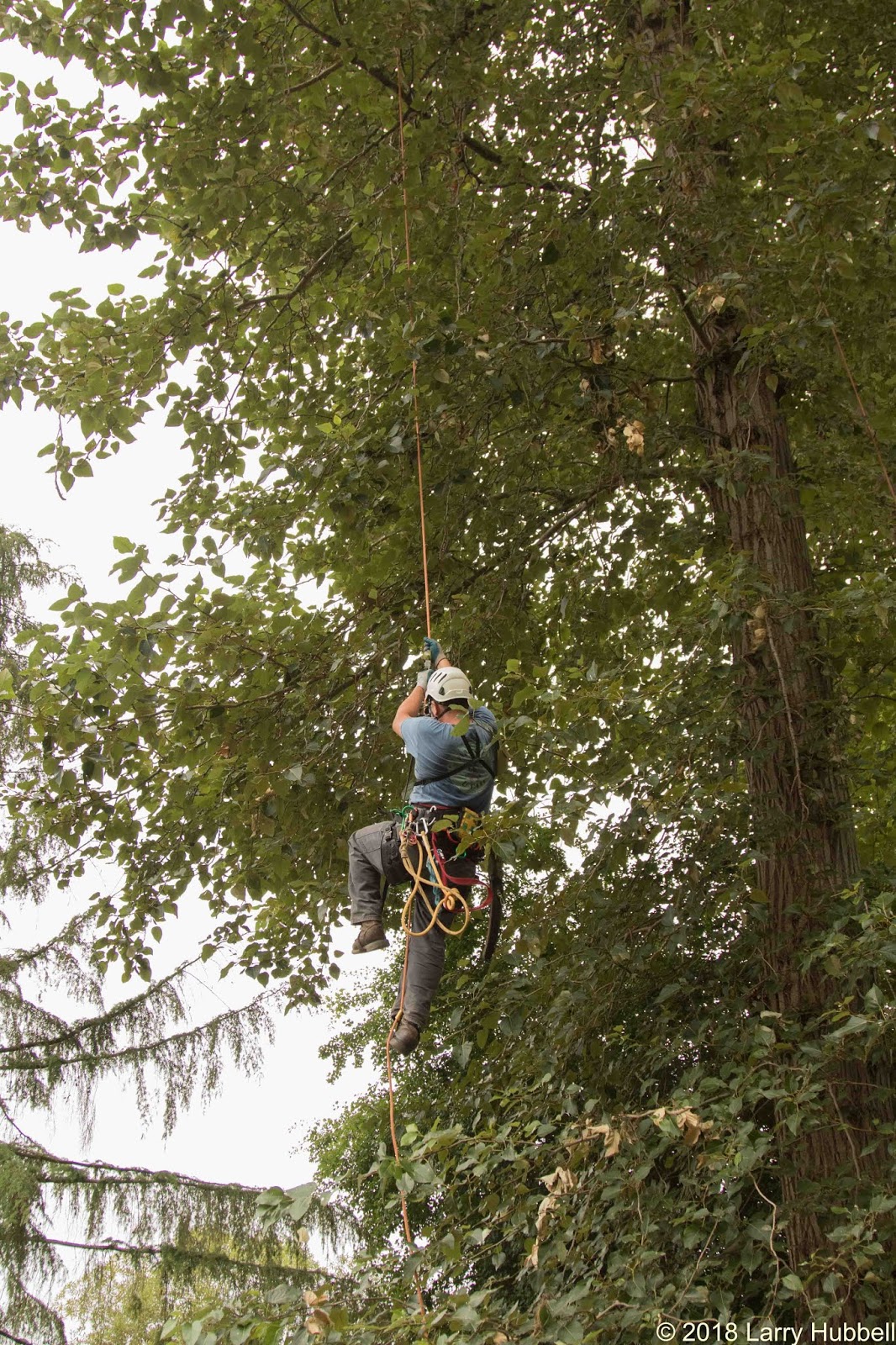
Clif begins the ascent to Lucy's nest site. 


I estimate the nest site at being about 100 feet in the air. In this photo Clif is about two thirds of the way to the site.

Drew and Clif trade off on the climbing. On this day Drew was providing ground support while at the very top of the photo you can see Clif has reached the nest site.

Here, Drew was preparing to send up materials for a temporary nest-like platform. The idea was that if Lucy could be returned to the site of the nest, hopefully the parents would resume feeding her and she could complete the normal branching process, which would end with her being strong enough to fly. After young eagles learn to fledge they usually spend a period of time with their parents learning to hunt, which would be the optimal way for Lucy to learn.

Clif preparing to receive materials

Jeff and Jim locking the escape hatch on the eagle elevator.

Cliff with the temporary platform installed and ready to receive Lucy.

The Lucy Lift in operation.

Sadly, just as Lucy was released the Blue Angels flew over and for whatever reason she was skittish and flew away. With great fear we watched as she flew all the way across Montlake Cut. Once again, she lost altitude the whole way. After she landed, she was unable to get airborne again. Luckily, Jeff and Jim were able to recapture her, unharmed. She was returned to PAWS, where she got another square meal. 

On Friday the process was repeated. This time the process was scheduled for after the Blue Angels completed their flights and her release was initiated from the ground. None the less she was still uncomfortable and as she was released she flew south and landed about halfway down in a large cottonwood behind the nest tree. (As of this morning she was still in the same location.)

The current assessment is that Lucy is too old to be returned to the nest site because she has consistently demonstrated the ability and desire to fly away. However, since she seems to only be able to fly down-hill, she is effectively only half-fledged. From my perspective half-fledged means she is capable of getting into trouble, but not capable of getting out. For example, she can fly well enough to land on the ground uninjured but she is apparently unable to get back to the safety of an overhead branch. The fear is that she could not escape from a coyote, raccoon or even an off-leash dog. 

If during the next few days you visit Montlake Cut or Montlake Park East (where the old Museum of History and Industry was located) please watch for Lucy. If you spot her on the ground please do not attempt to catch her but rather call PAWS or the Seattle Animal Shelter.

The phone number for PAWS is: 1-425-787-2500

The phone number for the Seattle Animal Shelter is: 1-206-386-7387

This is a unique situation where it would be best if the whole Montlake Community was watching for Lucy. So please feel free to forward the link to this post and ask your neighbor's for help.

Thank you in advance for your assistance.

Larry 


Going Native:

Without a well-funded Environmental Protection Agency, it falls to each of us to be ever more vigilant in protecting our local environments. Native plants and trees encourage the largest diversity of lifeforms because of their long intertwined history with our local environment and native creatures. I have been told that even the microbes in the soil are native to each local landscape. My hope is that we can inspire ourselves, our neighbors and local businesses to respect native flora and to support native wildlife at every opportunity. I have learned that our most logical approach to native trees and plants (in order of priority) should be to:

1) Learn and leave established native flora undisturbed.
2) Remove invasive species and then wait to see if native plants begin to grow without assistance. (If natives plants start on their own, then these plants or trees are likely the most appropriate flora for the habitat.)
3) Scatter seeds from nearby native plants in a similar habitat.
4) If you feel you must add a new plant then select a native plant while considering how the plant fits with the specific habitat and understanding the plant's logical place in the normal succession of native plants.

My intention in my weekly post is to include at least one photo each week and visually challenge us to know the difference between native and non-native lifeforms.


What type of plant is this? Is it native to Union Bay?


***************


Scroll down for the answer


***************


This is not the worst invasive plant, but it is not native to Union Bay. It is currently flowering in the Union Bay Natural Area. The highlighted links will take to two different sites, which will give you either a King County or a British Columbia perspective. 

l may be offline for a few days but I would love to hear if anyone can explain who and what  the wasp-like creature is doing on this plant. If you leave explanations in the comments section below the conversation can continue with or without me. (I think I understand what the Honey Bee is up to.)


***************


The Email Challenge:

Over the years I have had many readers tell me that Google is no longer sending them email announcements regarding my posts. Even more frustrating when they go to 're-sign-up', hoping that will enable them to once again start receiving the announcements, they get a message which says 'Sorry, you are already signed up.' Google has not responded to my requests for help with this issue. 

My functional work around is to setup my own email list and each week I manually send out a new post announcement. If you are experiencing the issue and would like to be added to my personal email list please send me an email requesting to be added. Thank you for your patience!


My email address is LDHubbell@comcast.net


*********************