

Cooper's Hawks are both deadly and beautiful. Last week, I happened to spot this young male in Yesler Swamp. The canopy of fresh Spring leaves surrounded us both. Brilliant sunlight found the blanket of green nearly impenetrable. The result was a yellow-green glow which evidently supplied the hawk with a sense of security. The young bird felt safe enough to close his eyes while rubbing his head on his shoulder.

I found myself totally mesmerized by the bird's beauty. Moments like these feel like an indisputable argument for living in harmony with nature. Thank you to the Friends of Yesler Swamp for removing invasive plants, restoring the native flora and inspiring us all.

The dampness of the central feathers on the hawk's chest may indicate he had just finished bathing. Personally, I have yet to see a Cooper's Hawk take a bath, but Martin Muller from the Urban Raptor Conservancy says, It happens.
(Update: The URC website is currently unavailable. From what I saw previously it will be well worth it to try again in a few days. Larry)
Martin and his partners, Ed Deal and Patti Loesche are the primary forces behind the Conservancy. In the early morning moonlight, just before the sun rises, they can often be seen searching Seattle treetops for subtle signs which indicate the nesting intent of our local Cooper's Hawks.
Ed, Martin and Patti apply bands to the legs of Cooper's Hawks. Ed explained that the goal of the banding is, 'To study the density and productivity of Cooper's Hawks in Seattle'. All indications show a steadily growing population. The bands also allow us to get to know and follow individual birds.
(The URC team applies purple bands on the left legs of male birds and orange bands on the right legs of females.)

In this particular instance, the '2 over 4' code indicates this is Percy. The same young hawk who was the star of the November post entitled, Persistence. He has survived the winter and apparently considers the Union Bay Natural Area his territory.

I suspect wet, heavy feathers clump together and make flight more difficult. Part of Percy's preening process included squeezing out the water and realigning the tiny velcro-inspiring, hooks and loops of his feather barbules.

Pulling a tail feather through the beak may be the most obvious example of this behavior.

A Cooper's Hawk's long tail enables it to twist and turn between branches inside the forest canopy. The tail works like a highly flexible sail which can caress, catch and thrust against the air. The result is a high degree of maneuverability which strikes fear into the hearts of juncos, sparrows, rats, rabbits, squirrels and of course pigeons. In last November's post, we got to know Percy the Pigeon Eater.

The vertical stripes on a Cooper's Hawk's chest indicate its youth. Percy is close to one year old, but since he is in his second calendar year, he is referred to as a Second Year bird. Earlier this week Martin mentioned that the vertical stripes also inform adult Cooper's Hawks that the bird is young and not a threat.
Yesterday, Ed explained that adult Cooper's Hawks chase away other adults, but generally only those of the same gender, e.g. the competition. Adults of the opposite gender are evidently considered less threatening and more of a potential, secondary mating opportunity.
Sometimes, immature birds are allowed to hang around an active nest site. Apparently, the resident adults, do not consider them competition. Ed calls them, 'Helpers'.

In some cases, immature birds become more than helpers. Young females, like this one, can be mature enough to lay eggs and occasionally take on the role of an adult female.

Yesterday, on the south side of Union Bay, Ed, his wife Gerry and I, were lucky enough to see this young, un-banded female eating food supplied by her new mate.

The male has the subtle orange chest-bars of an adult Cooper's Hawk. Ed also mentioned how young hawks have yellow irises and as they mature the irises turn orange and then ultimately they can even turn red.

Ed pointed out that the adult male's role is significantly more complicated than the female's. The male does not simply impregnate the female and leave - like a male Anna's Hummingbird.
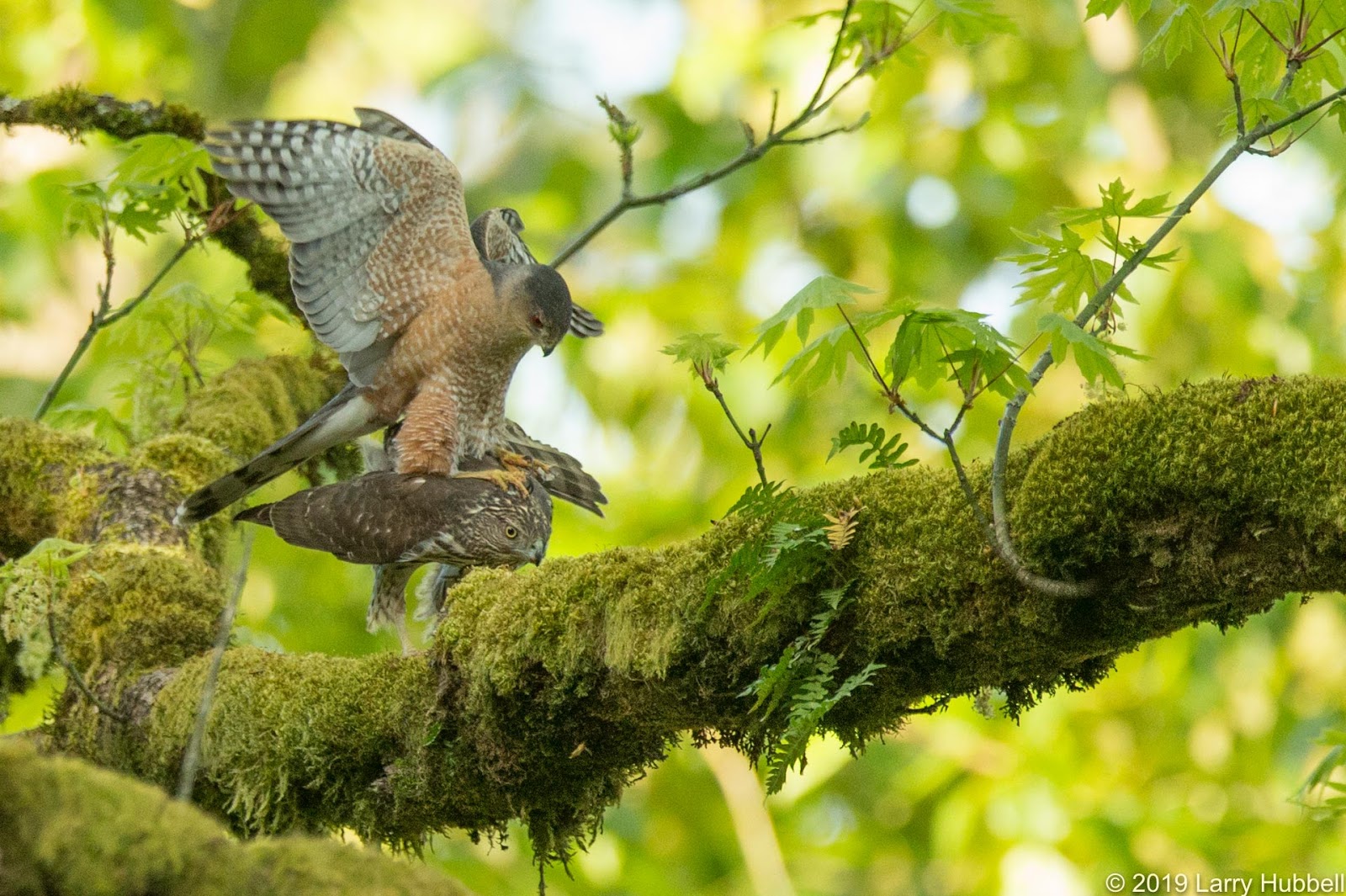
Initially, the male does much of the nest building, for which he is rewarded with mating opportunities. The male also supplies food to the female prior to and during nesting. After hatching, and even after the young fledge, the male continues to supply food to the young birds. In addition, when the female is on-eggs the male generally defends the nesting territory from other predatory birds.

In this case, after the mating was done, the young female feasted at length. Her bulging crop, just below her head, is full of undigested food which she carried away to a higher and safer location.
Large, moss-covered, horizontal Big Leaf Maple branches, like this one, are prime locations for Cooper's Hawk meals. Feathers and fur can often be found on the ground beneath them.

After mating the male rested for a few minutes before completing at least a dozen trips to the nest with additional sticks, which are often gathered from the brittle twigs on the inner branches of a Douglas Fir tree.

Afterwards, the male took the time to clean up the scraps.
Back on the north side of the bay, one of Percy's male neighbors met his demise, by flying headfirst into a window, earlier this week. Ed and I are hoping that Percy seizes the opportunity and begins delivering food to the female. Without a steady supply of food, the female will have to abandon her eggs. No one knows if Percy is mature enough to take on adult responsibilities. However, we do know he is highly persistent.
When you are near Union Bay you can help by bringing your binoculars, watching for banded Cooper's Hawks and reporting band sightings to the Urban Raptor Conservancy. Cooper's Hawks are capable of living over two decades. Hopefully, Percy's story is just beginning.
Have a great day on Union Bay...where nature lives in the city!
Larry
Going Native:
Without a well-funded Environmental Protection Agency, it falls to each of us to be ever more vigilant in protecting our local environments. Native plants and trees encourage the largest diversity of lifeforms because of their long intertwined history with our local environment and native creatures. I have been told that even the microbes in the soil are native to each local landscape. My hope is that we can inspire ourselves, our neighbors and local businesses to respect native flora and to support native wildlife at every opportunity. I have learned that our most logical approach to native trees and plants (in order of priority) should be to:
1) Learn and leave established native flora undisturbed.
2) Remove invasive species and then wait to see if native plants begin to grow without assistance. (If natives plants start on their own, then these plants or trees are likely the most appropriate flora for the habitat.)
3) Scatter seeds from nearby native plants in a similar habitat.
4) If you feel you must add a new plant then select a native plant while considering how the plant fits with the specific habitat and understanding the plant's logical place in the normal succession of native plants.
My intention in my weekly post is to include at least one photo each week and visually challenge us to know the difference between native and non-native lifeforms.

1) Learn and leave established native flora undisturbed.
2) Remove invasive species and then wait to see if native plants begin to grow without assistance. (If natives plants start on their own, then these plants or trees are likely the most appropriate flora for the habitat.)
3) Scatter seeds from nearby native plants in a similar habitat.
4) If you feel you must add a new plant then select a native plant while considering how the plant fits with the specific habitat and understanding the plant's logical place in the normal succession of native plants.
My intention in my weekly post is to include at least one photo each week and visually challenge us to know the difference between native and non-native lifeforms.

Is this a native or non-native type of flora?
Scroll down for the answer.
***************
Sorry, to disappoint everyone but I do not have a clue what kind of flower this is. I found it growing above Montlake Cut just to the west of the old boathouse. I suspect it is not native because I cannot find it in:
'Plants of the Pacific Northwest Coast' - Pojar and Mackinnon
or
'Wildflowers of the Pacific Northwest' - Turner and Gustafson
I would love to hear from someone who can identify it. My email address is:
LDHubbell@comcast.net
****************
Update:
Thank you to all who responded! Dennis, Richard, Tasha, Alejandro...
The winning entry appears to be, Forsythia. From what I have read, there are multiple species but they are mostly (maybe all) from the Old World and related to olives.
****************
For more information about native plants visit the Washington Native Plant Society.
***************
The Email Challenge:
Over the years I have had many readers tell me that Google is no longer sending them email announcements regarding my posts. Even more frustrating when they go to 're-sign-up', hoping that will enable them to once again start receiving the announcements, they get a message which says 'Sorry, you are already signed up.' Google has not responded to my requests for help with this issue.
My functional workaround is to set up my own email list and each week I manually send out a new post announcement. If you are experiencing the issue and would like to be added to my personal email list please send me an email requesting to be added. Thank you for your patience!
My email address is LDHubbell@comcast.net


