Mission: To promote the appreciation of wildlife and increase harmony between humanity and nature.

On Instagram: @unionbaywatch

Sunday, November 15, 2020

A Big Leafless Maple

On Friday, while walking near Arboretum Drive, it was hard to miss this Tuliptree all dressed up in its finest fall foliage. It was so attractive everyone turned their backs on the Bigleaf Maple trees on the other side of the pedestrian-only street.

The Maples had already dropped their leaves. At first glance, there was nothing particularly memorable or attractive about them. 

Tulip trees are part of the Magnolia family. They come from the southeast part of the United States. I was confused. I had expected that a tree from a warmer climate would drop its leaves earlier than a northwest native like a Bigleaf Maple.

It turns out that Tulip Trees are quite robust. They can grow in the heat of southern Florida while also thriving all the way north into the province of Ontario. I guess I wasn't totally wrong. It is a tree of the southeast, at least from a Canadian perspective. 
 
Without leaves obstructing the view there was suddenly more to see in the Bigleaf Maples. Initially, I noticed just a few small fluttering birds, high overhead, searching the moss-covered branches for food. They were often hidden in the shadows. A closer look revealed there were dozens of them! (I can see five in this photo.)

The notched tail, on the bird in the middle, indicates they are members of the Finch family. In the same way that an American Robin is a Thrush, the common name for this bird does not include the word, Finch.

This type of finch sometimes has yellow along the wings and tail. At the distance involved, I was lucky to catch this quick flash of yellow from under the tail.

Another important piece of identifying information was their relatively delicate pointed bills.

Unlike this female House Finch, the birds we are trying to identify do not have a heavy-duty, seed-cracking beak. However, they do share somewhat similar grayish-brown stripes.

Another finch, which we occasionally see in the Winter, who also has a delicate bill is the Common Redpoll. However, the birds in the Bigleaf Maple did not have red caps or black face masks.

That only leaves one likely local candidate. I believe these were Pine Siskins.


Even from the ground is was fun to watch them flitting around. I suspect there were at least fifty, if not more. I would have liked hearing them but with the distance involved, they were beyond my range. Click Here and listen to the third recording to hear their most distinctive call,

Suddenly, about half of the Siskins leaped into the air. Like a small cloud with a mind of its own, they evacuated the area.

A moment later this male, Pileated Woodpecker landed in the Bigleaf Maple tree. As far as I know, Pileated Woodpeckers are not known to prey on smaller birds. Still, I suspect its size was intimidating. When you are a small bird it is probably safer to fly at the first sign of danger. Waiting around to access the situation could be fatal.

The woodpecker worked his way around searching some of the same places where the Siskins had been. However, he came equipped with a much longer tongue, which enabled him to investigate the subsurface dwellings of carpenter ants and their larva.

Earlier, I was surprised to see the following sequence. Given that summer has passed and most young birds have already learned to feed themselves.

It looks like the bird on the right is coming closer to feed the bird on the left, even though I cannot see any food.

I cannot think of any other explanation. This certainly looks like feeding behavior to me. Pine Siskins are reported to sometimes have two broods in the same year, so I wonder if this could be one of the last young from a second brood. Maybe this is one of the last signs of summer for 2020.

Note: Even seed-eating birds, like Pine Siskins, feed insects to their young. 

When deciduous trees drop their leaves, at first glance, they may seem rather boring. Actually, without their leaves, a variety of avian activity can suddenly come into view. One might even call it a big reveal.  


In Other News:

Bald Eagles:
Saturday was a windy day. The trees continued to lose their leaves and eagles, ravens and hawks enjoyed the extra boost from the wind beneath their wings.

Common Ravens:
Earlier in the week, I followed the sound of ravens and crows until I could actually see a pair of ravens moving through the treetops in the Arboretum. As they flew away, from the crow harassment, I was surprised to see a third raven following along. Apparently, at least one of the young from this year's nest must be still hanging around the parents. It is also possible that what I saw was both of the young following after one of the adults. They all appeared to be the same size so it is only their behavior (and number) that makes me think one or more must be first-year birds. I have read that sometimes a young one will even hang around until the next Spring and help out with the next year's nesting process.

American Bitterns:
Last week, based on the range maps in All About Birds (and Birds of the World) I assumed that American Bitterns no longer nested to the west of the Cascades. Several readers pointed out information to the contrary. I was glad to learn there are year-round sightings on Whidbey Island, Spring sightings at the Ridgefield Wildlife Refuge and via Birdweb (by connecting through to the Sound to Sage Breeding Bird Survey) I learned of one confirmed nesting location in King County and many other possible and probable locations. Go Bitterns!

Wildflowers:
I also received this very handy plasticized wildflower pocket guide this week. It was compiled locally by our neighbor Jane Lundin. 265 flowers are sorted by color and surprisingly identified by common, scientific, and family names. It also contains a relative guide to each flower's size, as compared to the photo. That is a lot of critical information in a small package that looks quite handy, and light, for backpacking in the mountains next Spring. It is titled, Mountain Wildflowers of Washington.

Have a great day on Union Bay...where nature lives in the city and Black Birders are welcome!

Larry


Going Native:

Without a well-funded Environmental Protection Agency, it falls to each of us to be ever more vigilant in protecting our local environments. Native plants and trees encourage the largest diversity of lifeforms because of their long intertwined history with our local environment and native creatures. I have been told that even the microbes in the soil are native to each local landscape. I hope we can inspire ourselves, our neighbors, and local businesses to respect native flora and to support native wildlife at every opportunity. I have learned that our most logical approach to native trees and plants (in order of priority) should be to:

1) Learn and leave established native flora undisturbed.
2) Remove invasive species and then wait to see if native plants begin to grow without assistance. (If natives plants start on their own, then these plants or trees are likely the most appropriate flora for the habitat.)
3) Scatter seeds from nearby native plants in a similar habitat.
4) If you feel you must add a new plant then select a native plant while considering how the plant fits with the specific habitat and understanding the plant's logical place in the normal succession of native plants.

My intention in my weekly post is to include at least one photo each week and visually challenge us to know the difference between native and non-native lifeforms. 

(By the way, my friend Tom Brown pointed out that the application named 'Wildflower Search' is extremely helpful. Click on the highlighted link to see for yourself.

Also, Jane Lundin has created a small package, with a lot of critical information that looks quite handy, and light, for backpacking in the mountains in Springtime. It is titled, Mountain Wildflowers of Washington.)
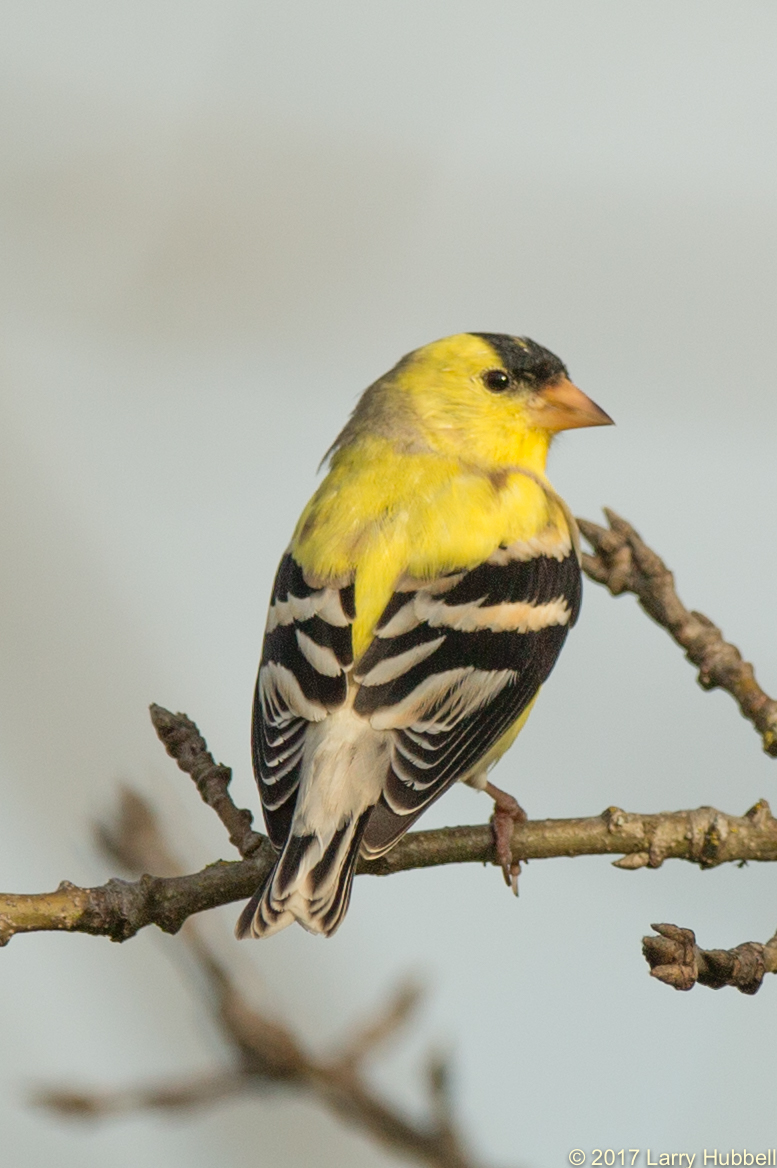


What species is this? Is it native to the PNW? 


Scroll down for the answer.


***************


American Goldfinch: Yes. Not only are they native to the PNW the American Goldfinch is our state bird. Even though we call it the Willow Goldfinch, it is still the same bird.


***************


The Email Challenge:


Over the years I have had many readers tell me that Google is no longer sending them email announcements regarding my posts. Even more frustrating when they go to 're-sign-up', hoping that will enable them to once again start receiving the announcements, they get a message which says 'Sorry, you are already signed up.' Google has not responded to my requests for help with this issue. 

My functional workaround is to set up my own email list and each week I manually send out a new post announcement. If you are experiencing the issue and would like to be added to my personal email list please send me an email requesting to be added. Thank you for your patience!


My email address is: LDHubbell@Comcast.Net


One more photo for the persistent:


Saturday, November 7, 2020

Masters of Camouflage

Last weekend was only the third time in nine years that I have seen an American Bittern on Union Bay. All three sightings have been along the shore and within a one hundred yard radius. Each of the bitterns walked in and out of the cattails while inspecting the shallow water along the shore for prey.

Curiously, I have been in my kayak each time I saw one of the Bitterns. Being close to their preferred habitat may have improved my odds of noticing them. On each occasion, I have watched them hunt. Sadly, during the two previous encounters, I did not see them catch anything. 

All three of the Bitterns were immature. Each bird lacked the black patch on the neck that would indicate maturity (Click Here to see an example). Since Bitterns are immature for only a small portion of their lives, I must have seen three different individuals. All three sightings were in the Fall. Most likely when they were each migrating towards Winter warmth.

This time, out of the corner of my eye, all I saw was a brief flash of movement. I had no clue what creature caused the motion. When I looked closer all I saw was the cattails slowly shaking to a stop.

According to the current range maps in "All About Birds" (and "Birds of the World") Bitterns apparently no longer nest west of the Cascades. In my previous Bittern post, I explained that 70 years ago Bitterns were known to nest on Union Bay. (Click Here to read the story.) They are currently shown as nesting in the northern half of the US and the southern half of Canada from the Cascades all the way east to the Atlantic Ocean. 

They are widespread. However, they only nest in and around wetlands - areas which we, humans, tend to drain and develop. Like many other birds, their numbers are declining. But they are so good at hiding it is hard to notice their shrinking population. 

The American Bitterns are so secretive that in Birds of the World, where they normally relate what a species natal down looks like, it simply says, "Undescribed." We still have a lot to learn about these incredibly specialized and secretive creatures.

This photo focuses on the vegetation in the foreground, instead of the bird. I believe this is what our eyes tend to see when we are searching the shore for birds. Because I was in the kayak and using a telephoto lens this photo might even feel a bit closer to the bird than if we were using binoculars from a more distant location.

Now, the focus has shifted from the foliage to the Bittern. Don't be discouraged if you still cannot see it. Even immature Bitterns are masters of camouflage and concealment.

Finally, here is the same photo cropped and enlarged.  Even though the Bittern nearly fills the screen, it is not exactly easy to see. I suspect that we have American Bitterns passing through Union Bay every Autumn, often without being noticed at all. I wonder if some might even spend their winters here?

Skipping ahead, here is another classic American Bittern camouflage pose. In this case, the stripes on the long thin neck line-up with the vertical vegetation and help to hide the bird. 

Notice how the Bittern holds its bill up out of the way and peers around its 'chin' or neck. 

Luckily, there were moments when the Bittern stood tall and backlit by the brilliant sunlight.

I am always amazed by how the neck can shrink. The Bittern is returning to the hunt.

With a somber and stately stride, it proceeded along the dark bank of the shore.

Momentarily, it raised its head. Once again it is peering around its 'chin'. Evidently, this odd position enlarges its field of vision - at least in the area where it is hunting

I waited. Patiently hoping, that I might see it catch something to eat.

After the venture along the shore, the Bittern turned back towards the area it had previously hunted.

With a sudden extension of its neck, it snagged a pollywog i.e. a young bullfrog destined to never reach maturity.

A little mashing and thrashing turned the tadpole into a mid-day meal.

An American Bittern's long neck makes swallowing its prey a bit of a challenge. The food had a long way to go. I am a bit surprised that the bird did not extend its neck up into the air to get a little extra help from gravity.

Unlike with humans, for a Bittern swallowing can be a multi-step process.

It took at least a half-a-dozen repeats of the swallowing effort to transport lunch from the upper end of the throat to its digestive destination.

Afterward, the Bittern turned and headed back towards its original location.

It stopped along the way. It was clearly enthralled with something. However, no matter how hard I tried, I could not see what it was looking at.

I suspect a small insect because of the way the Bittern slowly raised its head while maintaining its laser-like focus.

I never did spot the insect. However, watching the full extension of the Bittern's neck was a perfectly adequate reward for my efforts.

***************

This week's post is dedicated to Eric Kowalczyk. Eric was a kind and gentle neighbor with a fantastic knowledge of birds. His infectious love of everything avian was an absolute delight for those of us who were lucky enough to share a stroll along the shores of Portage Bay.

Thank you to Marianne and John for sharing and suggesting the following information be included here.


************************************


Have a great day on Union Bay...where nature lives in the city and Black Birders are welcome!

Larry


Recommended Citation
 Lowther, P. E., A. F. Poole, J. P. Gibbs, S. M. Melvin, and F. A. Reid (2020). American Bittern(Botaurus lentiginosus), version 1.0. In Birds of the World (A. F. Poole, Editor). Cornell Lab of Ornithology, Ithaca, NY, USA. https://doi.org/10.2173/bow.amebit.01

Going Native:

Without a well-funded Environmental Protection Agency, it falls to each of us to be ever more vigilant in protecting our local environments. Native plants and trees encourage the largest diversity of lifeforms because of their long intertwined history with our local environment and native creatures. I have been told that even the microbes in the soil are native to each local landscape. I hope we can inspire ourselves, our neighbors, and local businesses to respect native flora and to support native wildlife at every opportunity. I have learned that our most logical approach to native trees and plants (in order of priority) should be to:

1) Learn and leave established native flora undisturbed.
2) Remove invasive species and then wait to see if native plants begin to grow without assistance. (If natives plants start on their own, then these plants or trees are likely the most appropriate flora for the habitat.)
3) Scatter seeds from nearby native plants in a similar habitat.
4) If you feel you must add a new plant then select a native plant while considering how the plant fits with the specific habitat and understanding the plant's logical place in the normal succession of native plants.

My intention in my weekly post is to include at least one photo each week and visually challenge us to know the difference between native and non-native lifeforms. 

By the way, my friend Tom Brown pointed out that the application named 'Wildflower Search' is extremely helpful. Click on the highlighted link to see for yourself.


What species is this? Is it native to the PNW? 

The pattern of light and dark on the wings, the small head, and the reflective bill are all helpful in identifying this bird.


Scroll down for the answer.


***************


Turkey Vulture: Yes. It is native to our area. However, they do not spend their winters here. This one was seen high over the Arboretum in early October - heading south. Some even migrate as far as South America. 


***************


The Email Challenge:


Over the years I have had many readers tell me that Google is no longer sending them email announcements regarding my posts. Even more frustrating when they go to 're-sign-up', hoping that will enable them to once again start receiving the announcements, they get a message which says 'Sorry, you are already signed up.' Google has not responded to my requests for help with this issue. 

My functional workaround is to set up my own email list and each week I manually send out a new post announcement. If you are experiencing the issue and would like to be added to my personal email list please send me an email requesting to be added. Thank you for your patience!


My email address is: LDHubbell@Comcast.Net


One more photo for the persistent.


Saturday, October 24, 2020

Sgt. Pepper

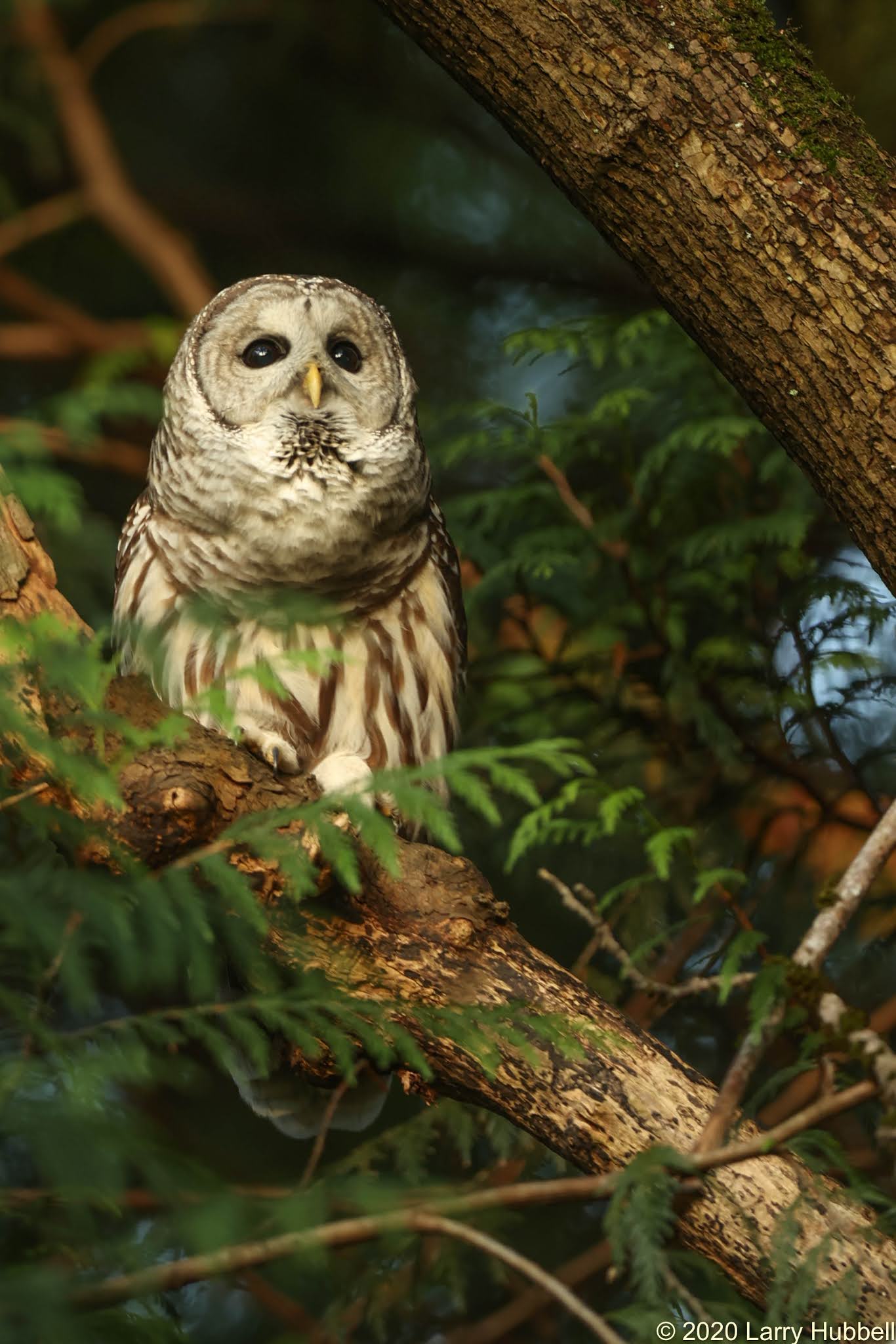
Toward the end of September, I decided to take an early morning walk to Foster Island. I must have I walked right under this owl without even noticing it. I was nearly a hundred yards away when Ginger, my daughter's dog, pulled at the leash. 

Ginger is generally quite aware of any canine competition. I looked back fully expecting to see a well-rested dog dragging another bleary-eyed soul toward the morning light. The sun was struggling to assume its full responsibilities. However, the trail was empty of humans and dogs
The shadowy shape on the ground looked duck-sized and given the proximity to the shore waterfowl seemed like a reasonable assumption. When the shapeshifted, my assumption shattered.

It was a Barred Owl on the ground. In the past, I have only seen Adult owls on the ground when securing food or water. Looking through my camera lens helped me to investigate the situation from a respectful distance. I was surprised by the apparent absence of any prey.

The owl was alert. It was carefully watching for any nearby movement. Its intensity implied that the previous night's hunting was not fully successful.

It seemed to be picking at a twig on the ground. As people approached it flew back to the tree. After they passed it returned to the ground. Like me, no one else noticed the owl - even though it was sitting just a few feet above their heads. It returned to the tree.

As the sun fought through the cottonwoods a shaft of light lit up the foliage below the owl.

The owl remained intently focused. It reminded me of a person staring into a campfire.

Again, the owl returned to the shaded ground. Its colors were a surprisingly similar match to the leaf litter, gravel, and twigs.

After the owl left, I inspected the spots where it landed. There was no obvious sign of food.

When an Eastern Gray Squirrel worked its way through willows along the shore, the owl gave chase, apparently, still hungry. The squirrel was much too quick, especially given the owl's obvious, daylit approach. Ultimately, the owl gave up and disappeared into denser vegetation. Its early morning hunger reinforced the idea that it was a young, inexperienced hunter.

A couple of weeks later, near the end of an October day, I found a solitary owl watching a field of grass just south of Foster Island Road. I cannot prove it is the same owl but the location and behavior make it seem likely. Barred Owls are territorial and they do not generally migrate. So the odds of seeing the same owl, or at least the same pair, in the same area are pretty good.

Ginger and I stood silent and still at the far edge of the grass for at least a half-hour. The owl noticed us once.

It quickly resumed searching the grass and the trees for something tasty to eat.

Searching the trees overhead seems like a poor hunting strategy. (On the other hand, when sitting out in the open it may be a very good defensive strategy. I have seen Bald Eagles and Ravens stalking or chasing Barred Owls and we have both in the area. Plus, Great Horned Owls reportedly eat them as well.)

Adult Barred Owls tend to stay undercover and to focus on what is below them. They often sit near the water's edge as darkness falls. They wait patiently for a small creature to reveal itself. Then, when the prey looks the other way the owl spreads its wings and silently descends. If this owl spotted viable prey overhead in the trees the odds of success would quickly diminish while the owl attempted to gain the necessary elevation. The smaller creature would be likely to notice its approach and easily scamper away to safety.

This week, I have seen and heard the owl twice more. Each time toward the end of the day. I am assuming it is the same bird in part because I have yet to hear an answering call. I suspect it is trying to stake out its first territory and hoping to attract a viable mate.

The first evening, when I heard it call it was doing the complete Barred Owl statement, e.g. "Who cooks for you?, Who cooks for you?" Sadly, for the owl, the only answer I heard was from a young girl out for a walk with her parents.

The next evening the calls I heard were much shorter. I do not know why? However, I still did not hear a reply. 

If you happen to walk through the north end of the Arboretum, especially toward the end of the day, please listen for the call of the Barred Owl. In particular, listen for a reply. It will be curious to see who is the first to hear two owls calling from different directions in the north end of the Arboretum.

I believe this photo was taken just as the owl called out. Its mouth is apparently open, Curiously, even though there is a dark patch in the feathers they still hide the mouth from view. It is a bit harder to see in the video below but it still seems like the open mouth remains hidden whenever the owl calls out. This is a new observation for me.


I hope this owl refines its hunting technique before winter arrives and food gets even harder to find. If it succeeds then by spring it may even attract a mate. Currently, it reminds me of the title to an old Beatles' song, "Sgt. Pepper and the Lonely Hearts Club."

Have a great day on Union Bay...where nature lives in the city and Black Birders are welcome!

Larry


Going Native:

Without a well-funded Environmental Protection Agency, it falls to each of us to be ever more vigilant in protecting our local environments. Native plants and trees encourage the largest diversity of lifeforms because of their long intertwined history with our local environment and native creatures. I have been told that even the microbes in the soil are native to each local landscape. I hope we can inspire ourselves, our neighbors, and local businesses to respect native flora and to support native wildlife at every opportunity. I have learned that our most logical approach to native trees and plants (in order of priority) should be to:

1) Learn and leave established native flora undisturbed.
2) Remove invasive species and then wait to see if native plants begin to grow without assistance. (If natives plants start on their own, then these plants or trees are likely the most appropriate flora for the habitat.)
3) Scatter seeds from nearby native plants in a similar habitat.
4) If you feel you must add a new plant then select a native plant while considering how the plant fits with the specific habitat and understanding the plant's logical place in the normal succession of native plants.

My intention in my weekly post is to include at least one photo each week and visually challenge us to know the difference between native and non-native lifeforms. 

By the way, my friend Tom Brown pointed out that the application named 'Wildflower Search' is extremely helpful. Click on the highlighted link to see for yourself.


What species of fern is this? Is it native to the PNW?

Here is a second more distant view - in case it helps. These ferns can be seen in the Arboretum along the Loop Trail.


Scroll down for the answer.


***************


Giant Chain Fern: It is a native West Coast fern. According to the University of Washington, it is listed as a sensitive plant on the endangered species list. I suggest learning what it looks like just in case you have one growing in your yard. You might want to protect it. Click on the name to visit the UW fact sheet. 

Thank you to Andy Mitton from the Berger Partnership for teaching me about this plant.


***************


The Email Challenge:


Over the years I have had many readers tell me that Google is no longer sending them email announcements regarding my posts. Even more frustrating when they go to 're-sign-up', hoping that will enable them to once again start receiving the announcements, they get a message which says 'Sorry, you are already signed up.' Google has not responded to my requests for help with this issue. 

My functional workaround is to set up my own email list and each week I manually send out a new post announcement. If you are experiencing the issue and would like to be added to my personal email list please send me an email requesting to be added. Thank you for your patience!


My email address is: LDHubbell@Comcast.Net


One more photo for the persistent.

As the owl moved deeper into the foliage it became progressively more difficult to see.