

The snow is gone and even though the cold wind still blows, Spring is on the way. This photo from last year at about this time shows a female Wood Duck checking out one of our new nest boxes. She was obviously looking for a a place to lay her eggs. Her mate was watching carefully. Apparently, he was trying to protect her from the unwanted advances of any other male Wood Ducks. My friend, Martin Muller, suggested this type of behavior is called 'Mate Guarding'. 'Tis the season for Wood Duck reproduction.
Any day now our team of Union Bay observers will begin watching Wood Ducks. The behaviors we will be looking for include inspecting-nests, egg-laying and mate-guarding. The ultimate dream behavior would be to watch ducklings, within 24 hours of hatching, jump out of a nest box. Ducklings are precocious. They do not wait around. By their second day they are walking, swimming and feeding themselves. The ducklings certainly know how to hit-the-ground-running or more precisely, how to land-on-the-water-feeding.

Earlier this month it felt like winter might never end.
The Spring and Summer of 2018 was the first breeding season with our new Wood Duck nesting boxes in place. We recorded our observations and made some interesting discoveries. For example,
- The first observed nest box inspection (by a female Wood Duck) was on March 5th.
- The estimated timing of the first egg laid was the first week in April.
- The estimated beginning of the first incubation was in mid-April.
- The first ducklings seen were on May 14th.
- The last, new ducklings seen were on July 11th.
We have inspected seven of the ten boxes and found clear indications of egg laying in three of the boxes. At least three more of the boxes contained one or more feathers which indicated they were probably inspected by a female Wood Duck.
**************
The challenge in this week's post is to determine the appropriate season for each of the following four sets of three photos.
The bulleted information above provides some clues. Looking closely at the vegetation in the photos may help. Plus, it is good to know that in the Summer, males lose their beautiful breeding plumage. However, they keep their brilliant red eyes, even in their non-breeding, e.g. eclipse, plumage.
For advanced credit, you could also try organizing the three photos inside each season by their appropriate month. In the complete set of 12 photos, each month is represented just once. To simplify the process I consider the December, January and February photos to be in the Winter season. March, April and May I categorize as Spring. June, July and August are in the Summer set. Which leaves September, October and November as Fall.
Note: The terms, Sets 1, 2, 3 and 4, do not correlate to the natural arrangement of the seasons. Each of these headers, is only a 'bucket' into which I have collected three photos from a single season. Your challenge is to figure out in which season each set of these Wood Duck photos was taken. Good Luck!
Set 1:
A:

B:

C:

Set 2:
D:

E:

F:

Set 3:
G:

H:

I:
Set 4:
J:

K:

L:

--- Spoiler Alert ---
Beyond this point you will see the photos reorganized by season and month.
Spring: (Set 4)
March:
This is a photo of a female entering a natural cavity in a tree. It was taken at the end of March. The timing means we could debate whether she was inspecting a potential nest site or actually entering a nest to lay an egg.
April:
May:
Summer: (Set 1)
June:
The red eye, plus the red and orange color at the base of the bill, are clear year-round indicators of an adult male. The tattered looking feathers indicate breeding season is over and the male is beginning to replace his feathers with a more feminine-looking, non-breeding plumage, e.g. eclipse plumage.
July:
These ducklings are no longer newly hatched, but given that they are still fairly young we have to be in either late-Spring or the earlier half of Summer. The dried yellow leaves in the photo should have helped you think Summer instead of Spring.
August:
I believe this is a hatch-year Wood Duck because all of the feathers on the head appear to be almost exactly the same length. The white around the eye makes me think it might be a female. However in August, first-year males typically do not yet have the red eye of an adult male, so the gender of this bird remains unknown.
Note: The lily pad in the photo is nice and green, while the duckling is getting close to full-size. Hence, this photo had to be in late Summer of early Fall.
*******
Bonus Photo:
August:

After talking so much about eclipse plumage, I decided I better include an example. Here are two mature male Wood Ducks, in eclipse plumage, during the month of August.
*******
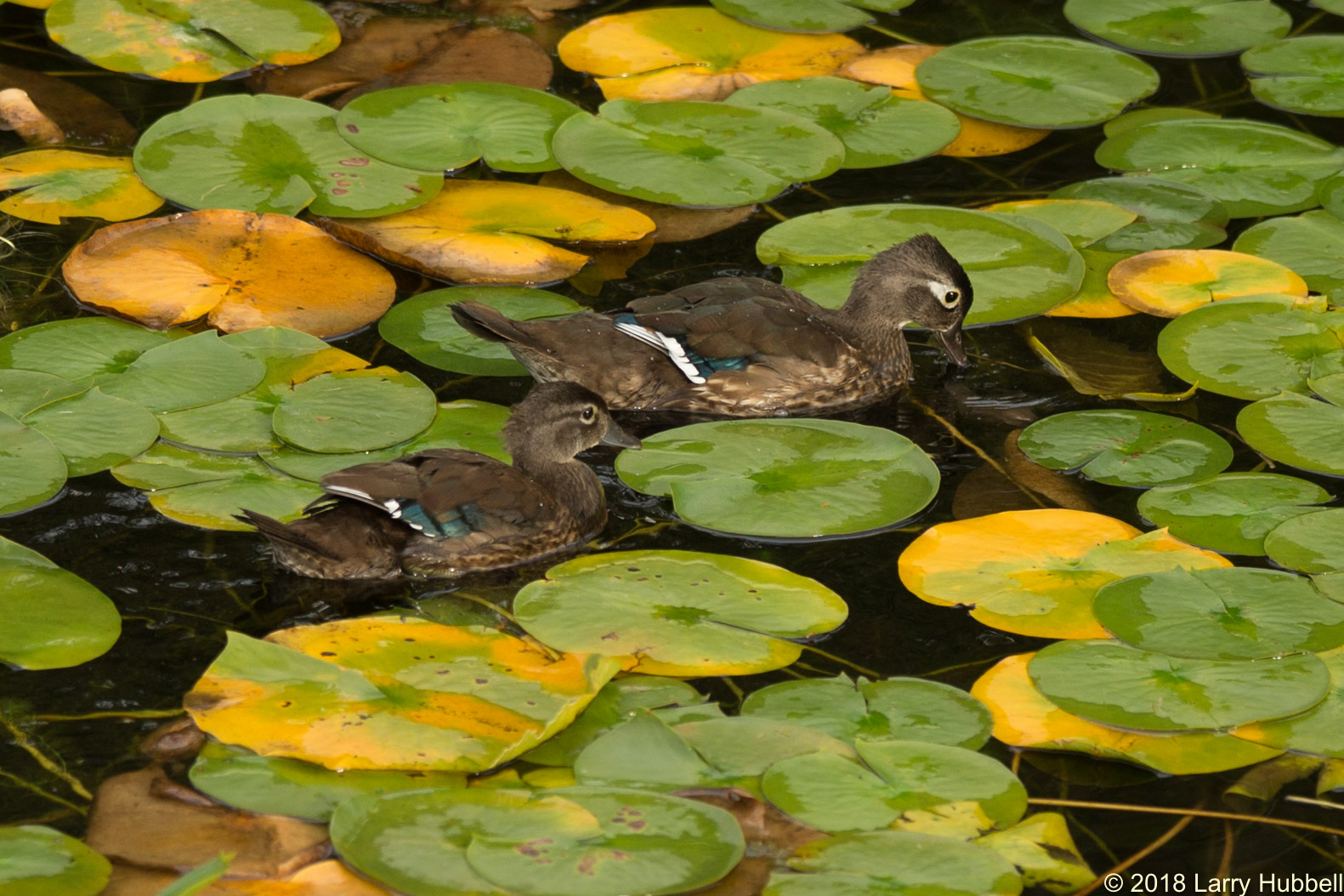
This photo is full of hints. First, the lily pads are starting to turn yellow so we are no longer in Summer, however, many of the plants are still green so it cannot be too late in the Fall. The adult female is being followed by a first-year bird which is another indicator of early Autumn. Soon, the young bird will get its adult plumage and then go its separate way in life.
By the way, did you notice the hint of white 'fingers' on the lower portion of the young duck's face? These white markings are most consistently found on adult males. On an obviously young bird, still following its mother around, it seems logical to conclude that the white-fingers probably indicate it is a first-year male, whose eyes have not yet turned red.
October:
The male is in his bright, freshly-minted breeding plumage while the lily pads are looking a bit sparse. I believe the majority of the plants in the background are a form of wort which reaches its prime after the lily pads begin to decline. Admittedly, this is hard to see with the focus in the photo being on the ducks. There are no longer any young ducks hanging around the female.
This photo contains the least amount of green in the Fall set. So, we can conclude it was taken in November.
Winter: (Set 2)
December:
The total lack of any bright green foliage hints at Winter. However, there is a slight touch of yellow-green in the foliage, just above the male's head. This, along with the untrodden look of the vegetation indicates early Winter.
January:
This Winter photo shows a group with more male than female ducks. In spite of the uneven numbering, the gathering looks quite peaceful. Maybe the intensity of breeding season has not yet begun. Along with the total lack of green, these two hints point towards mid-Winter.
February:
In this, the last photo of Winter, the male Wood Ducks are competing for the female's attention. If I remember correctly, I had the impression she had already selected a mate, but the other males were intent on getting her to reconsider. Breeding season was just about to begin.
This post is dedicated to Chris Kessler, for his weekly dedication and partnership in watching the Wood Ducks and their boxes during every week of the 2018 season!
If you are interested in learning more about Wood Ducks and documenting their behavior while devoting a few hours, every week to observing the nesting process around Union Bay, please let me know. My email address is at the bottom of this post.
Have a great day on Union Bay...where nature lives in the city!
Larry
Going Native:
Without a well-funded Environmental Protection Agency, it falls to each of us to be ever more vigilant in protecting our local environments. Native plants and trees encourage the largest diversity of lifeforms because of their long intertwined history with our local environment and native creatures. I have been told that even the microbes in the soil are native to each local landscape. My hope is that we can inspire ourselves, our neighbors and local businesses to respect native flora and to support native wildlife at every opportunity. I have learned that our most logical approach to native trees and plants (in order of priority) should be to:
1) Learn and leave established native flora undisturbed.
2) Remove invasive species and then wait to see if native plants begin to grow without assistance. (If natives plants start on their own, then these plants or trees are likely the most appropriate flora for the habitat.)
3) Scatter seeds from nearby native plants in a similar habitat.
4) If you feel you must add a new plant then select a native plant while considering how the plant fits with the specific habitat and understanding the plant's logical place in the normal succession of native plants.
My intention in my weekly post is to include at least one photo each week and visually challenge us to know the difference between native and non-native lifeforms.

1) Learn and leave established native flora undisturbed.
2) Remove invasive species and then wait to see if native plants begin to grow without assistance. (If natives plants start on their own, then these plants or trees are likely the most appropriate flora for the habitat.)
3) Scatter seeds from nearby native plants in a similar habitat.
4) If you feel you must add a new plant then select a native plant while considering how the plant fits with the specific habitat and understanding the plant's logical place in the normal succession of native plants.
My intention in my weekly post is to include at least one photo each week and visually challenge us to know the difference between native and non-native lifeforms.

In this December photo, we see Monty in the background selecting a branch to add to their new nest. The branch is from what type of tree? Note: All the foliage in this photo is from the same kind of tree. The shape of the leaves is a critical hint. Is the tree native to Union Bay?
Scroll down for the answer.
***************
Black Cottonwood: Yes, it is native to Union Bay. Click Here to read about a half a dozen different creatures which utilize this tree. Also, 99.9% of the branches, which I have seen, our local eagle use in nest building have come from Cottonwoods. Plus, two out the three Union Bay eagle's nests are located in Cottonwoods. In addition, all three pairs of local Bald Eagles have one or more favorite hunting perches in a Cottonwood Tree.
***************
The Email Challenge:
Over the years I have had many readers tell me that Google is no longer sending them email announcements regarding my posts. Even more frustrating when they go to 're-sign-up', hoping that will enable them to once again start receiving the announcements, they get a message which says 'Sorry, you are already signed up.' Google has not responded to my requests for help with this issue.
My functional workaround is to set up my own email list and each week I manually send out a new post announcement. If you are experiencing the issue and would like to be added to my personal email list please send me an email requesting to be added. Thank you for your patience!
My email address is LDHubbell@comcast.net


