Mission: To promote the appreciation of wildlife and increase harmony between humanity and nature.

On Instagram: @unionbaywatch
Showing posts with label Cooper's Hawk. Show all posts

Saturday, March 14, 2020

"X" Marks The Spot

As a pair of birds crossed Montlake Cut, my eye followed their trajectory. They landed in a coniferous tree to my east. The second bird was a crow. I was less certain about the first. Before I reached the tree, two crows flew out, circled and landed nearby. My hope for some avian excitement faded.

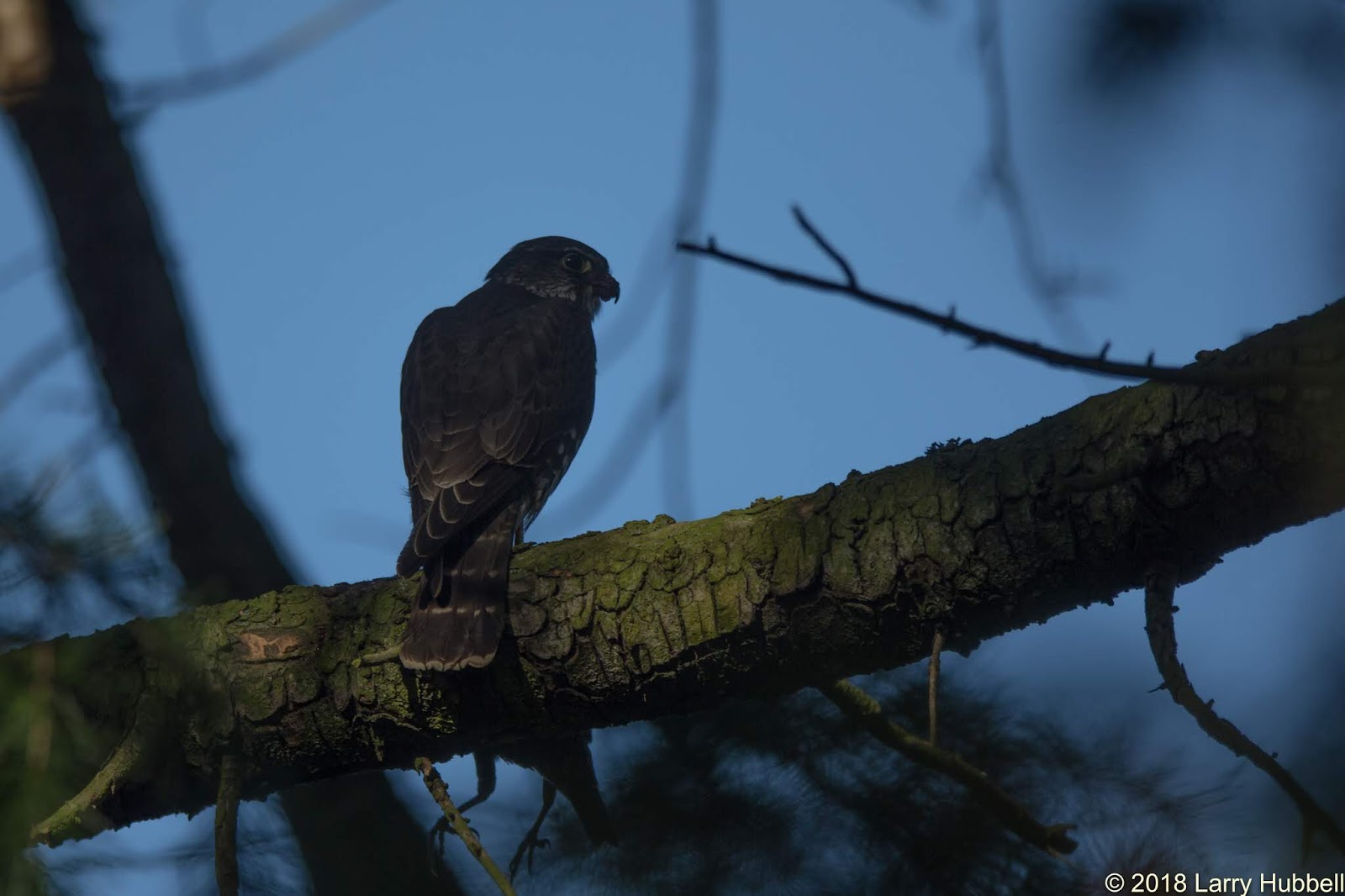
I was almost passed the tree when I glanced back over my shoulder. I caught a surprising glimpse of a small predator sitting silently in the shadows. My initial thought was Cooper's Hawk, however even in poor light, I quickly noticed that the tail did belong on an accipiter.

A young Cooper's Hawk may have a light (or white) coloring on the tip of the tail - as shown here. However, the light bars on the upper portion of the tail are not white and certainly not thin. Accipiters, including our local Sharp-shinned Hawks, also have much longer tails than the bird in the first photo.

A mature Cooper's generally has less whitish coloring on the tips of its tail feathers. However, when their tail feathers are backlit the lighter barring can appear almost white. In any case, with Cooper's Hawks, the bars are wide and the tails are long, unlike the bird in the shadow.

Suddenly, I became aware of the small birds around me. I could hear a Black-capped Chickadee, an alarmed Bewick's Wren and I could see a highly observant Dark-eyed Junco staring intently at the small, dark predator. All About Birds says, "The more dee notes in a chickadee-dee-dee call the higher the threat." I heard seven in a row.

Finally, a shaft of sunlight found the perched predator. The dark eye offset by the pale yellow ring, the pointed wingtips that crossed and the multiple thin, light bars on the tail made it obvious, the bird was a Merlin. I am sure the Junco arrived at this conclusion much faster than I did. For the Junco, this type of awareness can mean the difference between life or death. 

The Merlin was watching everything. It glanced up, most likely watching for the crows.

It glanced down. Checking out the small birds. It may have been making sure they were not upset by some other nearby threat. At that point, the light hit its bill. Finally, I noticed the red color and realized that coloring did not originate with this bird. I am sure the Junco was already well aware of the blood on the bill. 


One last comparison to a perched Cooper's Hawk, notice how the wingtips stay on their respective sides of the bird's body. Unlike, with the Merlin, they do not come close to crossing or touching.

Glancing below the branch, I finally noticed the tail and feet of a smaller bird. My respect for the observation skills of the Junco continued to increase.

Once the Merlin felt relatively safe, it resumed plucking and feeding

There are three subspecies of Merlin in North America.  The Black Merlin, residing in the Pacific Northwest, is a stationary, year-round resident. (Maybe we should be thankful for those warm winter rains.) The other two Merlin subspecies migrate south during winter.


During the feeding process, the tail of the prey was briefly exposed to sunlight. I began wondering if I would see enough to identify the species of the prey.

The Merlin continued to keep a watchful eye on its surroundings.

Later, while reviewing the photos, I found an angle where I can just barely make out light-colored spots on tips of the feathers on the back of the bird being consumed. I can think of only one bird, with these types of spots, and especially, this time of year.

I suspect the prey was a European Starling. Given that starlings are invasive and chase  native birds out of their nest sites my empathy for the starling passed quickly.

It looked like the Merlin had consumed about half of the starling by the time the crows returned. They came in quietly, hopping from branch to branch among the shadows. The Merlin watched their approach but did not appear nervous. They ended up directly above the Merlin.

Finally, a crow dived. It descended directly at the Merlin. The Merlin called out loudly as it took flight. I could not see the action. However, I circled a dividing hedge in time to see the Crow eating three or four small bites of food. Apparently, the Merlin escaped with the bulk of the remaining food. 


Earlier, as the Merlin moved about, the sunlight fell on its crossed wingtips and projected a shadow on the upper tail. Even when not in use, the sharply-pointed primaries of this small falcon were evident. I smiled at the thought, "X marks the Merlin". 

This photo of a Peregrine Falcon implies, it might be more appropriate to say, "X marks the Falcon. Actually, in most of my perched peregrine photos, the wingtips are generally not crossed. A question for a future post might be, Do any other predatory birds have wingtips that frequently cross?

Surprising Fact: According to the weight ranges listed on All About Birds, the largest Peregrine Falcon (most likely female) can weigh tens times as much as the smallest Merlin (most likely male).


It may be impossible to know what a bird feels, but in my opinion, the Merlin behaved fearlessly. It stood its ground, as long as possible. Even though it was facing two larger opponents, who were intent on stealing its lunch. The Merlin's screech sounded more like anger than fear. Plus, the Merlin was strong enough and fast enough to carry significant weight and still escape the Crows. 

Not surprising my previous post about a Merlin also included Crow harassment. Click Here to read about it. Crows may be larger and possibly the more intelligent species. However, one on one, I would bet on the Merlin.

Have a great day on Union Bay...where nature lives in the city!

Larry

Going Native:

Without a well-funded Environmental Protection Agency, it falls to each of us to be ever more vigilant in protecting our local environments. Native plants and trees encourage the largest diversity of lifeforms because of their long intertwined history with our local environment and native creatures. I have been told that even the microbes in the soil are native to each local landscape. I hope we can inspire ourselves, our neighbors and local businesses to respect native flora and to support native wildlife at every opportunity. I have learned that our most logical approach to native trees and plants (in order of priority) should be to:

1) Learn and leave established native flora undisturbed.
2) Remove invasive species and then wait to see if native plants begin to grow without assistance. (If natives plants start on their own, then these plants or trees are likely the most appropriate flora for the habitat.)
3) Scatter seeds from nearby native plants in a similar habitat.
4) If you feel you must add a new plant then select a native plant while considering how the plant fits with the specific habitat and understanding the plant's logical place in the normal succession of native plants.

My intention in my weekly post is to include at least one photo each week and visually challenge us to know the difference between native and non-native lifeforms. 


What species of moth is this? Is it native to our area? 


Scroll down for the answer.


***************


Sorry, that was a trick question. Last month, when I took the photo I really thought I was looking at a moth. Much to my surprise, the matching photo I found was on page 342 of Merrill A. Peterson's 'Pacific Northwest Insects', under Brush-footed Butterflies. They are native to the area. The scientific name is Nymphalis Californica. For more information Click Here. Note: Depending on which photo is displayed, when you get to the linked website, you may need to page through a couple to see a similar example.


***************


The Email Challenge:

Over the years I have had many readers tell me that Google is no longer sending them email announcements regarding my posts. Even more frustrating when they go to 're-sign-up', hoping that will enable them to once again start receiving the announcements, they get a message which says 'Sorry, you are already signed up.' Google has not responded to my requests for help with this issue. 

My functional workaround is to set up my own email list and each week I manually send out a new post announcement. If you are experiencing the issue and would like to be added to my personal email list please send me an email requesting to be added. Thank you for your patience!

My email address is: LDHubbell@Comcast.Net


***************


As a reward to those who have read this far, here are a photo of a young Cooper's Hawk. 

 
Notice the graduated length of the tail feathers - unlike what you would see with a Sharp-shinned Hawk.


Sunday, January 27, 2019

Overlooked


How do we know this is a female Downy Woodpecker?

By winter, the variety of smaller bird species around Union Bay has declined. Luckily, nature compensates birdwatchers by removing the leaves from deciduous trees. Leafless branches provide a few more opportunities to see our non-migratory resident birds. None the less, quick little birds can be easily overlooked.

A Bewick's Wren inspects the moss and lichen for tasty miniature lifeforms. 

During short, sunlit days hungry birds can become more active and somewhat easier to see.

We know this is a male Downy Woodpecker due to the small red spot on the back of his head.

This Downy Woodpecker decided to hop along the top of the log while prospecting for nuggets of nutrition.

It must have taken at least ten minutes before this nervous little Pacific Wren decided it was safe to sneak out of the leaf litter and enjoy a brief moment in the sun.

However, the moments when small birds sit motionless, out in the open, in direct sunlight are the exception not the rule. More often, little birds search for food under leaf litter, in and around fallen logs or among the branches and twigs of small bushes and trees. The intervening foliage often obscures our view. Their fast flickering motions can make them hard to track even when they are in plain sight.

Here are a few examples of how small birds can be easily overlooked. The Downy Woodpecker in this photo can be a bit difficult to see even with its red, white and black coloring.

(It is fairly close to the center of the photo.)


Even more challenging is a little brown wren. Especially, since it has turned its tail toward the camera. It is almost perfectly in the middle of the photo. 

Often, when I glance down at a setting on my camera and then try to look up and continue photographing a small bird I can no longer find it - even when the bird has not have moved at all. 

Can you spot the Towhee in this photograph? Being easy to overlook is a critical survival skill for small birds. Predators are constantly searching for an easy meal.

For example, on Friday, this young Cooper's Hawk leaped up from the ground and perched on this small branch in the Union Bay Natural Area. It sat, watching every little movement, for nearly a half an hour. I suspected it had recently fed. Nearby, a Dark-eyed Junco sounded a warning to all who would listen. 

Cooper's Hawks usually weigh less than a pound. They are not the smallest, and certainly not the largest of predatory birds, however, they are perfectly-sized to hunt small songbirds and little woodpeckers.

Given its relatively small size, Cooper's Hawks must also be aware of larger predators. Turning its head sideways allows a better view of any potential danger in the sky.

From this angle, it looks like the Cooper's Hawk has a partially full crop. The 'neck' area just below the head looks slightly swollen with food. 

Vertical stripes on the chest of a Cooper's Hawk indicate it is a young bird. Even though it is not yet fully mature Cooper's Hawks sometimes mate and attempt to raise young before they get the horizontal barring which indicates maturity.

I wondered what the young hawk was watching. Was there a larger predator in the area?

We were very close to the location where I spotted this Red-tailed Hawk in early November.

I wondered if the Cooper's Hawk had its eye on a distant Red-tailed Hawk circling overhead. Red-Tailed Hawks can easily weigh three or four times as much as a Cooper's Hawk. 

Later on Friday, I spotted this immature Bald Eagle looking down from a perch in a Cottonwood Tree on the eastern side of the Union Bay Natural Area. Red-tailed Hawks do not have much to fear from Cooper's Hawks, but they must watch out for Bald Eagles. Eagles can easily weigh three or four times as much as a Red-Tailed Hawk.

It is interesting to note that the perches, which these predatory birds used, increased in elevation in proportion to the bird's weight. The Cooper's Hawk was about 10 feet above the ground, the perched Red-tailed Hawk was approximately 25 or 30 feet in the air, while the Bald Eagle was probably 60 to 70 feet above the ground.

When predators pick off smaller birds its like filtering out the gene pool. As a result, the smaller birds who survive, keep getting faster, their camouflage keeps getting better which makes them even easier for us overlook.

One way to spot the smaller birds is to follow the gaze of a larger predator. Predatory birds look over everything while overlooking almost nothing.

Have a great day on Union Bay...where nature lives in the city!

Larry

ps: The Spotted Towhee was in the upper left quadrant of the earlier photo. Also, the female Downy Woodpecker has no red on her head.


Going Native:

Without a well-funded Environmental Protection Agency, it falls to each of us to be ever more vigilant in protecting our local environments. Native plants and trees encourage the largest diversity of lifeforms because of their long intertwined history with our local environment and native creatures. I have been told that even the microbes in the soil are native to each local landscape. My hope is that we can inspire ourselves, our neighbors and local businesses to respect native flora and to support native wildlife at every opportunity. I have learned that our most logical approach to native trees and plants (in order of priority) should be to:

1) Learn and leave established native flora undisturbed.
2) Remove invasive species and then wait to see if native plants begin to grow without assistance. (If natives plants start on their own, then these plants or trees are likely the most appropriate flora for the habitat.)
3) Scatter seeds from nearby native plants in a similar habitat.
4) If you feel you must add a new plant then select a native plant while considering how the plant fits with the specific habitat and understanding the plant's logical place in the normal succession of native plants.

My intention in my weekly post is to include at least one photo each week and visually challenge us to know the difference between native and non-native lifeforms.


What species is this? Is it native to Union Bay?


Scroll down for the answer.


***************


Yellow Flag Iris: A noxious week in Washington. Click on the highlighted name to learn more.


***************


The Email Challenge:

Over the years I have had many readers tell me that Google is no longer sending them email announcements regarding my posts. Even more frustrating when they go to 're-sign-up', hoping that will enable them to once again start receiving the announcements, they get a message which says 'Sorry, you are already signed up.' Google has not responded to my requests for help with this issue. 

My functional workaround is to set up my own email list and each week I manually send out a new post announcement. If you are experiencing the issue and would like to be added to my personal email list please send me an email requesting to be added. Thank you for your patience!


My email address is LDHubbell@comcast.net


Monday, November 26, 2018

Persistence

While heading home, after a visit to the Union Bay Natural Area on Saturday, I thought my 'birding' for the day was done. I was wrong. It was just before 3 p.m. when a startled dogwalker pointed out this avian interaction and visually suggested restraint.

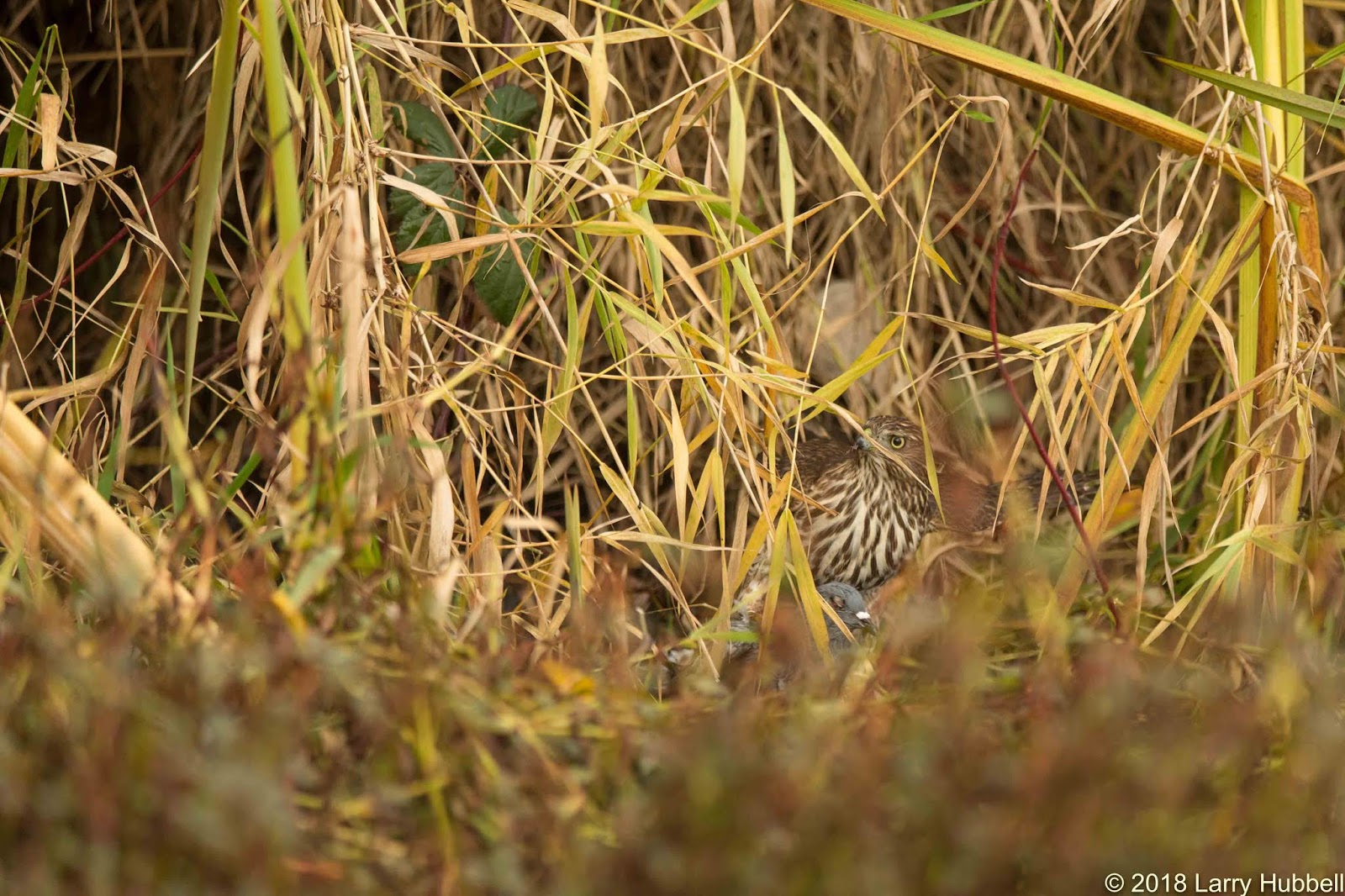
I assume, the Cooper's Hawk had just captured the Rock Pigeon, otherwise, there would have been a lot more feathers surrounding the scene.

The hawk mantled the prey, e.g. it used its wings and tail to hide the pigeon, while it continued to pluck feathers. Mantling reduces the chances of a larger predator seeing and stealing the meal. The list of creatures who could easily disturb a small hawk is long. At a minimum, it includes our local Bald Eagles, a passing Red-tailed Hawk, Gulls and of course American Crows. 


In addition, a Raccoon, a Coyote, a River Otter or even an off-leash Dog could easily scare a small, male Cooper's Hawk off of its prey. All of these potential interlopers have been seen around Union Bay. The hawk's cautionary instinct is not a frivolous behavior, however, the plucking seemed a bit presumptuous.


The plump pigeon was still actively objecting to the idea of being a belated Thanksgiving dinner for an inexperienced young hawk. Since a Rock Pigeon and a male Cooper's Hawk can be similar in weight the result of their interaction was not a foregone conclusion.

For the young hawk, a meal of this size might make the difference between surviving the winter, or not. The struggle continued. With each passing moment, the young hawk's predatory skills seemed to increase, while the odds for the pigeon decreased.

With a smaller bird, like a Dark-eyed Junco, the hawk's talons would be relatively longer. This would enable the hawk to quickly pierce a vital organ and dispatch the prey far more quickly and humanely. 

On the flip side, the similar size of the two birds still gave the pigeon a chance.

When another inadvertent pedestrian approached too close, the Cooper's Hawk momentarily released its prey. A larger or more experienced hawk might have attempted to carry its meal to an elevated perch. The large, horizontal, moss-covered branches of a Big-leaf Maple tree are prime feeding sites for experienced Cooper's Hawks. The upper branches of maple trees provide cover from airborne interlopers, while the elevation of the mid-level branches slows down the approach of most mammals.

Given a split second of respite, the pigeon flew. The pigeon's instincts were good. It dived into a nearby thicket of cattails, bushes and small trees. The hawk gave chase but the highly motivated pigeon dived deeply and hid well.

After about five minutes, the hungry young hawk popped out of the thicket with just one, small, downy feather stuck to its bill. 

The persistent little hawk seemed to consider its options while listening for any sound of the pigeon attempting to escape its fate. Given the hawk's persistence, I am thinking we should call him, 'Percy'.

After a few moments of rest, Percy turned and clearly considered resuming the hunt. From this angle, we can see that his crop, the area just below the throat, is still relatively small. The crop enables predatory birds to consume their prey, fairly quickly, before retiring to a safer location to digest their meal. Somewhat, similar to sitting on the couch and watching a football game after consuming your Thanksgiving Dinner. 

If you read last week's post, you know the vertical stripes on the chest of the hawk tell us this is a first-year bird, but how do we know it is a male. In this case, the answer is related to the 'jewelry' on the hawk's left leg.

This particular hawk was 'banded' by a team from the Urban Raptor Conservancy (URC) on July 17th, 2018, in Laurelhurst. Given that female raptors are generally larger than males, the team deduced this bird was a male Cooper's Hawk and banded it with a purple band on the left leg. With females, they use an orange band on the right leg.


****************

In addition to studying Cooper's Hawks and Peregrine Falcons, Ed Deal explains that the Urban Raptor Conservancy is embarking on a new project, 

'Right now our primary focus is on fundraising for our cooperative study with PAWS - testing dead raptors for rat poison residues. Our goal is to determine the baseline level of exposure in hawks and owls in Western WA......which has never been done.  We have enough money to send off a test batch of 5 samples to make sure all systems work.  We hope to get that done in the next week or two.  PAWS has 35 more samples in the deep freeze....at $100 a sample we have a lot of grant writing and fundraising ahead of us...'

Today, Cooper's Hawks, Barred Owls, Bald Eagles (and sometimes even pets) consume live rats who may carry rodenticides within their bloodstreams. The bioaccumulation of rodenticides can easily kill predatory creatures. A critical step to reducing this inadvertent destruction is to prove the frequency and existence of the poison. You can help by donating via the Urban Raptor Conservancy website, please Click Here.

****************


Percy dove back into the thicket.

Initially, he was visible among the many small red branches.

As he moved lower into the cattails he became harder to follow. Soon, he disappeared completely. An occasional abnormal wiggling of the cattails was the only clue that the hunt continued. I watched and waited.

Finally, more than twenty minutes, after the Rock Pigeon's escape, Percy appeared with the pigeon in tow.

As the young hawk began to eat I realized this was another unique opportunity. I wondered, How long would it take for a Cooper's Hawk to consume a full meal? Ten minutes passed.

By the way, I promise not to expose you to any of the more explicit photos.

Twenty minutes passed. Between each bite, the young hawk would raise up and check for potential intruders. Thirty minutes passed and the pace of his eating did not change.

After 50 minutes, the hawk's crop was quite visibly extended.

 I was beginning to wonder if Percy would ever get full.

Finally, after an hour of feeding, he took a few last looks at the remains of the meal before flying off to the northeast. Percy quickly disappeared in the direction of the Union Bay Natural Area.

It turns out that a full meal for a Cooper's Hawk is similar in length to a human lunch hour. Of course, about half of that time was spent watching for potential bullies and thieves. Surprisingly, while sitting on the ground and fully exposed, Percy ate the full meal without interruption. This was not the safest choice, but it worked. Percy still has a lot to learn but with continued luck and his natural persistence he has a chance to survive the coming winter. Please keep your eyes open and watch for Percy. The numbers on his purple band are '2' over '4'. 

Have a great day on Union Bay...where nature lives in the city!

Larry


Going Native:

Without a well-funded Environmental Protection Agency, it falls to each of us to be ever more vigilant in protecting our local environments. Native plants and trees encourage the largest diversity of lifeforms because of their long intertwined history with our local environment and native creatures. I have been told that even the microbes in the soil are native to each local landscape. My hope is that we can inspire ourselves, our neighbors and local businesses to respect native flora and to support native wildlife at every opportunity. I have learned that our most logical approach to native trees and plants (in order of priority) should be to:

1) Learn and leave established native flora undisturbed.
2) Remove invasive species and then wait to see if native plants begin to grow without assistance. (If natives plants start on their own, then these plants or trees are likely the most appropriate flora for the habitat.)
3) Scatter seeds from nearby native plants in a similar habitat.
4) If you feel you must add a new plant then select a native plant while considering how the plant fits with the specific habitat and understanding the plant's logical place in the normal succession of native plants.

My intention in my weekly post is to include at least one photo each week and visually challenge us to know the difference between native and non-native lifeforms.


What type of frog is this? Is it native to Union Bay? 


Scroll down for the answer.


***************


Frogs are not my area of expertise. However, I suspect the frog above is an American Bullfrog. They are not native to the West Coast. They are widespread and invasive. I believe they will even eat our smaller, native Pacific Tree Frogs.

Pacific Tree Frog


***************


The Email Challenge:

Over the years I have had many readers tell me that Google is no longer sending them email announcements regarding my posts. Even more frustrating when they go to 're-sign-up', hoping that will enable them to once again start receiving the announcements, they get a message which says 'Sorry, you are already signed up.' Google has not responded to my requests for help with this issue. 

My functional workaround is to set up my own email list and each week I manually send out a new post announcement. If you are experiencing the issue and would like to be added to my personal email list please send me an email requesting to be added. Thank you for your patience!


My email address is LDHubbell@comcast.net


*********************