Mission: To promote the appreciation of wildlife and increase harmony between humanity and nature.

On Instagram: @unionbaywatch

Sunday, July 9, 2017

The Ouzel's Eyelid

On Friday, above Snoqualmie Pass, this young bird begged for food. Did you notice how the yellow gape of the youngster provides a target for the parent.

Today, we call this species the American Dipper. I find this official name functional and appropriate. Dipper, describes the manner in which this species is almost constantly moving. They dip and dive below the surface of the churning white water while searching for food. They continue to flex their legs and dip their bodies anytime they momentarily stand on a rock, log, or shore. It is quite likely that any English-speaking person upon seeing this bird for the first time might call it a dipper. On the other hand, the name is not nearly as mysterious and musical as ouzel. 

In John Muir's writing, he, and others, referred to these birds as water-ouzels. No doubt this originated because our North American species behaves similarly to the european water-ouzel or dipper.  


John Muir's lengthy observations and poetic descriptions of this species' behavior are eloquent and beautiful. He clearly loved and respected water-ouzels. Mr. Muir stated, "The Ouzel alone of all birds dares to enter the white torrent. And though strictly terrestrial in structure, no other is so inseparably related to water, not even the duck, or the bold ocean albatross, or the stormy-petrel." You can read more of his work on the Sierra Club website.

The dipper's compact body, short tail, long strong toes, and powerful rounded wings are all adapted to searching for food while submerged underwater. This stream was filled with fresh snowmelt, only just slightly above freezing. Neither the cold, nor the force of the fast falling water deterred the dippers. I doubt any other species of North American bird would feed its young on a wet rock in the middle of such a cold, cascading, stream.

The day before, my friend Dave Galvin led us up above Red Pass. Dave is a man of many passions. I met Dave last fall when we both began the Seattle Audubon's Master Birder class. Last summer, Dave biked from the Pacific to the Atlantic ocean. (Click Here to read about the 5000 mile trip.) During the winter Dave likes to snowshoe and often ends up on top of Guye Peak - which is the symmetrical peak behind Dave. Dave also maintains the forest around the Sahalie Ski Club which is located on the south side of the peak.

Note: In the photo above, the light green meadows laying low in the distance are the Snoqualmie ski slopes.

At approximately 5000', there was only one small patch of snow left on the north side of Guye Peak. 

From Red Pass we also looked down on our camp, just to the right of the 'puddle' of melted snow. 

Given the dampness of the ground Dave suggested it had only been a few days since our campsite was completely covered in snow. It was quite clear where the water to feed the cold cascading streams was coming from.

It was less obvious where the water was headed. The size, scope and complexity of watersheds make they difficult to fully comprehend. Watersheds include all land which drains into a particular body of water. Generally, they center around rivers. As a result, watersheds seldom match our governmental boundaries. In fact, we often use rivers as visible boundaries - like the Columbia River between Oregon and Washington.

By cutting watersheds into pieces, e.g. cities, counties and states, we make the responsibility for managing the impact of humans on water extremely challenging. In my dream world, watersheds would be the basis for our governing organizations. In this fantasy, watershed, world, Snoqualmie Pass would be near the intersection of three 'states'.

We started our hike on the Pacific Crest Trail. In most areas, the snow melting on the east side of the trail flows down into the Yakima River, then into the Columbia and out to the Pacific. While snow or rain on the west side of the trail, flows into the Snoqualmie River which merges into the Snohomish and flows in to the Puget Sound, north of Everett. 

Just a mile or two southwest of Snoqualmie Pass, snow melts and flows into the Cedar River which in turn flows into Lake Washington. For the last 100 years, since the Montlake Cut was created, Lake Washington flows out through Union Bay and the Ballard Locks to Puget Sound. The same Cedar River also supplies our tap water in Seattle. 

The primary difference in water quality between our tap water and the water in Union Bay is the unintended metropolitan pollutants, with combined-sewer-overflows(CSO) being a prime example. Follow the CSO link to get a look at the scope of the issue.

Back at the stream we watched as the adult slipped into the cold swift water, to search for food. In John Muir's day I believe dippers where just as common in lowland streams as they are today in our pristine mountain flows.

Temporarily hidden from view, the adult is searching below the surface directly in front of its offspring. It appeared that the young one was calling loudly for more food but I doubt any living creature, including its parent, could hear the call above the noise of the rushing water.

From what I can ascertain, the only contrasting color, other than their pale legs, on an adult dipper is the white of their eyelids. On young birds there does appear to be some white on the trailing edge of their wings. Most likely, these white tips wear away soon after they enter the water and begin searching for food on their own.

It seems to me that if the bio-region concept of Cascadia takes hold, the most appropriate 'regional bird' might be the water-ouzel. After all, it is apparently the only bird to feed, live, and reproduce, full-time, in the cascading streams of the mountains which are central to this region. 

Note: The proposed bio-region of Cascadia, containing Oregon, Washington and British Columbia, would at least unite most of the Columbia River watershed into a single governmental entity.

If you happen to get away from the shores of Union Bay, I suggest searching for a fast flowing stream, the beautifully adapted water-ouzel, and the momentary flash of its bright, white eyelid.

Have a great day!

Larry

Going Native:

Without a well-funded Environmental Protection Agency, it falls to each of us to be ever more vigilant in protecting our local environments. Native plants and trees encourage the largest diversity of lifeforms because of their long intertwined history with local, native creatures. I have been told that even the microbes in the soil are native to each local landscape. My hope is that we can inspire ourselves, our neighbors and local businesses to plant native flora and to support native wildlife at every opportunity. My intention is to include at least one photo each week and visually challenge us to know the difference between native and non-native lifeforms.

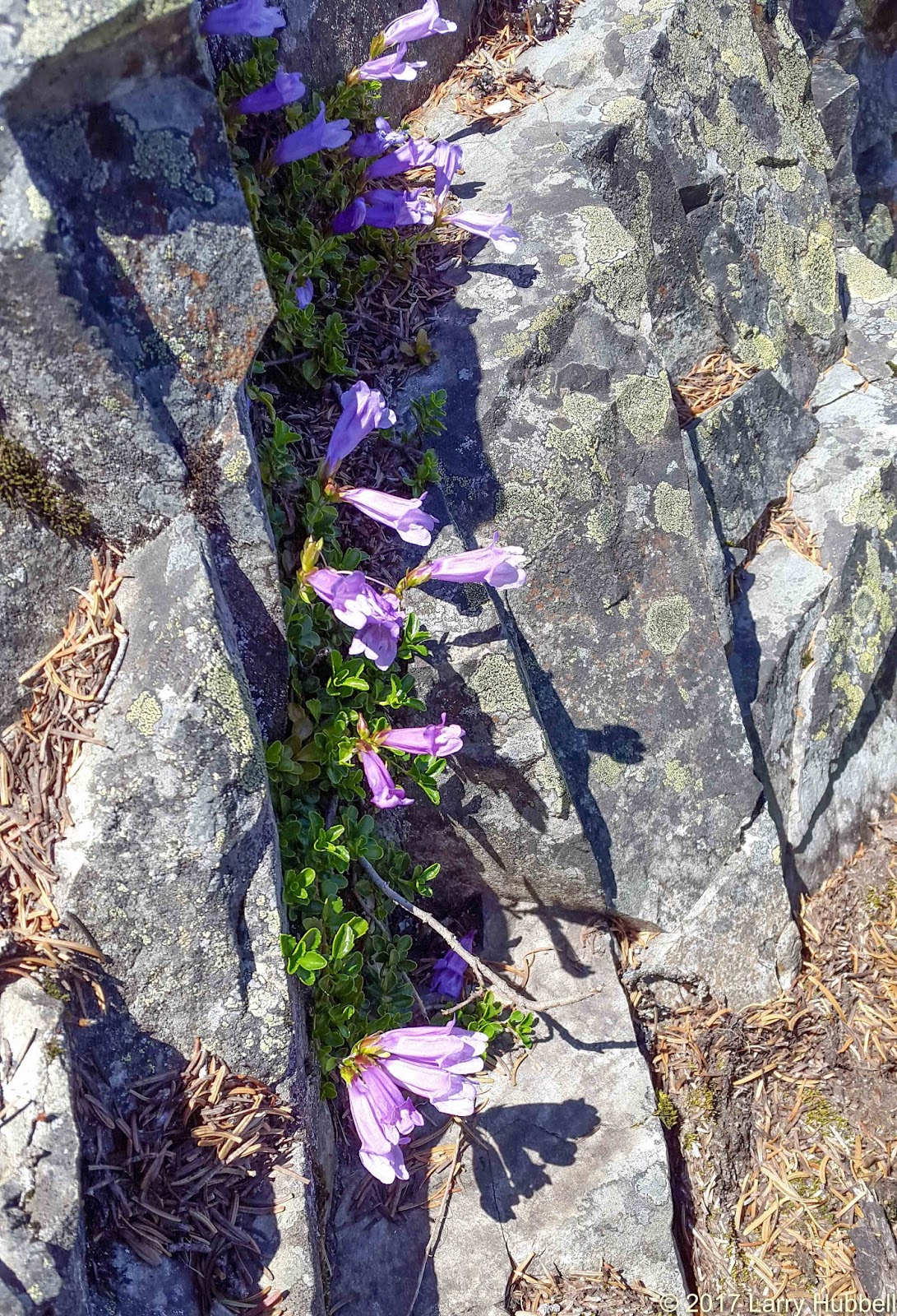
In addition to his many other skills, Dave Galvin has also learned many of the native flowers which can be found soon after the snow melts in our Cascade Mountains. Here are a few examples. Do you know their names?

A)

B)

C)

D)


************

Scroll down for the answers

*************


I must preface the answers by saying I am relying on my hearing and note taking - both of which can be suspect - to relay Dave's names of these flowers. If there are any errors in the naming I am sure it is mine.


A) Wild Strawberry (Frageria sp.)
B) Primarily Spreading Phlox (Phlox diffusa) with some Indian Paintbrush (Castilleja sp.)
C) Creeping Penstamon (Penstemon Davidsonii)
D) Pink Mountain Heather (Phyllodoce empetriformis)


Sunday, July 2, 2017

Diamonds Are Optional

A lot can happen in a year. Chester and Lacey are now experienced Union Bay breeders. You can read about their unique, potentially first in a hundred years, experience in the post 'Something to Celebrate'. Since then they have separately completed their fall and spring migrations, covering thousands of miles. According to All About Birds osprey may fly as much as ten thousand miles per year. Chester and Lacey have returned to their Union Bay nest site and each other. Plus, Lacey started sitting on eggs around May 15th - just like last year. 

Currently, Lacey spends most of her time in the nest. Occasionally, she takes brief breaks. Sometimes, she flies figure eights around the nest to temporarily escape her maternal confinement. Last week, while Chester guarded the nest, Lacey flew over and snagged another dead branch to continue elevating the exterior of their avian nursery (see the photo above).

This photo was taken last year on July 10th. Given that Lacey began sitting at about the same time this year, we may be able to see the young in the nest sometime in the next week. According to All About Birds their incubation period is between 36 to 42 days. They are almost certainly beyond that time frame.

Most likely the young have already hatched and are simply not yet strong enough to hold their heads above the edge of the ever-rising nest. Clearly, the visibility bar is being raised this year. Notice the growth of the nest between this photo from last year and the current photos.

This year, Chester is once again consistently bringing food to the nest. This photo from last week, is an example of his hard work and willingness to put the family's well-being ahead of his own. He will often deliver food to the nest, then go back out and catch his own food before finally returning to sit nearby and eat.

This morning, Chester delivered a fish as usual. Lacey ate and possiby fed the young. The process was hidden to me. Finally, it appeared that Lacey covered the young to protect them from the early morning chill and seemed to settle in for some quiet time. 

During this time Chester had been watching from a nearby cottonwood tree. He often guards the nest from that elevated position. If Lacey sees a potential threat she will call out sharply and Chester will be the first to take to the air to defend the nest. 

While Lacey was resting quietly, Chester came to life and flew over to the nest. He landed, looked Lacey in the eye, and then picked up the remains of the fish and flew away to feed himself. In someways it was a rather brave maneuver because the female osprey can be as much twice as large as a male. They can also be rather possessive, especially of food intended for their young. Maybe it it is a sign that Lacey trusts Chester and his ability to deliver food. In any case, it is an osprey behavior I have never seen before.

An easy way to tell Lacey and Chester apart is by looking at their chests. Lacey has a dark 'necklace' which is scattered across her upper chest. Chester, in keeping with his name, has a chest of pure white

Chester and Lacey are particularly sensitive to any potential harassment from other predatory birds. Bald eagles, red-tailed hawks and even other osprey are consistently consider a threat.

This week, I watched Chester and Lacey escort a wandering and confused young eagle out of their airspace. I am sure the first-year eagle was much happier when it escaped their frantic attention and finally reached the Laurelhurst neighborhood.

Last October, I watched their daughter Kate chase off a red-tailed hawk, all by herself. Last summer I watched the parents drive off every eagle within eyesight and any other osprey which attempted to fly near the nest.

You can imagine my surprise when last week a third osprey came and landed in the nest. Even more astonishing was the lack of reaction from Chester and Lacey. They did not appear to be at all concerned. The only other osprey I have ever seen in their nest were their own young.

Can you see any differences between the bird above and Chester and Lacey? Personally, I think the neck on this third bird seems a bit more slender. Also, the thin delicate necklace is clearly different. It is much lighter than Lacey's necklace, while also unlike Chester's unmarked chest.

Here is a good view of Chester's chest, just prior to dropping off a delivery of sushi for Lacey's lunch.

The top of the third bird's head is also patterned differently than Chester or Lacey. Last year, Jim Kaiser, the osprey biologist who designed, built, and installed this nesting platform, told me about a study in Europe which demonstrated that osprey can be uniquely identified by the patterns on top of their heads. 

Chester and Lacey's mild-mannered acceptance of this third bird makes me think that it must be one of their offspring. The necklace implies the bird is most likely female. Last year, Chester and Lacey successfully raised three young. They had two males, which we called Wilbur and Orville, and a third sibling, their sister who we call Kate. In the prior year (2015), Chester and Lacey did not complete a nest and did not have any young. 

In Birds of North America (BNA) it says, 'Band returns (Henny and Van Velzen 1972, Poole and Agler 1987, Ewins and Houston 1992) and sightings of individuals on overwintering areas during the northern summer indicate first-year birds remain on overwintering grounds ca. 18 mo, only returning in their third calendar year. Osprey very rarely return to breeding grounds in the spring following their first migration south (AFP; M. McMillian, personal communication).'

All things considered, my best guess is that the third bird must be Kate. I can think of no other rational explanation for their combined behavior.

This photo was taken on October the 3rd, 2016 it shows a lonely Kate, all by herself. This photo was taken just prior to her migration south. She was the last of the five osprey to leave Union Bay. Possibly her hesitance to leave implies that she has a strong attachment to Union Bay. Maybe a special bond with her birthplace has brought her back. 

Some could argue that the pattern of Kate's coloring looks a bit different this year. I agree. My supposition is that she has completely replaced her juvenile plumage with slightly different patterns and colors. Frankly, I have no way to be positive whether the observed differences between the 2016 version of Kate and this year's third bird are consistent with normal osprey development.

There is however one thing of which I am fairly certain, whether our third bird is Kate or Not-Kate it seems only logical to conclude it is a member of Chester and Lacey's family. Most likely it has returned, in its first year, to the place of its birth (or hatching). If so, then it is, by the BNA definition, a rare bird behavior. 

Have a great day on Union Bay...where with luck you may see Kate in the sky - diamonds are optional!

*****************

Update:


Breaking news just in from Doug Parrott:

Hi Larry,

I was at the Fill this am (Sunday) and there are as least two chicks in the Osprey nest. Their timing is just about right on from last year. By the way another great post. Attached photo from today.

Best,
Doug

Photo by Doug Parrot - July 2nd, 2017
Thank you! Doug


*****************


Have a great day on Union Bay!

Larry


Going Native:

Without a well-funded Environmental Protection Agency, it falls to each of us to be ever more vigilant in protecting our local environments. Native plants and trees encourage the largest diversity of lifeforms because of their long intertwined history with local, native creatures. I have been told that even the microbes in the soil are native to each local landscape. My hope is that we can inspire ourselves, our neighbors and local businesses to plant native flora and to support native wildlife at every opportunity. My intention is to include at least one photo each week and visually challenge us to know the difference between native and non-native lifeforms. 


************

Scroll down for the answer

*************


Garden Loosestrife


This yellow invader is currently blooming in the Union Bay Natural Area. It spreads not just via the flowers but more importantly and invasively via the root system. The folks at the UW Botanical Gardens are stuck between a rock and a hard place. They do not have enough resources to eradicate the weed manually and the only cost effective means of controlling the weed is therefore an herbicide.


Recommended Citation

Bierregaard, Richard O., Alan F. Poole, Mark S. Martell, Peter Pyle and Michael A. Patten.(2016).Osprey (Pandion haliaetus), The Birds of North America (P. G. Rodewald, Ed.). Ithaca: Cornell Lab of Ornithology; Retrieved from the Birds of North America: https://birdsna.org/Species-Account/bna/species/osprey


Saturday, June 24, 2017

Elderberry Whine

In early April, Goldie was looking well kept and healthy. I call her Goldie because of the golden feathers on her forehead. I find her to be a rather mysterious bird. In Birds of North America (BNA) it states, 

'Female...forehead to mid-crown generally appearing grayish or brownish but possibly tending toward yellow-brown in older birds.' 

This seems to imply that Goldie is an older bird. 

Note: You can view the BNA citation and credit at the end of this post,

Chip and Goldie feeding near their potential 2017 nest site.

Goldie is Chip's new mate. She's also new to his, and now their, Union Bay territory. His  previous mate, Storm, was mysterious in her own right, primarily because of her bright red irises. 

Thank You to the many readers who responded to my earlier request for photos showing the iris color of mature female pileated woodpeckers. Your responses have helped me to document that red-eyed pileated woodpeckers (including one male) exist between Union Bay and the Alderwood Mall area. All other documented photos and sightings I have been sent, both inside and outside of the Alderwood-to-Union Bay corridor, show only yellow irises on mature pileated woodpeckers. 

The primary exceptions are:

a) Very young birds with blue/gray irises which generally appear very dark except when in bright sunlight.

b) Brown or yellow-brownish irises in apparently juvenile or first-year females and

c) Goldie and Storm

In BNA the following statement is made regarding iris color, 

'Brown in Juveniles and first-year females; brownish yellow in first year males (B.L. Noel pers. comm.); yellow to golden in adult males and some females. Not known when iris in some females changes to yellow.'

I have photos showing that Storm's irises were red for at least three years. During which time she was obviously mature since each year she laid eggs and raised young. This is a situation which is at the least undocumented in BNA. You can see more photos of Storm and her young by clicking here.

Goldie's mystery is, how can she have a yellow/golden forehead, which is supposed to indicate she is an older bird, while she also has brown irises which, theoretically, indicate she is a first-year bird. I am trying to catch photos of Goldie on a regular basis so we can watch to see when and if her eye color ever changes to yellow or red.

In late March, Chip showed Goldie his progress on his partially finished new nest site.

In early April, Chip continued the construction process. You can read more about how important woodpeckers and standing snags are to our local wildlife by Clicking Here.

Here is one of my best, well-lit photos of Goldie's brown irises from around the same date.

A few days later, Goldie was in the nest and inspecting the surroundings. I suspect she laid her eggs sometime during the next few weeks.

It was the end of May before I actually saw a young bird. I am thinking it takes about a month for incubation and a few days after hatching for young birds to gain enough strength to stand at the entry hole and begin begging for food.

The next day I saw Chip leaving the nest with a very large fecal pouch. Clearly, parenting was under way. At this point I had only seen the one young bird and I was curious if there were more.

Within a couple of days, the young bird appeared to grow stronger and his colors became more vibrant. From the distribution of the colors it was obvious he was a male.

Two days later all three siblings appeared at the entry and began begging for food. The size and brighter colors implied to me that one of the males was clearly the elder sibling.

In this photo we can see some of the differences between the two young males. The red on the lower and larger bird is slightly brighter. There are also differences in the white of their superciliums, e.g. eye-lines. In the older male, who I started thinking of as 'Lewis', the thin white markings end behind the eye. In the younger male, who I call 'Clark', the white line actually terminates above the middle of the eye.

The same markings are consistently visible in this photo. We see Chip feeding Lewis on the left, while Goldie is feeding Clark on the right. This was the first time I ever remember seeing two adults feeding two different young at the same time. I think this may have happened because of the size of this snag. The mostly dead tree is large enough that both adults can perch and feed the young without being hidden behind the curvature of the trunk.

On the same day Chip also fed the young female. I have been calling her, 'Gawea', short for Sacagawea. Gawea has had a challenging time competing for food with her brothers. This was also the first time I have ever seen a young pileated turn upside down in a bid to be fed. There is no arguing with success.

The next day, in another first for me, I found Chip collecting red elderberries.

My immediate thought was, Is he eating the little red berries or collecting them to feed to the young?

Twenty minutes later, I saw Goldie bringing food to the nest. She was looking decidedly wet and unkept. The strain of finding food and feeding three young looked like it was beginning to show.

Ten minutes later, Chip answered my earlier question. Beside the white remnants of larva on his bill, he had also clearly regurgitated at least one of the red elderberries to feed to Lewis and Gawea. If you have not noticed, the female pileated woodpeckers do not have red on their foreheads or cheeks.

In this particular case, Gawea is pinned down and unable to get her share of the food.

My biggest pileated surprise happened last Saturday morning. I was laying in bed when I heard the call of a pileated outside my window. I rushed to the back deck and followed the sound, which was repeated multiple times. Across the fence, in the back yard of my neighbor, was Lewis the young pileated. He was clearly calling for his parents to bring him food.

This was my first notice that any of the young woodpeckers had fledged e.g. learned to fly. I knew he was at least a quarter of a mile from the nest. I doubted the parents could hear him, especially if they remained near his potentially unfledged siblings. I put a few blueberries out where Lewis could see them, but they only attracted crows.

An hour later I headed for the pileated nest hoping to determine if Clark and Gawea had also fledged. Two blocks from home I heard a pileated again and turned to find three of them on a telephone pole.

A closer inspection showed it was Lewis who was being fed by Goldie. You might want to notice the difference in the color of their red top knots. I find it is also interesting to see the difference in their 'black' feathers as well. Being fresh from the nest, Lewis has not been exposed to much sunlight or weather. This, and that fact that he and his feathers are much younger, has kept his feathers darker and obviously more fresh than Goldie's.

I found Clark in the nest. He was calling for food on an average of about once every thirty seconds. 

After about an hour, Chip finally arrived with food. Apparently Gawea had already left the nest. At this point not only do the parents have to feed themselves and three young, they also have to locate the young and potentially fly to three different locations to deliver food. An end to their ordeal is almost in sight. The young will now slowly begin to feed themselves, however I have seen young in the field being fed by parents as late as August.

On Saturday afternoon, I once again heard Lewis on my neighbor's property. This time he was on a telephone pole in the front yard - still begging for food.

Within two days Clark was gone and the nest has been silent ever since. I think the frequency of the young pileated calls for food steadily increases as they get closer and closer to fledging. The begging wasn't exactly a whining sound to me but it certainly seemed emotionally similar, which is why I titled this post, Elderberry Whine.

Have a great day on Union Bay...where woodpeckers whine in the city!

Larry

Going Native:

Without a well-funded Environmental Protection Agency, it falls to each of us to be ever more vigilant in protecting our local environments. Native plants and trees encourage the largest diversity of lifeforms because of their long intertwined history with local, native creatures. I have been told that even the microbes in the soil are native to each local landscape. My hope is that we can inspire ourselves, our neighbors and local businesses to plant native flora and to support native wildlife at every opportunity. My intention is to include at least one photo each week and visually challenge us to know the difference between native and non-native lifeforms. 


************

Scroll down for the answer

*************


Red Elderberry

This is one of my favorite native plants. Lately, I have seen band-tailed pigeons and crows eating the berries, as well as the pileated woodpeckers. You should read the literature very carefully before deciding whether or not to eat the berries. It seems to me nature made them red for a reason. I choose to leave them for the birds.


Recommended Citation

Bull, Evelyn L. and Jerome A. Jackson.(2011).Pileated Woodpecker (Dryocopus pileatus), The Birds of North America (P. G. Rodewald, Ed.). Ithaca: Cornell Lab of Ornithology; Retrieved from the Birds of North America: https://birdsna.org/Species-Account/bna/species/pilwoo