Mission: To promote the appreciation of wildlife and increase harmony between humanity and nature.

On Instagram: @unionbaywatch

Friday, August 23, 2024

Born To Fly

By April 15th, 2024 Stewart (on the left) and Hope (on the right) had returned to their nest site, at the University of Washington, IntraMural Activity field number three (i.e. IMA3), north of Union Bay, in Seattle, WA. This is their sixth year of egg-laying at this site and their sixth and a half year of nest building. Click Here to read more about their early efforts.

Assuming no fatal accidents or illnesses, they are most likely the same two individuals that we observed attempting to build their first nest, at this location in 2018. The fact that the Osprey have a strong sense of site fidelity and generally live 15 to 20 years helps to support this assumption.

Females on average weigh nearly twenty percent more than males. Their size alone implies that Hope, on the right, is the female. Also, with mature Osprey the females typically have some dark brown streaks or spots on the chest and males usually don't. These characteristics are also apparent in the photo. In addition, they have different reproductive roles, which are generally gender specific.

The male is expected to deliver fish to the nest, and both genders work on nest building, although the males may initially do more, and ultimately, the female spends much more time at the nest, laying eggs, incubating, and later feeding the young.

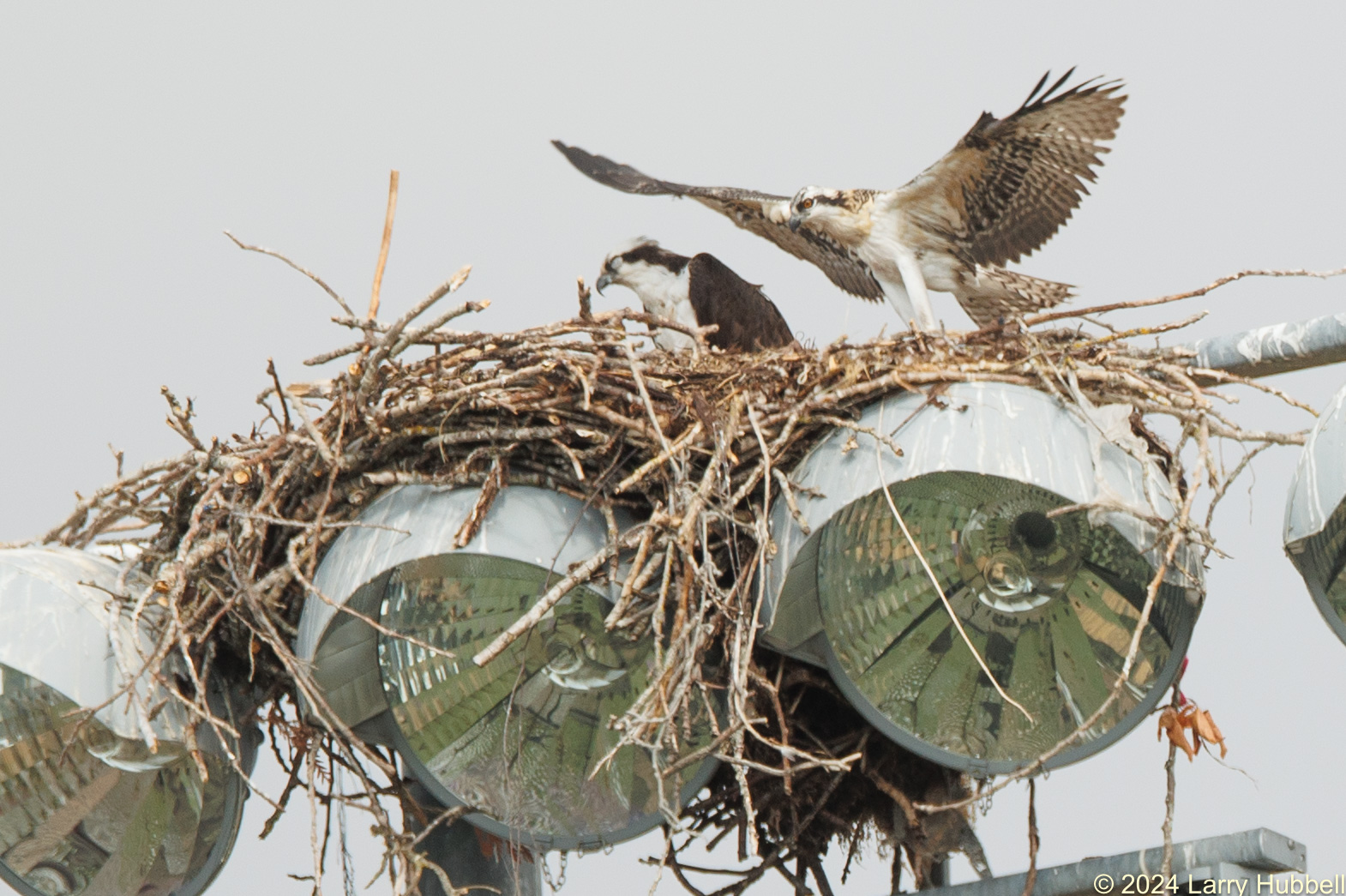
In this photo, Stewart was taking to the air to go find food. Osprey typically dine on fish. I have heard they will occasionally eat other small creatures but so far I have never seen that happen.

You might want to notice the size of their nest. In mid-April, it was still primarily confined to the area between the second and third lights from the right.

I remember hearing Hope begging Stewart for food. It would not have surprised me to see Stewart bring back food and use it to inspire Hope to mate with him. Click Here to see how that was done by the previous pair that historically nested just to the south in the Union Bay Natural Area.

However, when Stewart returned with his catch he seemed indifferent to Hope's hunger as he settled on a nearby light pole he looked over at Hope with his catch in full view.

Then he turned his back and proceeded to carefully consume his fish. 

I do not understand his logic. Maybe he needed to keep his strength up and was preparing to make another run to secure food for Hope. However, if that was the case, why not eat somewhere hidden from Hope? Clearly, Stewart does not think like me. 

Three months later, here is Stewart bringing a fish to the nest for Hope and one of their offspring. Evidently, Stewart successfully managed his relationship with Hope because they created offspring.

During the intervening months not only were eggs laid, incubated, and hatched but the nest also grew, dramatically.

Last week, Hope was still bringing sticks to the nest.

Also last week, one of their young could still be seen flexing its wings, gaining strength, and preparing to fly. Counting how many young Hope and Stewart produce is always challenging. Their nest is large and positioned on top of a very tall light pole. Young ones resting in the middle of the nest are completely hidden from the ground.

This time of year the young birds of most other species have already learned to fly and are learning to find their food. 

Since Osprey migrate, from Mexico, in the Spring their nest-building, egg-laying, etc. typically happens later than it does among our larger resident birds. As a result, the young of the Common Ravens, Barred Owls, and Bald Eagles are all out of their nests by now. On the other hand, when this photo was taken on August 14th, this young Osprey was still doing flight prep.

The young one is smaller than Hope. In addition to its size, there are other clues to its youth.

Update: My friend Martin Muller has pointed out that at this stage, when the young are ready to leave the nest, they are full-grown. In which case its size does not indicate youth but rather that it is a male.  


One of the most beautiful is the color of its irises. I find the orange coloring of a young bird's eyes particularly appealing.

The young bird's wing flaps close to Hope's head, but does not scare her into moving away.

However, Hope is smart enough to close her outer eyelid. 

Unlike ours, the eyelids of Osprey close from the bottom up. I suspect this arrangement is particularly helpful when a fish is wiggling about and hoping to make a last-second escape. I would think closing their eyes from the bottom up protects them a split second sooner than our top-down approach.

With enough food, patience and practice young birds learn to lift off and fly. 

However, learning where to land is another challenge. This young one quickly exchanged feet on top of this slender snag as the wood wiggled back and forth. It rapidly and repeatedly reached out and retracted its wings, trying to find a peaceful balance.

However, after a few seconds of intense effort, the young one departed, apparently aiming for a more stable substrate.

Here is another example of a young one trying to land on one of the slender wires surrounding the soccer field just below the nest.

Finally, here is one a few days later trying to perch on a wire on the south side of the U-Village parking garage. It eventually hopped over and stood on the top of the building. Clearly, figuring out where to land is a learning process. This type of behavior is another indicator of youth.

In flight, when viewed from above, the dark brown feathers on a fledgling's back and wings display long rows of white tips that show where each layer of feathers ends. The layering looks and functions similar to shingles on a roof. Since the arrangement of bird feathers is far more ancient than shingles, I suspect shingles may have been inspired by feathers.

Among mature Osprey the white tips on their feathers have worn away or been replaced with totally dark feathers, which makes the layering much harder to see.

When looking at the underside of the young ones, you may notice a tawny tinge of color on their white feathers. 

With adults, their white feathers are much "cleaner". The contrast between their light and dark coloring is quite crisp.

When the more mature young, who had already learned to fly, noticed Stewart heading toward the nest with a food, they quickly returned.

It was almost a family reunion...

... and when Stewart arrived, momentarily, the full family of five was reunited.

Seconds later a Great Blue Heron happened to pass over, high above the nest.

When Stewart took to the air, the Heron realized its mistake. It tried to speed up and change course, but Herons are not particularly quick.

Soon, Stewart caught up and chased the Heron away to the south. I lost sight of them when they both dropped below the tree line in the direction of Husky Stadium. I doubt Stewart attacked the Heron, but I suspect the Heron will not fly near the Osprey nest anytime soon.

One lucky youngster was "hand-fed" bite-sized pieces by Hope.

My friend Ronda, who watches the nest daily, sees the young more clearly than I do. She has named them Celine, Cyril, and Carmel. We saw Celine and Cyril flying about and playing chase with each other last week. Just this week Ronda reported Carmel is finally flying too.

In the early Fall adult females are usually the first to head south, they are followed by the adult males. Curiously, the young migrate south all on their own and without any previous experience. Click Here to see how the annual Osprey migration plays out on the animated eBird weekly abundance map. (Push the white arrow on the bottom to get it moving.)

If you want to see the young in flight or test your ability to pick out the young versus the adults, I would suggest visiting the IMA3 field soon. A month from now, the whole family could be gone for the Winter.

Have a great day on Union Bay...where nature lives in the city and Black Birders are welcome!

Larry


Going Native:

Each of us, who breathes the air, drinks water, and eats food should be helping to protect our environment. Local efforts are most effective and sustainable. Native plants and trees encourage the largest diversity of lifeforms because of their long intertwined history with our local environment and the local native creatures. Even the microbes in the soil are native to each local landscape. 

I hope we can inspire ourselves, our neighbors, and local businesses to respect native flora and support native wildlife at every opportunity. I have learned that our most logical approach to native trees and plants (in order of priority) should be to:

1) Learn and leave established native flora undisturbed.
2) Remove invasive species and then wait to see if native plants begin to grow without assistance. (When native plants start on their own, then these plants or trees are likely the most appropriate flora for the habitat.)
3) Scatter seeds from nearby native plants in a similar habitat.
4) If you feel you must add a new plant then select a native plant while considering how the plant fits with the specific habitat and understanding the plant's logical place in the normal succession of native plants. 

*************** 

Keystone native plants are an important new idea. Douglas Tallamy, in the book "Nature's Best Hope ", explains that caterpillars supply more energy to birds, particularly young birds in their nests, than any other plant eater. He also mentions that 14% of our native plants, i.e. Keystone Plants, provide food for 90% of our caterpillars. This unique subset of native plants and trees enables critical moths, butterflies, and caterpillars that in turn provide food for the great majority of birds, especially during the breeding season. 

Note: Flowering plants and trees, i.e. those pollinated by bees, are also included as Keystone Plants.

This video explains the native keystone plants very nicely:

https://www.youtube.com/watch?v=O5cXccWx030


The Top Keystone Genera in our ecoregion i.e. Plants and trees you might want in your yard: 

Click Here


Additional content available here:

https://wos.org/wos-wp/wp-content/uploads/2022/10/Native-Plant-Resources-10-7-22.pdf


******************

In the area below, I am displaying at least one photo with each post to help challenge us to know the difference between native and non-native lifeforms. 

One of the following two flowers is native (Common Yarrow) and one is not (Queen Anne's Lace). Can you tell which is which?


Is this a native flower?

Is this a native flower?


Scroll down for the answer.


******************


Thank you to Whitney for pointing out the differences between these two plants!


Common Yarrow: (In the first photo.)

Yes. It is a native plant. There are records of a wide variety of medicinal uses which you can read about by Clicking Here. This same USFS post is also my source for learning that it is sometimes referred to as Milfoil. This must stem from the second half of its Latin name, "Achillea Millefolium" which means "having a thousand leaves." I think the frilly little leaflets in the photo certainly reinforce that definition. Click Here to see information from the Burke Museum.

This can be found south of the Friends of Arboretum Creek visioning site along the Loop Trial in the Arboretum, i.e. north of Parking Lot #19.

Queen Anne's Lace:  (In the second photo.)

This plant was introduced from Europe and is considered a weed by King County. It can be found around the IMA3 field below the Osprey nest. While very similar to Common Yarrow one easy difference is the relative sparsity of leaves. Click Here to see information from the Burke Museum.


*****************


The Email Challenge:


Over the years, I have had many readers tell me that Google is no longer sending them email announcements. As of 2021,
 Google has discontinued the service.

In response, I have set up my own email list. With each post, I will manually send out an announcement. If you would like to be added to my personal email list please send me an email requesting to be added. Something like:

                Larry, Please add me to your personal email list. 

My email address is:  

                     LDHubbell@comcast.net

Thank you!


*******************


The Comment Challenge:

Another common issue is losing your input while attempting to leave a comment on this blog. Often everything functions fine, however, sometimes people are unable to make it past the robot-detection challenge or maybe it is the lack of a Google account. I am uncertain about the precise issue. Sadly, a person can lose their comment with no recovery recourse. 
Bottom Line: 
If you write a long comment, please, copy it before hitting enter. Then, if the comment function fails to record your information, you can send the comment directly to me using email.
My email address is:  

                     LDHubbell@comcast.net

Sincerely,

Larry


Tuesday, July 30, 2024

Tree Hawks

This adult Cooper's Hawk was seen circling above Montlake Cut in March of last year. It may seem strange to think of a bird in an empty sky as a "tree hawk" but even when soaring high overhead the shape of its body provides clues about its capabilities. 

For example, their fairly small size and relatively short rounded wings enable them to fly between tree trunks and branches that larger birds, like Red-tailed Hawks and Common Ravens, find challenging to navigate. (Cooper's Hawks are similar in size to American Crows.) Their long tails enable them to twist and turn quickly, which helps them follow small prey through dense foliage and underbrush. 

Not only do Cooper's Hawks often hunt in wooded areas locally they generally mate, build nests, hatch their eggs and raise their young in and among trees. The Arboretum is a perfect example. However, Cooper's Hawks are not all precisely the same. Individuals and their choices vary. For example, Cooper's Hawks nest in all 48 of the lower continental United States. I am sure that they must somehow survive in places where trees are scarce. Still, they do seem most perfectly adapted for life among trees.

For the last month, friends and I, have been seeing young Cooper's Hawks in the Arboretum. Many questions come to mind, How many are there? Where did they nest? Will the parents nest here next year? When folks see a young hawk laying on a limb, like the one in this photo,  they ask, What is it doing? Is that normal?

I don't remember ever seeing a mature Cooper's Hawk belly-down in the middle of a branch. 

I suspect among the young ones this is a carryover habit from spending time lying down in the nest. By Fall, when they are out hunting on their own, and their parental food supply has been terminated, I expect this habit will be forgotten. Among adults, I only remember seeing them in a somewhat similar horizontal position during mating and brooding.

By the way, the white spots on the back of a Cooper's Hawk are one of the indications of youth. The spots imply it either hatched this year or at most last year. My friend Martin, from Urban Raptor Conservancy, says that by the end of August, during their second year, the spots are typically gone.

Here is an example of an adult Cooper's Hawk with a relatively spotless back.

Vertical dark brown spots on the chest are another indication of youth. 
(Note: This is the same bird that you will see later with ruffled feathers.)

Among adult Cooper's Hawks, their chests have a horizontal orange barring. Their eyes seem to transition over time. The more mature birds seem to have vibrant orange irises that sometimes even deepen into a stunning red.

Among the youngest, i.e. a few months old, the eyes often reflect a sky-blue color. However, sometimes, I wonder if I am seeing a very pale green or yellow reflection instead.

Later, as they approach maturity and for a while thereafter their irises appear to go through a brighter yellow stage. This particular young one was spotted in early Spring among some trees next to Useless Bay on Whidbey Island. (The March wind, blowing in off the Sound, provided a perfect example of having one's feathers ruffled.) Seeing the spots on this bird in March implied it hatched out in the previous year and was nearing one year old, at the time this photo was taken.

This same Whidbey Island bird was clearly hunting on its own as I watched it eat a small bird and then catch and consume the bat that it was holding in this photo.

*************

Thank you to Sarah Schmidt who suggested this might be a Big Brown Bat, but she wasn't positive. She explained that there are a total of nine species of bats in our area.

I was also surprised to learn from Sarah about the variety of winter survival strategies among local bat species. One species migrates south when the weather gets cold, some hang around and survive via torpor i.e. slowing their metabolism, and other species choose to hibernate.

*************

This young female, photographed in the Arboretum in April of last year, was also in her second calendar year, i.e. about one year old, and with spots on her back and yellow eyes. Nonetheless, she appeared to lay eggs, incubate, and hatch multiple young last year. This conclusion was easier to establish because she was caught and banded with an orange bracelet, with the code 8/U, in 2023. Thank you, Martin!

Although this photo does not show perfect proof, I believe this is the same female, because I have repeatedly seen her "8/U" bracelet. Here, she was in the same general area of the Arboretum as last year, but sitting above her new 2024 nest. This year, she once again appeared to lay eggs, incubate and hatch out young. If I am right, it is her offspring you will be seeing in the following photos. Did you notice how at two years old she now has her adult plumage?

Last week, my friend, Jeff Graham, found another way that young Cooper's Hawks interact with the trees, or at least potential trees, in the Arboretum. 

Click Here to see Jeff's video.


The next morning, I also found one of the young stalking pine cones. Apparently, it is great practice for future hunters.

Soon, there were two more siblings, chasing after the first one. I am guessing they might have been wondering, What have you caught? Is it good to eat? Can we steal some? 

The bird in the back is holding its head at a most curious angle. Of course, it is difficult to know if what looks like curiosity in a bird is related to the feeling we have when we hold our heads at an angle.

A few days later I found one of the smaller siblings nearby. The "tell-tail" sign seems to suggest it was eating a rat. 

If you haven't read about rats and the impact of rodenticides please Click Here and review the research being done by the Urban Raptor Conservancy. I also really like the idea that raptors are the solution.

In the same tree on the next branch above it, a larger sibling (probably a female) was keeping a close watch on the feeding process. I was expecting that the upper bird might make a grab for a portion of the food, or push the smaller sibling to the side and take it all.

However, to my complete surprise, the larger bird quietly descended and calmly landed next to the smaller hawk. 

The larger bird then grabbed a bill full of feathers from the smaller bird's chest.

It held the feathers for two or three seconds, which seemed like a surprisingly long time. After it let go both birds seemed to cock their heads to one side as if wondering, "What was that about?"

Next, the smaller bird extended its right wing, but it did not seem like a fearful reaction or an attempt to flee, it looked like it was just regaining its balance. 

Then both birds settled back down and remained seated side by side. I don't know why the second bird grabbed the feathers. Was it allopreening? (Which is when one bird grooms another.) Did the larger bird spot a tiny morsel of food, which it removed from the feathers? Was it really trying to intimidate the other bird and steal some leftovers? I find that unanswered questions are just part of the intrigue, mystery, and allure of nature. 

In any case, these young Cooper's Hawk siblings seem to be amazingly close and friendly with each other.

A few days earlier, I was finally able to get a count of the siblings. Due to the huge crop full of food, i.e. the visible bump below its chin, this one had, evidently, just finished eating. Another was continuing to eat while others were coming and going in nearby branches.

Finally, I caught these three sitting in a single Vine Maple tree, while a fourth stalked among the ferns below. 

At the same time, a fifth sibling continued to eat on a horizontal branch in a nearby tree. 

I am now fairly certain that this year there are at least five young Cooper's Hawks growing up (and occasionally hunting pine cones) among the trees in the Arboretum.

Have a great day on Union Bay...where nature lives in the city and Black Birders are welcome!

Larry


Going Native:

Each of us, who breathes the air, drinks water, and eats food should be helping to protect our environment. Local efforts are most effective and sustainable. Native plants and trees encourage the largest diversity of lifeforms because of their long intertwined history with our local environment and the local native creatures. Even the microbes in the soil are native to each local landscape. 

I hope we can inspire ourselves, our neighbors, and local businesses to respect native flora and support native wildlife at every opportunity. I have learned that our most logical approach to native trees and plants (in order of priority) should be to:

1) Learn and leave established native flora undisturbed.
2) Remove invasive species and then wait to see if native plants begin to grow without assistance. (When native plants start on their own, then these plants or trees are likely the most appropriate flora for the habitat.)
3) Scatter seeds from nearby native plants in a similar habitat.
4) If you feel you must add a new plant then select a native plant while considering how the plant fits with the specific habitat and understanding the plant's logical place in the normal succession of native plants. 

*************** 

Keystone native plants are an important new idea. Douglas Tallamy, in the book "Nature's Best Hope ", explains that caterpillars supply more energy to birds, particularly young birds in their nests, than any other plant eater. He also mentions that 14% of our native plants, i.e. Keystone Plants, provide food for 90% of our caterpillars. This unique subset of native plants and trees enables critical moths, butterflies, and caterpillars that in turn provide food for the great majority of birds, especially during the breeding season. 

Note: Flowering plants and trees, i.e. those pollinated by bees, are also included as Keystone Plants.

This video explains the native keystone plants very nicely:

https://www.youtube.com/watch?v=O5cXccWx030


The Top Keystone Genera in our ecoregion i.e. Plants and trees you might want in your yard: 

Click Here


Additional content available here:

https://wos.org/wos-wp/wp-content/uploads/2022/10/Native-Plant-Resources-10-7-22.pdf


******************

In the area below, I am displaying at least one photo with each post to help challenge us to know the difference between native and non-native lifeforms. 


Is this a native flower? If so, which one is it?


Scroll down for the answer.


******************


Common Yarrow:

Yes. It is a native plant. There are records of a wide variety of medicinal uses which you can read about by Clicking Here. This same USFS post is also my source for learning that it is sometimes referred to as Milfoil. This must stem from the second half of its Latin name, "Achillea Millefolium" which means "having a thousand leaves." I think the frilly little leaflets in the photo certainly reinforce that definition.


*****************


The Email Challenge:


Over the years, I have had many readers tell me that Google is no longer sending them email announcements. As of 2021,
 Google has discontinued the service.

In response, I have set up my own email list. With each post, I will manually send out an announcement. If you would like to be added to my personal email list please send me an email requesting to be added. Something like:

                Larry, Please add me to your personal email list. 

My email address is:  

                     LDHubbell@comcast.net

Thank you!


*******************


The Comment Challenge:

Another common issue is losing your input while attempting to leave a comment on this blog. Often everything functions fine, however, sometimes people are unable to make it past the robot-detection challenge or maybe it is the lack of a Google account. I am uncertain about the precise issue. Sadly, a person can lose their comment with no recovery recourse. 
Bottom Line: 
If you write a long comment, please, copy it before hitting enter. Then, if the comment function fails to record your information, you can send the comment directly to me using email.
My email address is:  

                     LDHubbell@comcast.net

Sincerely,

Larry


Wednesday, June 26, 2024

A Barred Owl Dilemma

Friends often ask, "What do you think about the Barred Owls?" My heart replies, They are beautiful, silent, and intelligent raptors. We are lucky to have them in our cities. 

However, the real question my friends seem to want answered is, What do you think of the US Fish and Wildlife's plan to eliminate some of the Barred Owls? Barred Owls out compete Spotted Owls in the old growth forests of Oregon, Washington and California. The research shows Spotted Owls decline when competing with Barred Owls. 

This link has more details on the issue from the US Fish and Wildlife. Please be patient, it may take multiple tries to actually get through. 

Historically, Barred Owls did not exist in the west coast forests. In the last century, they have found forested "bridges" that allowed them to cross the plains and reach the west. Apparently, these forest pathways were created by the trees planted on farms built across the North American plains. 

Spotted Owls, on the other hand, are specialists. They can only live and survive in our western old growth forests. The competition is even more serious because the old growth forests have been vastly reduced by logging in the last century. Spotted Owls are smaller than the Barred Owls, less aggressive, reproduce much slower, and are less abundant when sharing the same habitat. Barred Owls eat a much wider variety of foods, so they have smaller territories and multiple pairs of Barred Owls can survive in the same area that would support only one pair of Spotted Owls. In addition Barred Owls do quite well in our city parks, in second growth forests and other places that Spotted Owls avoid.

Here are a few examples of the wide variety of creatures that Barred Owl eat:

The least surprising food for a Barred Owl is a rat. Their consumption of Norway Rats maybe the most low cost, easy, ecologically sustainable, and effective way to manage these non-native creatures. 

By the way, rodenticides bioaccumulate and not only kill Barred Owls, but also the native Cooper's Hawks and any other creatures that regularly consumes rats. Learn more about alternative solutions to rat problems at the Urban Raptor Conservancy.

It also makes sense that the Barred Owls, who originated in the forests of Eastern North America, might catch and consume creatures that also originated in the east. For example, a young Eastern Cottontail Rabbit makes a perfect meal for a Barred Owl. In Seattle, the Barred Owls also feed on our non-native Eastern Gray Squirrels. 

Moles are a local native food source for Barred Owls that are abundant in the Arboretum. Most often, the Owls probably catch them when young moles leave their original nest and begin looking for their own territory. Curiously, WDFW suggests that young moles usually only disperse 30 yards or less from their original nest, but they do so rather slowly.

Barred Owls also eat native birds. Here the adult is feeding an American Crow to its owlet.

 In this case, the adult caught a Spotted Towhee for its young.

In the Arboretum, Barred Owls also hunt for food in the Woodland Garden ponds. This 2021 photo was the first time I actually saw one catch and consume one of the Northwestern Salamanders that live in the ponds.

Two weeks ago, I watched an adult, not far from the Woodland Garden ponds, bring a Northwestern Salamander to one of its young. The owlet held onto the rather large amphibian for quite awhile as if unsure what to do next. Its sibling watched anxiously - but did not intervene. A couple of times, the adult reached out as if it might retrieve the Salamander. Although, it may have also been preparing to catch it if it fell. Ultimately, the owlet kept a firm grip and finally consumed the Salamander.

A special Thank You to Tom and Harriet who both found the young owlets before I located them!

Last week, just after the rain stopped, I went out hoping to find the Barred Owl owlets again. First, I noticed the sounds of the American Crows, which led me to one of the adult owls. I followed the owl at a distance as it evaded the Crows and hunted Dark-eyed Juncos. While flying directly towards the Juncos it passed so close I could smell the scent of its dank moist feathers. After failing to catch any food, it settled on this branch and began cleaning and preening its matted and wet feathers.   

I waited and watched, hoping, it might lead me to the owlets.

After pulling a number of feathers through its beak, which removes water and realigns the barbs, it began spreading and shaking its tail.

Then it fluffed up virtually all of its feathers at once.

Is finished by shaking its head while holding its body perfectly still. 
(I would not try this at home.)

Finally, as the darkness began to fall, it apparently decided it had to find something to feed the young. It was almost like a last resort.

The Owl flew to a small grassy glade, surrounded by the tall trees of the Arboretum. It landed barely six feet above the ground and studied the soil intently. Twice, it flew down and landed in the grass. The second time it was successful. I have seldom seen Barred Owls hunt like this but in each case it was just after a rain. The Barred Owls apparently understand that when enough water sinks into the soil, worms come to the surface for air.

After making the catch, it flew to a nearby maple tree and delivered the worm to its young.

These examples of the varieties of food that Barred Owls will eat are not exhaustive. But it does illustrate the flexibility of the Barred Owls and how that helps them out-compete the Spotted Owls. The Spotted Owls are known to only find food in old growth forests. 

Personally, I would love for the old growth forest and the Spotted Owls to survive, and thrive, and be available for future generations. However at best shooting Barred Owls is a temporary work around. Maybe, this approach will enable us to save the Spotted Owls from extinction while we discover a real, sustainable solution to the issue. (Click Here for a photo comparison of a Barred Owl and a Spotted Owl.)

However, if climate change continues, it seems unlikely that the old growth forests will survive. Exceptionally hot dry summers are likely to kill the ancient trees, even if we are lucky enough to protect them from forest fires. Once the old growth is gone, not only will the Spotted Owls disappear but all the other creatures that reside only in old growth forests will also be gone. 

After taking some time to think this through, my concern about shooting Barred Owls is, 

"Are we wasting time and resources that should be focused on the more critical crisis of climate change?"

I do believe we are lucky to have Barred Owls, who appear to be able to adapt and survive in spite of climate change, rodenticides, and all of our other unintended consequences.

Have a great day on Union Bay...where nature lives in the city and Black Birders are welcome!

Larry

ps: Follow the following link for another perspective on the Barred Owls versus the Spotted Owls.

and another:

Going Native:

Each of us, who breathes the air, drinks water, and eats food should be helping to protect our environment. Local efforts are most effective and sustainable. Native plants and trees encourage the largest diversity of lifeforms because of their long intertwined history with our local environment and the local native creatures. Even the microbes in the soil are native to each local landscape. 

I hope we can inspire ourselves, our neighbors, and local businesses to respect native flora and support native wildlife at every opportunity. I have learned that our most logical approach to native trees and plants (in order of priority) should be to:

1) Learn and leave established native flora undisturbed.
2) Remove invasive species and then wait to see if native plants begin to grow without assistance. (When native plants start on their own, then these plants or trees are likely the most appropriate flora for the habitat.)
3) Scatter seeds from nearby native plants in a similar habitat.
4) If you feel you must add a new plant then select a native plant while considering how the plant fits with the specific habitat and understanding the plant's logical place in the normal succession of native plants. 

*************** 

Keystone native plants are an important new idea. Douglas Tallamy, in the book "Nature's Best Hope ", explains that caterpillars supply more energy to birds, particularly young birds in their nests, than any other plant eater. He also mentions that 14% of our native plants, i.e. Keystone Plants, provide food for 90% of our caterpillars. This unique subset of native plants and trees enables critical moths, butterflies, and caterpillars that in turn provide food for the great majority of birds, especially during the breeding season. 

Note: Flowering plants and trees, i.e. those pollinated by bees, are also included as Keystone Plants.

This video explains the native keystone plants very nicely:

https://www.youtube.com/watch?v=O5cXccWx030


The Top Keystone Genera in our ecoregion i.e. Plants and trees you might want in your yard: 

Click Here


Additional content available here:

https://wos.org/wos-wp/wp-content/uploads/2022/10/Native-Plant-Resources-10-7-22.pdf


The Email Challenge:


Over the years, I have had many readers tell me that Google is no longer sending them email announcements. As of 2021,
 Google has discontinued the service.

In response, I have set up my own email list. With each post, I will manually send out an announcement. If you would like to be added to my personal email list please send me an email requesting to be added. Something like:

                Larry, Please add me to your personal email list. 

My email address is:  

                     LDHubbell@comcast.net

Thank you!


*******************


The Comment Challenge:

Another common issue is losing your input while attempting to leave a comment on this blog. Often everything functions fine, however, sometimes people are unable to make it past the robot-detection challenge or maybe it is the lack of a Google account. I am uncertain about the precise issue. Sadly, a person can lose their comment with no recovery recourse. 
Bottom Line: 
If you write a long comment, please, copy it before hitting enter. Then, if the comment function fails to record your information, you can send the comment directly to me using email.
My email address is:  

                     LDHubbell@comcast.net

Sincerely,
Larry