Mission: To promote the appreciation of wildlife and increase harmony between humanity and nature.

On Instagram: @unionbaywatch

Saturday, January 14, 2017

Nature's Delight

For me, the most challenging part of writing is finding the start of the story. 

My mind bounces from one moment to the next, from one creature to the next, from one plot to the next. Nature is never simple. The more I see around Union Bay the harder it is to snip-out short, concise pictorials. Since I only experience one moment at a time, you would think it would be easy. Each interaction with nature might seem discrete and complete - like  little round beads following one after the other on a string. In reality, each creature I observe and all of their experiences are interconnected by multiple threads, webs and links. Nature is massively complex, highly interwoven and vastly beyond my ability to comprehend. 

On Friday as I stepped out from under the new 520 construction on Foster Island, my eye was attracted by a streak of black and white, flashing from one tree to the next. My pulse quickened as I followed the flight of the pileated woodpecker. He landed in a small tree in front of me and began excavating. Moments later, he was interrupted by the noise and shadow of a crow passing over.

In a flash, the pileated did a 180 around the tree. I wondered if the woodpecker viewed the crow as a threat or a warning.

Earlier, I saw four young eagles sitting in a tree on Foster Island. By the time I sprinted out to the island I could no longer find the eagles, but that did not mean the danger had passed.

The crow landed below the woodpecker and began working its way up the tree.

The woodpecker, with his crest slightly ruffled, ignored the crow, circled back around the tree and continued his efforts.

Looking away for a moment, I glanced across the bay and spotted five trumpeter swans sitting outside Yesler Cove. I shook my head and sighed.  

On Tuesday I stumbled across the trumpeter swans while visiting the Union Bay Natural Area. The lack of sunlight left me wanting more. After studying the forecast I picked Thursday morning to kayak out onto the bay for more light and a better angle. 

On Thursday just after dawn, the sunlight was brilliant and the angle was great. The photos would have been exquisite - if only the swans had showed up. 

Having missed the swans on Thursday morning, in the afternoon I ending up walking south along Arboretum Drive. I stopped along the way when I heard the unmistakable sound of a pileated woodpecker. I circled off the road, down the stairs and back north on the parallel path. Following the rhythmic beat, I found wood chips raining down from the sky. It was my first sighting of a pileated woodpecker in nearly two months.

The bird was excavating non-stop about forty feet up in a very healthy-looking western red cedar. I was confused. Normally, pileated woodpeckers work at great length in soft, slightly decomposing trees or snags. Finally, after 20 or 30 minutes of hard work, the excavation suddenly stopped. The woodpecker began quietly dipping his head in the hole and feeding. He must have finally reached a carpenter ant's nest, hidden in the heart of an otherwise health tree. 

An additional surprise was realizing that the whole process was being watched by a mature barred owl in the next tree to the east. I have no doubt the woodpecker was aware of the owl, I simply suspect hunger on a cold day was a powerful motivator.

Imagine my surprise to find a second pileated woodpecker on Foster Island the next morning. I look for swans and eagles and keep finding pileated woodpeckers. This seemed especially ironic since the woodpeckers had been eluding me for months. Clearly, I only observe nature, I do not comprehend how it all works together.

In the meantime the crow finally worked its way up to a branch above the Foster Island woodpecker. This must have irritated or alarmed the pileated, so it flew to a nearby cottonwood tree. 

The woodpecker landed just below a cavity in the tree. It made me wonder if the location was accidental or intentional. Did the woodpecker intend to disappear into the safety of the tree if it was pursued?

After a few moments the crow wandered off. The pileated checked the sky and prepared for departure.

Lucky for me, he headed back down to the same tree.

One of the reasons I think this is a young bird is the light whitish edging visible on the ends of its breast feathers. In addition, it seems smaller than a full grown adult. I suspect this may be Squall the young male bird we last saw in July. Click Here to see the prior post.

When one of the young eagles finally did passed overhead, Squall became very quiet and observant.

Over the next half hour Squall moved from one tree to next on Foster Island.

He ended up on a small tree very close to the trail.

If you look closely at this photo and the next two, you can see he is removing food and pulling it into his beak.

If you walk out onto Foster Island, coming from the direction of the Don Graham Visitor's Center, and then take a left as if you are heading towards Marsh Island, this will be the first tree on your left. 

The two holes almost parallel to the ground should make the tree obvious, even if Squall is not hanging out when you get there.

Apparently, feeling the need to get a better angle, Squall spreads his wings and tail in the process of adjusting his perch.

If I had not gotten hungry I am sure there would have been more interactions between Squall and his neighbors. It is hard to walk away from young bald eagles, trumpeters swans in the distance and the beauty of a pileated woodpecker.

A parting shot.

Have a great day on Union Bay...where nature does as it pleases!

Larry


Sunday, January 8, 2017

Coming To My Senses

Nature is full of mysteries and surprises just waiting for us to ask the questions which lead to  exciting discoveries. My little discovery this week is at best a working hypothesis, waiting to be proven right or wrong. Even so, I can certainly see why scientists are attracted to the mysteries of the natural world.

My last post from 2016 was titled, 'Tis the Season'. It was all about this red-breasted sapsucker who appeared to have settled in on a single cedar tree for the winter. The hundreds of pre-drilled sap wells were an obvious attraction. With all the deciduous trees having lost their leaves (and their sap flow) for the winter where else would a sapsucker go? 

Two years ago, I watched a red-breasted sapsucker spend the winter in the same cedar tree. It seemed logical to assume that this little sapsucker would be there all winter as well. I was wrong. For the last week, no matter how often I have checked the cedar tree, I could not spot the little red bird. 

I have learned to accept that there is far more going on around me than I can perceive.  Much of what is happening is invisible to my senses. I cannot see the flow of the jet stream which manipulates our weather. I cannot see water flowing underground or the flow of the sap in the trees. I do not hear the high pitched sounds that Ginger, my daughter's dog, can hear. Nor can I smell the complex world of scents which she enjoys. There are even light waves and possibly colors which are invisible to me but highly useful for other lifeforms - like flowers, bees and birds.

The wild creatures which I do see, like birds for instance, simply flash before my eyes and then they are gone. I seldom get to watch a single creature long enough to know where it has been, where it is going and why. Maybe I should not have been surprised at the sapsucker's 'disappearance'.

During the middle of the week, while watching for varied thrush who were eating dried berries in the ash trees, I ran into a fellow photographer. She mentioned that earlier in the day she saw a sapsucker in one of the ashes. 

The next day I too found a sapsucker sitting in one of the ash trees. The ash trees are just to the north of our sapsucker's well-drilled cedar tree. The close proximity caused me to suspect this could be the same red-breasted sapsucker. If so, why did it leave the tree of a thousand holes? What was it doing among the ash trees which have no sap flow in the winter and at this point just a few handfuls of dried up old berries.

It turned out the sapsucker was ignoring the berries while picking through the lichen and moss.

Apparently the bird was looking for insects or larva.

It would grab a beak full of moss and flick it over its shoulder. The behavior reminded me of the way a pileated woodpecker will throw chips over its shoulder while excavating for larva or ants in a dead snag.

In any case I was certainly happy to see the red-breasted sapsucker. I was still a bit confused about why it had apparently left the cedar tree with all of those wonderful sap-sucking holes.

Suddenly, there was a swirl of activity and noise. I heard a crow uttering a dry, croaking sound. As I turned to watch, I noticed the crow was clearly frustrated and trying to avoid being caught by a small accipiter. Most likely, a male cooper's hawk, but possibly a sharp-shinned. 

Lately, I have seen the fast-flying, bird-eating little hawks dash into the ash trees more than once. Given that the trees have been fairly full of berry-eating robins, interspersed with a few varied thrush and an occasional hermit thrush, it is not surprising that the little hawks keep showing up. As soon as the smaller berry-eating birds spot one of the hawks they scatter to the wind. 

Surprisingly, the sapsucker simply rolled over and clung to the side of the branch.

This hiding in plain sight approach seems logical when a sapsucker is surrounded by the shadows, branches and twigs of a fairly dense evergreen tree, like a cedar.

However when the bird is exposed on a leafless limb of an ash tree, this approach seems like a risky maneuver. In the sapsucker's defense, it stopped searching for food and was clearly aiming its upper eye at the sky and watching closely for any sign of the approaching predator.

After a a few moments, both the crow and the hawk seemed to have moved on, and the sapsucker crawled back on top of the branch and continued its search for food. 

At some point in the process I had a 'Eureka' moment - or you could say I came to my senses. I realized that during the last week, when the sapsucker had apparently abandoned the cedar tree, the weather had been consistently below freezing. I suspect that at these unusually low temperatures even the sap of an evergreen tree may stop flowing or at least slow to a trickle. Most likely, the sapsucker went looking for insects or larva because there was little or no sap available, even from a coniferous, evergreen tree.

As our weather warms up I will be watching to see if the little red-breasted sapsucker returns to the tree of a thousand holes. 

Have a great day on Union Bay...where sapsucker's live in the city!

Larry


Sunday, January 1, 2017

King of the Ice

Golden-crowned kinglets are very busy birds. They seldom stop to absorb the warmth of the sun or pose for a photograph.

They are constantly searching for food.

It would seem logical to conclude this bird is picking seeds out of the western red cedar cones. 

Actually, I suspect it is searching among the cones for insects. 

Golden-crowned kinglets are primarily predators, even though they are similar in weight to a hummingbirds. This means the tiny creatures which they consume are minuscule.

If you look closely near the yellow stripe on top of this bird's head, you can see just a hint of reddish-orange. The orange or red coloring indicates the bird is male. The very small amount makes me suspect it is still fairly young.

This second male has a much more extensive red-orange stripe, which implies he is fully mature. 

After the leaves fall and the foliage thins, kinglets are somewhat easier to see. Plus, when it gets cold They seem to come down from the treetops and spend more time searching for food near my eye level. 

They search quickly. If you blink, they are gone. 

This bird is hanging upside down with its wings extended for takeoff. At the same time, its head has already turned right side up and he appears to be focused on his next meal.

At a few tenths of an ounce, even a clump of moss can hold a kinglet's weight while it searches for tiny mite-sized creatures.

In a spilt second the inspection is done.

Given a profile view it can be nearly impossible to tell a male from a female - unless he raises his reddish crest.

Sometimes just a hint of color shows through the yellow stripe. Birds of North America (See the citation below) also mentions that golden-crown kinglets have a single tiny feather which covers each nostril. I suppose this feather helps to retain body heat. So far, I have been unable to catch a close up of one of these tiny feathers.

It certainly gives me something to shoot for.

I do believe the tiny bit of fuzz at the end of this bird's beak is actually an insect, spider or mite. Imagine how many thousands of these tiny creatures he must eat to fuel his frenetic pace.

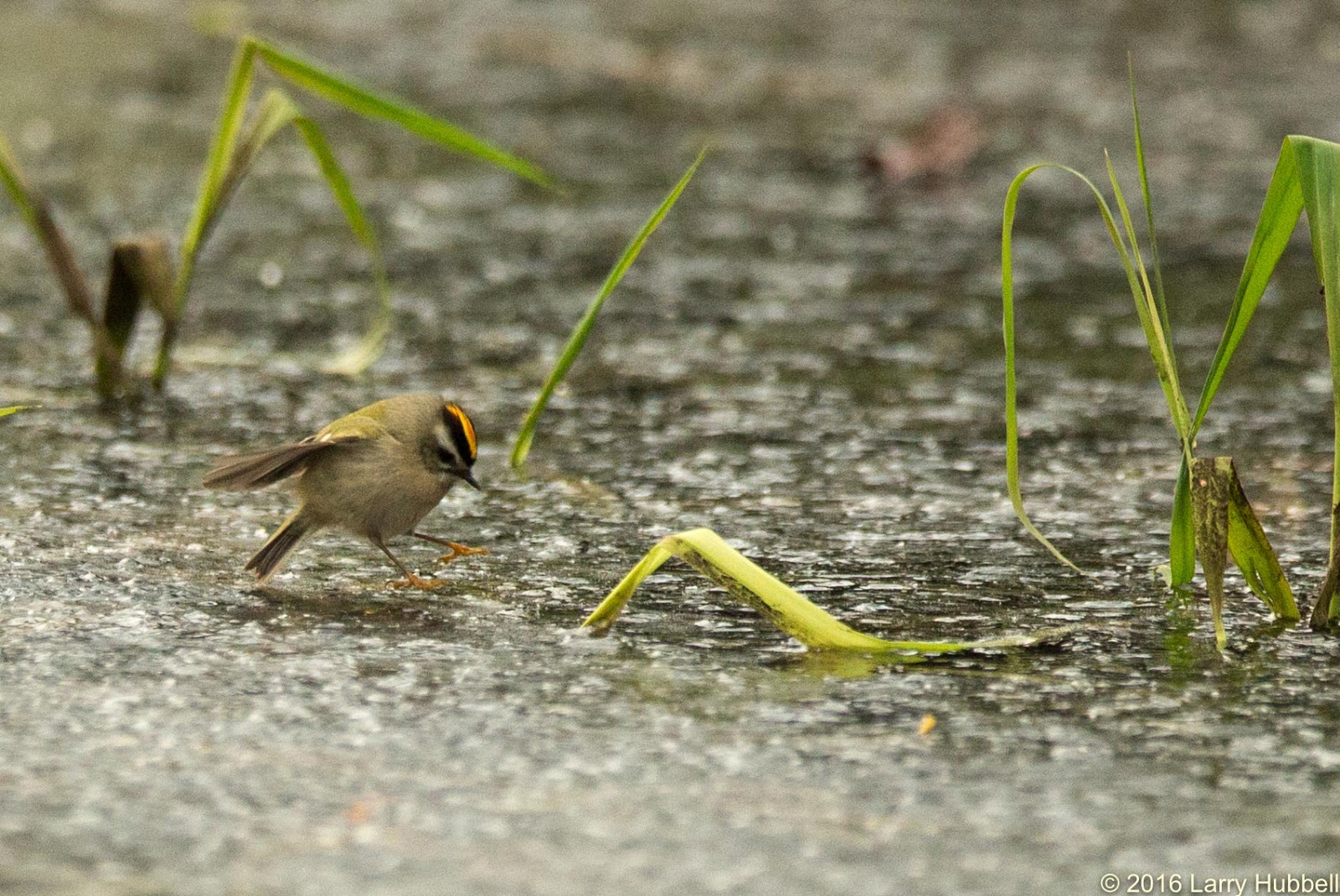
During this December, my most surprising kinglet encounter was in this marshy area near Elderberry Island. The tiny kinglet came down and began searching the frozen surface of the water.

Birds of North America (BNA) does mention that in the winter kinglets will eat a small amount of vegetable matter.

My best guess is that he is searching for tiny windblown seeds drifting across ice.

Even with the temperature below freezing, the kinglet jumps around the ice with its normal, frantic pace. BNA says these tiny birds can survive in weather as cold as -40 degrees centigrade.

Given their special and unique skills, I suppose a sunny winter afternoon is like a warm walk in the park to a golden-crowned kinglet.

Have a great day on Union Bay...where nature live in the city!

Larry

PS: David Zuckerman sent in a interesting update to last week's post. Scroll down to read the rest of last week's story.

On another note during yesterday's Christmas Bird Count a young, eagle-eyed bird counter spotted a coyote on Canoe Island, just south of the Union Bay Natural Area. Given the demise of the coyotes last summer it is nice to know there is at least one still with us. Go Canidae!


Recommended Citation

Swanson, David L., James L. Ingold and Robert Galati. (2012). Golden-crowned Kinglet (Regulus satrapa), The Birds of North America (P. G. Rodewald, Ed.). Ithaca: Cornell Lab of Ornithology; Retrieved from the Birds of North America: https://birdsna.org/Species-Account/bna/species/gockin


Thursday, December 22, 2016

'Tis The Season

The red-breasted sapsucker is a diligent, hardworking bird. Ninety-nine percent of the time when I find one, it is hanging on the trunk of a tree, hidden among the branches and mining a sap well.  

In summer and spring I see them working primarily on deciduous trees. Trees which have no leaves in the winter must have a robust flow of sap when they are putting out new growth. Maybe, it is the volume of flow which attracts the sapsuckers or maybe the sap is simply sweeter - even to me maple syrup sounds sweeter than cedar syrup. 

In the winter after the deciduous trees have gone dormant, I find sapsuckers working in coniferous trees. About a week ago, for the first time this year I spotted this red-breasted sapsucker in a western red cedar.

The tree is about two feet in diameter at the base and maybe 35 feet in height.

It is covered with thousands of holes. The first thing people ask when they see all the holes is, 'Does it hurt the tree?' This tree's foliage may be slightly more sparse than other western red cedars, but it certainly does not appear to be dying. I do wonder if the tree might have been a bit taller by now if it had not been selected by sapsuckers. Two years ago I noticed a sapsucker working this tree - even then it was already covered with sap wells.

Curiously, just ten feet to the east is a second slightly smaller western red cedar tree. I have checked the second tree very closely and I cannot find a single well. I cannot help but wonder why the sapsuckers prefer one tree over the other.

This photo demonstrates the sapsucker's usual level of activity. The body is propped up on its tail and nearly perfectly still - while the head is in constant motion. Unlike most other woodpeckers, the tapping and drilling of sapsuckers is usually syncopated. Like the rhythm of a jazz musician or boxer throwing punches, I can never predict their pace. Click Here - and then scroll down and press the triangle - to hear one for yourself.

Whenever a large bird flies over, the sapsucker glances up at the sky.

Unlike a robin or a varied thrush which can be similar in size, the sapsucker is seldom flushed by a potential predator. Robins and thrush are usually more exposed because they are often eating fruit on the periphery of a tree. The sapsucker simply clings to the trunk of the tree, with numerous branches interwoven above its head. It finds safety among the shadows.

I have only seen the sapsucker leave the safety of the western red cedar tree once this week.

It landed on a nearby deciduous tree and began a sap well.

I suspect it was a test.

It was as if the bird was asking, 'Has your sweet summer sap really stopped flowing?'

The sapsucker soon flew away. Apparently, the little bird learned that wishing does not make it so.

Earlier this week, my friends Uli and Stella mentioned seeing a rare winter visitor in the Arboretum - the red-naped sapsucker. I have not seen it. Just in case one of us gets lucky, I thought it would be good to include this photo from January of 2015. I find the black and white stripes on the side of the head are the most obvious differences. I would certainly love to get more photos of a red-naped sapsucker.

In any case, the good news is we have just passed the winter solstice. The days are getting longer. There are buds on the indian plum - in which the hummingbirds like to nest. Creatures large and small are preparing for the new year. Any time now the great horned owls and the anna's hummingbirds will be laying eggs. It may be winter, but the signs of spring are all around us.

Happy Holidays!

Larry

Update:                                                                                                          12-23-16

Earlier today David Zuckerman, Manager of Horticulture for the University of Washington Botanical Gardens, graciously provided the following update regarding the tree shown in this post.

Larry,

I just got back in from the cold damp Legume collections. The tree in question is actually a hybrid between our WRC and Japanese Cedar. Scientific name: Thuja plicate x standishii. And, yes, tree to the north is same. They are 234-62-A and B respectively.

They were received as seed from Horsholm Arboretum, Denmark, in 1962. Planted out in early 70's.

Health of tree is Good. Same as specimen to the north which doesn't appear to have any sapsucker signs.

Cheerio!

David

I really appreciate David's effort, expertise and update. It is wonderful to know for sure that the sapsucker's holes are not endangering the health of the tree. Plus the fact that it is a cross between a Western Red Cedar (WRC) and a Japanese Cedar, along with its relatively young age, may explain the tree's shorter stature as compared with a mature WRC.

Thank you, David!