Mission: To promote the appreciation of wildlife and increase harmony between humanity and nature.

On Instagram: @unionbaywatch

Saturday, July 9, 2016

A Helping Hand

What comes to mind when you think of the Washington Park Arboretum? Trees, flowers, exotic plants, birds, going-for-a-run or walking-your-dog, these are just a few of the valid answers. By definition, an arboretum is a forest created for education. Even though I mostly photograph birds, I primarily think of trees when I think of the Arboretum. The Arboretum contains over 10,000 plants and trees from all over the world. Since I was old enough to climb, I have loved trees. Even as a child I loved leaving city streets, classrooms and deadlines and climbing up into a cool, green world of life.

To this day, I love green leaves rustling in the breeze. I love fresh air, the smell of pine needles and the invigorating scent of sap. I breathe their air and the trees breathe my carbon dioxide. We do not exist without each other. We are both just of a part of something larger than ourselves. We are all interlocking pieces of life on earth.

Individuals do not last forever, and this week a western hemlock tree with a dead trunk was scheduled to be removed from the Arboretum. I was lucky enough to run into David Zuckerman, Manager of Horticulture, and Raymond Larson. Ray is the Curator of Living Collections at the University of Washington Botanicals Gardens (UWBG). Ray graciously agreed to leave the lower portion of the dead tree standing for a few more years.

At some point a woodpecker, possibly a flicker, made a nest or a roost in the dead portion of tree. Often these holes are expanded or reused by other creatures. By leaving the snag standing, Ray is giving these creatures a potential place of refuge. As luck would have it, nature provided us a prime example of how this might be beneficial. When I returned the next day to photograph the snag I was interrupted by a flash movement. 

Coming towards me, from the direction of the snag, was a young pileated woodpecker. She landed on a giant dogwood, Cornus controversa, a tree which normally grows in China or Japan.

The light orangy-red color of her bushy top knot indicated that she is still in her first summer. It seems likely to me that she is Misty, the sister of Squall and Windy, who we got to see in  last week's post. She promptly grabbed hold of the little dead branch just in front of her and began inspecting it for food. Misty still has a lot to learn. As soon as she tapped at the little branch, it broke loose and they both fell. Luckily, she had wings. After falling three of four feet she spread her wings and glided into a mahonia.

This is is the same type of plant in which we saw a Townsend warbler late last year. Warblers and the Anna's hummingbirds love the plant because it blossoms in the dead of winter. Misty likes the plant for a different reason.

After months of hard work, the blossoms have slowly grown into little blue fruits. Misty goes to great lengths to add the fruit to her diet. 

During summer and fall, and possibly even through winter, Misty's parents will allow her to remain in their territory. During that time she will need a safe place to spend her nights. It would not surprise me if she chooses to expand the hole in the hemlock snag. She certainly seems to love being in the Arboretum. 

A day earlier, I spotted her hanging out on a Douglas fir.

Yesterday, I saw her hanging out around the tulip trees. The official name for these trees is, Liriodendron tulipfera. They are a North American tree but they originated in the eastern portion of the continent.

Making it through the first winter can be the most challenging part of a young bird's life. Having a potential roosting spot that only requires minor modifications can be a huge benefit. It means she can devote more of her time to feeding and growing stronger, instead of excavating a place to sleep.

Given the 10,000 living specimens that Raymond Larson has to manage, it seems unlikely that saving a place for young birds is in his job description. But we can all be glad he decided to help. Being part of a happy, healthy world requires that we follow Ray's example and do a little extra for nature.

One of the ways we can help is simply learning more about the natural world. We cannot live in harmony with nature unless we pay attention to what is happening around us. Fortunately, it turns out that next week Ray is teaching a class about plants in the Arboretum. If you would like to learn more about the class, Click Here. 

Have a great day on Union Bay...where nature can always use a helping hand!

Larry


Tuesday, July 5, 2016

Coyote Challenge

To my readers,

The following is an open letter addressing the killing of three coyotes in Laurelhurst. If you agree (or disagree) with my perspective please feel free to inform Director Woodruff of your opinion. I have also be sent the following directly via email to: 

       roger.a.woodruff@aphis.usda.gov

Roger A. Woodruff
Washington State Director of Wildlife Services
Animal and Plant Health Inspection Service
United States Department of Agriculture

Update:

Apparently, Mr. Woodruff has just retired. The new acting Director is:

Terry L. Smith

      terry.L.smith@aphis.usda.gov

Dear Director Smith,

I was extremely disappointed to learn that three coyotes were killed last week, near Union Bay, in the Laurelhurst neighborhood of Seattle. Historically, humanity's fear and ignorance of wild creatures has often led to killing and extermination. My fear is, if we do not learn to coexist with wild creatures then future generations will live in a dismal world of crows, concrete and mechanical contraptions. 

My personal goal is to promote harmony between nature and humanity, specifically around Union Bay which includes the Laurelhurst area. My blog about nature-in-the-city is called, Union Bay Watch. I believe that if we pay attention to wildlife, and treat wild creatures intelligently, we can find ways to coexist. 

A few weeks ago, I met one of the adult coyotes on the trail in the Union Bay Natural Area. Given the time of the year and because the coyote was out and about at mid-day, I suspect it was looking for food for its young. The coyote turned and fled into the brush as I approached. A perfectly acceptable response from a truly wild creature.

Because of my blog and my local interactions, I have talked with many different people who have seen the coyotes. No one who I spoke with mentioned any aggressive behavior. I truly believe the majority of the local people have been excited and happy to have coyotes as neighbors. I hope we can all agree that killing wild creatures should be a last resort.

The information I have read and the reaction from the neighbors causes me to seriously question whether extermination was warranted. The only justification I can find for the killing is, as reported on King5 News, "Wildlife services received a request to assist in the management of several coyotes near the Laurelhurst neighborhood in Seattle. The coyotes had become increasingly aggressive towards people and pets in the area."

This statement leaves a lot to the imagination. I admit I do not know the details. I can however make a couple of logical assumptions given the information provided.

a) Since no injuries to humans were reported, I suspect the coyotes did not injure anyone.

b) Since no injuries to pets were noted, I suspect the coyotes did not injure any pets, either.

If the coyotes did not injure any humans or their pets then I wonder, What exactly did they do? What does "increasingly aggressive" really mean? 

Does it mean that in the Spring, with young to feed, the coyotes were being seen more often during the day, because their normal nocturnal hunting was not sufficient? Does it mean that the coyotes chased someone's cat up a tree? Does it mean that they growled at an off-leash dog that came near their den? Does it mean that the coyotes came into to someone's yard because the owner left pet food or open garbage outside? All of these fictional examples could be resolved with human education. It makes me wonder if the actual situation could have also been resolved with community guidance and instruction.

The Washington Department of Fish and Wildlife provides an extensive online resource entitled, Living with Wildlife. The highlighted link goes directly to the specific portion of the site related to coyotes. The site lists many non-lethal options.

Our Canadian friends propose a simple three-step process for learning to deal with coyotes. The Stanley Park Ecological Society says, "1) Be Big, Brave and Loud. 2) Never Feed. 3) Spread the Word." They have additional links and information on their site, Co-existing with Coyotes. Please note that they even have an educational program for K-7 students. If our northern neighbors can teach their kindergarten students how to safely encounter coyotes I suspect we should be able to do the same. 

Was education given a fair chance? I have read nothing which implies that the folks in Laurelhurst were provided instruction on how to co-exist with coyotes. The next time your organization is contacted to resolved an issue with coyotes, I sincerely hope you will ensure that the community as a whole gets to participate in the process and that the educational alternatives are fully exhausted.

Thank you in advance for your thoughtful consideration of this issue.

Larry Hubbell
www.UnionBayWatch.blogspot.com

Update to Readers:

Does anyone happen to have a photo of the coyotes they would be willing to share?


Thank you to Doug Parrott for sharing his coyote photo taken on June 26th at the Union Bay Natural Area.

More Updates:

From the folks at The Laurelhurst Blog.


Here is the post the Laurelhurst Blog did on Friday about the killings:


And here are posts about coyote sightings:


More Photos:


********

Also here is the link to Jim Robertson's wonderful coyote photos which he provided in the comment below.

http://www.all-creatures.org/aw/coyote.html


Sunday, July 3, 2016

Teachable Moments

When visiting the Arboretum, I constantly listen for sounds. Locating the source of a bird call or an unusual noise can be challenging, but also very rewarding. This week, when I heard a loud hammering noise at first I thought, that must be coming from the new trail construction. 

I changed course slightly and expected for the sound to remain somewhat distant, since I was an eighth of a mile from the trail work. Surprisingly, after just a few steps I realized the noise was now behind me. Clearly, it had nothing to do with the trail construction. I stopped and turned - searching the forest. I spotted Chip, our local mature male pileated woodpecker, quietly gathering food while Squall, his young son, watched. The hammering continued. Neither of the male birds were the source of the sound.

 
Finally, I spotted a flash of motion at the base of another tree. It turned out to be one of a Squall's sisters. She had been hidden by ferns while loudly hammering away at the bark of a douglas fir tree.  

She twisted and turned, inserting her tongue in the cavity she made while searching for her reward. I suspect she must be older than Squall, given her more mature feeding skills. Either that, or Squall is simply enjoying the easy life.

After a few moments, Squall joined Chip and was rewarded for his patience. From the Birds of North America website (citation below) I learned that immature pileated woodpeckers have less barbs on their feathers. This explains why Squall's top knot is more bushy and not as sleek as Chip's.

Chip moved on - while Squall lingered in the sunshine.

Squall's sister, let's call her Windy, took a break and stretched a bit.

It is seldom that I catch a photo which displays any of the white on the top side of their flight feathers. I find this white at the base of their primaries to be surprising. Especially because it is usually hidden under the covering of their covert feathers. Click here to visit the Feather Atlas and get a more complete view. I wonder why nature has endowed them with this apparently unused coloring.

The young birds took to the air following Chip. I lost them among the trees but luckily we were all headed in the same direction, and a few moments later I found them again. There is just enough information in this photo to identify each of the individual birds. Can you tell which bird is which? 

The young birds watching Chip work could be considered one clue to his identity. At about this point I realized that Chip was teaching by example. Whether his teaching was intentional I do not know. Clearly, he was showing his offspring that hollow places in trees can hold water, soften the wood and attract edible insects. 

Clinging to the rope-like bark of the big-leafed maple tree, Chip feeds Squall. At the same time, Windy applies the lesson-learned and feeds herself. It is common knowledge among humans that females mature faster than males. I wonder if the same could be true for pileated woodpeckers?

Ultimately, even Squall takes a turn feeding in the cavity. 

Note: This is a great example of why pileated woodpeckers are key enablers of other creatures. Their ability to excavate a hole and provide future nesting sites, which may be used by a wide variety of other lifeforms, is highly unique. To my knowledge, their excavation abilities outpace all other local forms of woodpeckers and other wildlife as well.

After gathering a few morsels from the gnarly bark of a douglas fir, Chip provides Squall with a taste of the lifeforms found on and around this species of tree.

Chip's next stop was on the straight fine bark of a western red cedar, however his actual goal was the bright red berries hanging on the neighboring plant.

Once again Chip provides Squall with a teaching taste. In this case, it contained a little  huckleberry heaven.

Almost immediately, Windy jumped into the elegant little bush and began plucking berries with gusto. 

While her silhouette makes identification difficult, it does provide a rare example of a pileated woodpecker perched on a small branch looking almost like a large songbird. Even at her young age, you can see the tips of her tail feathers show some wear. They lack the normal rounded shape of most bird feathers. Normally, pileated woodpeckers land on the sides of trees or on larger more substantial branches. In both cases, they usually use their tails for support which increases the wear. Their tails are being used like a third leg in almost all the photos in this post.

Their final stop, which I observed, was in the cavity of a broken western red cedar. The fine straight grain of the wood provides a beautiful contrast as Chip offers Squall a taste of the food he collected from within the tree.

Never before have I noticed pileated woodpeckers making so many brief stops, on such a variety of trees and plants. I find it impossible to imagine that Chip was unaware of the valuable information he was providing to his offspring. It also seems unlikely that he just happened to always be feeding Squall instead of Windy. I truly believe that Chip varied the level of instruction and reward to fit the student and maximize the teachable moments.

Have a great day on Union Bay...where nature lives in the city!

Larry

PS: In the earlier photo, where I asked you to identify the three birds, Chip was in the middle. The darker red on his head is the clue which easily identifies him as the older more mature bird. If it had been a closer photo, you could have also seen Chip's yellow irises - one of which is visible in the first huckleberry photo. The young birds' irises are still a dark grey-blue color. Squall is the young bird at the top of the photo. Both young birds can of course be categorized by the paleness of their red top-knots. Squall can by distinguished from Windy by the reddish malar stripe and forehead which only males have. By elimination, Windy must to be the bird at the bottom of the photo.

Recommended Citation
Bull, Evelyn L. and Jerome A. Jackson. 2011. Pileated Woodpecker (Dryocopus pileatus), The Birds of North America Online (A. Poole, Ed.). Ithaca: Cornell Lab of Ornithology; Retrieved from the Birds of North America Online: http://bna.birds.cornell.edu/bna/species/148


Saturday, June 25, 2016

Feathers and Feelings

I find it impossible to look at a barred owl and not be impressed. There is the perfect symmetry and balance. There is the way every feather aligns. Each individual feather is a work of art and all together they form a masterpiece. 

Each feather has multiple functions. Plus, they usually belong to a set of feathers with a group purpose as well. There are primary, secondary and tertiary flight feathers. There are multiple types of coverts. Wing coverts cover the base of the flight feathers, both above and below the wing, which helps to keep the airflow smooth and unperturbed. There are similar tail coverts. The upper ones are visible in this photo. Each owl must have hundreds of feathers. In addition to aerodynamics, warmth and camouflage, facial feathers help the owl to hear the smallest sound, while unique wing feathers allow the owl to glide in virtual silence.

With a shudder, an owl can raise most of its feathers at once. I wonder if the purpose is to add air and retain body warmth, or to realign the feathers, or both.

In nature, it seems like nothing is ever done for just a single purpose.

A critical portion of the owl's time is spent maintaining its feathers.

The beak closes over each side of the base of the feather, then as the owl pulls away from its body the interlocking barbs and barbules become perfectly realigned.

Maintaining their feathers is not always a solitary practice. 

 Allo-preening may communicate intentions beyond grooming in both mammals and birds.

Scientists caution us about ascribing human intentions and emotions to other creatures. It can cause us to misunderstand the behaviors we see.

By the way, given that males are slightly smaller than females, I believe the bird on the left is the male.

It is interesting how genetic research seems to be showing that we have a shared heritage with all life on earth.

It makes me wonder if scientists will someday discover that behaviors which we share with other creatures have a common genetic basis.

Either way, it can be hard to ignore the feelings that other creatures evoke in us.

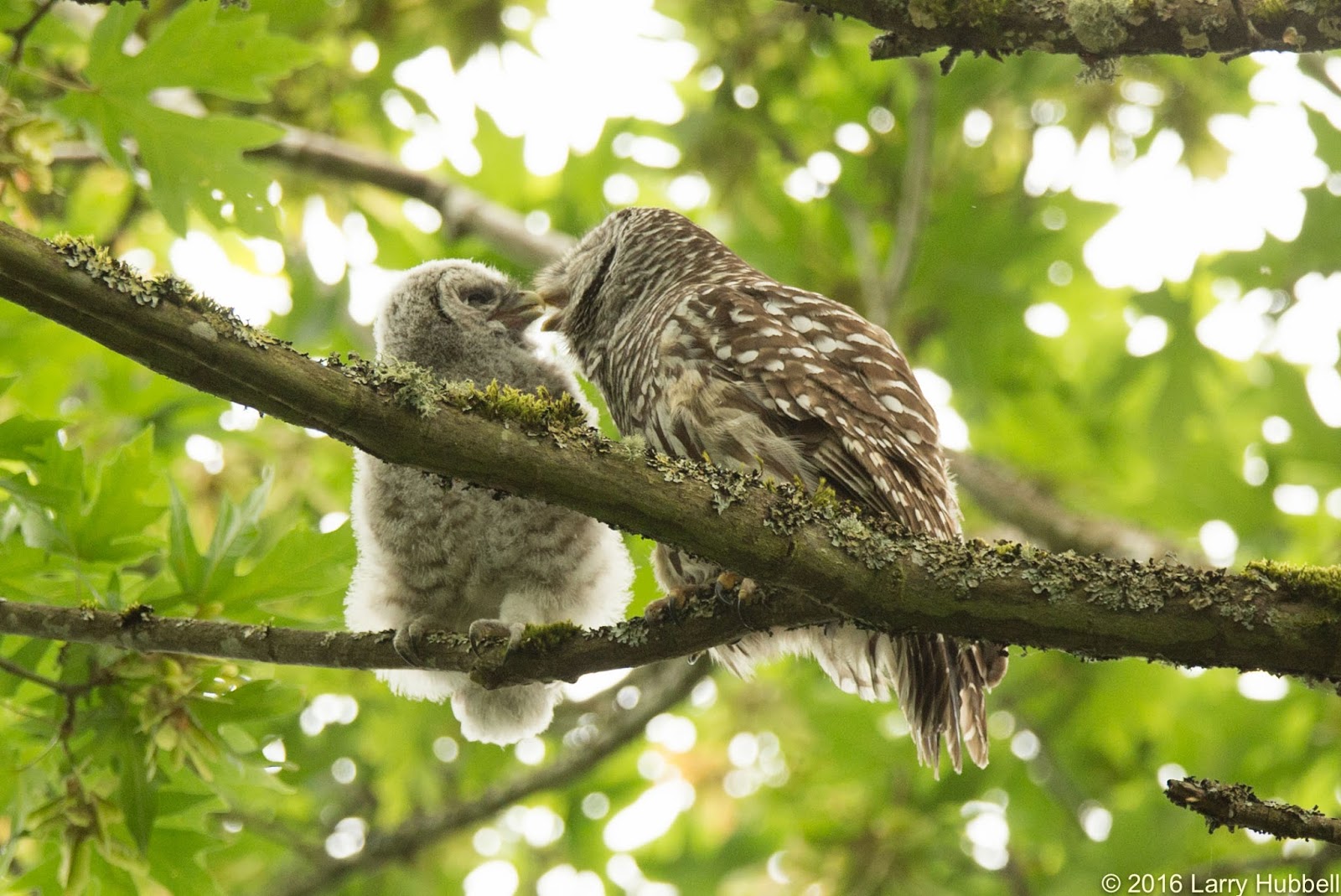
Especially when we see an adult caring for its offspring.

When the young bird takes a turn at grooming the parent, it certainly makes me think this may be an instinctual behavior. Have you ever wondered if we have instinctual behaviors?

If you read last week's post, Flight Risk, about Dizzy Dean and Prudence then you will understand when I say that I suspect this young bird is Prudence. Either way, this photo shows the young bird just two days after it left the nest.

I wonder if this particular motion has to do with grooming or the young bird's desire to be fed or something else which I have yet to comprehend.

Clearly the parent appears focused on the grooming.

Have you ever felt like someone was getting just a little too close?

Sometimes there comes a moment when you realize you need a little elbow room.

If you have ever had a child in kindergarten or grade school, you may have noticed that some parents tend to hover rather close to their children.

When the child pulls away, they just move a little closer.

Some parents can be a bit slow to get the hint.

The budding signs of independence are easily ignored.

On the other hand, until you become a parent, you can never really understand what it means to be invested.

It is hard to blame a parent for caring.

In the end, every child must learn to go it alone. It is only a question of time.

I do believe that keeping an open mind is critical to the process of scientific discovery. Observing wild creatures can teach us a lot. Watching wildlife can also help to stay us mentally and physically healthy, even if we are not scientists.

Sometimes I do wonder if anthropomorphizing may be the lesser of two evils. Paying attention to the feelings which the creatures around us evoke and knowing how much we share in common may actually motivate us to do more to protect them. 

Have a great day on Union Bay...where nature lives in the city!

Larry