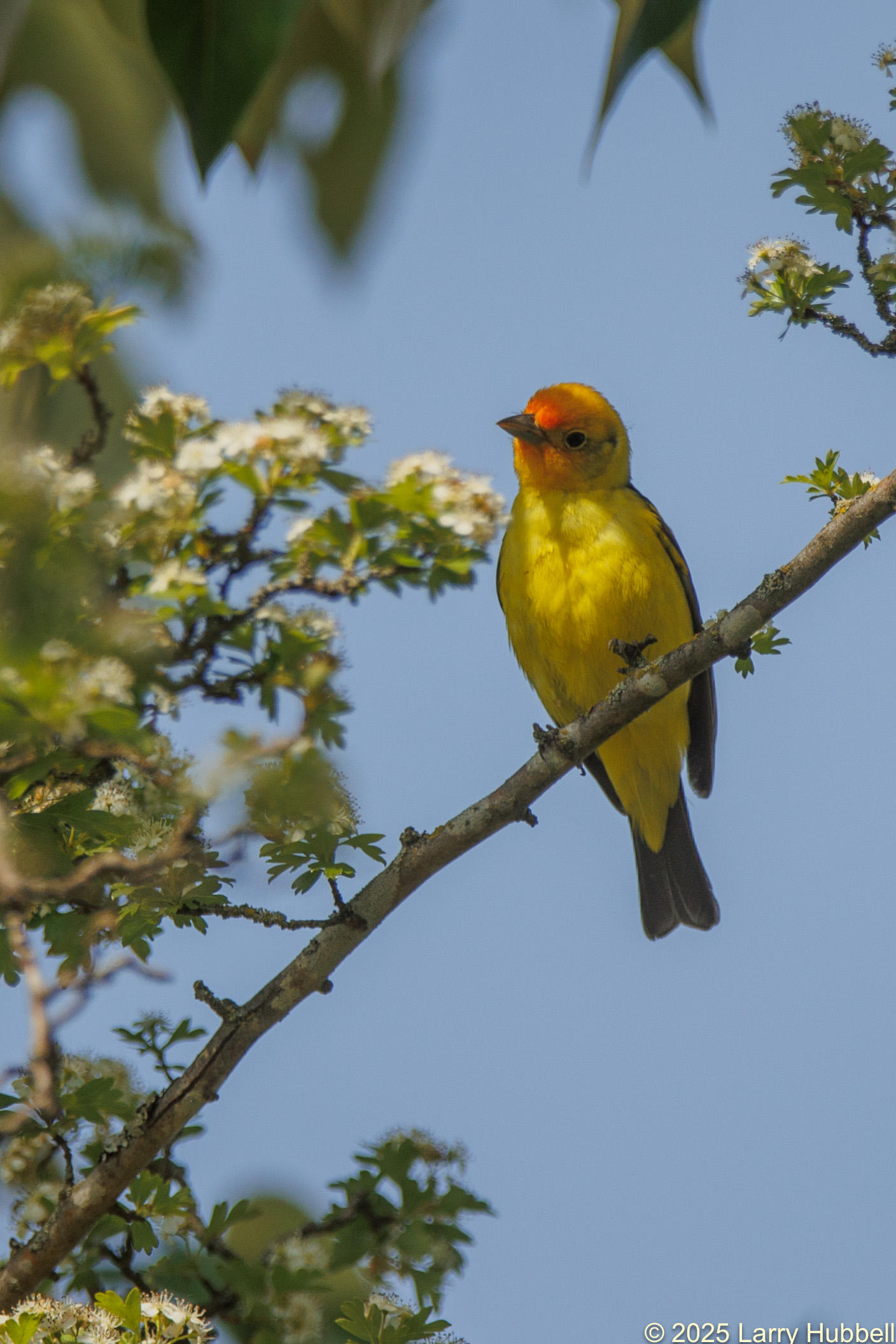
A male Western Tanager is a highlight of Spring. They remind me of sunshine with wings. The brilliant yellow and the splash of reddish-orange makes me wonder, How do I miss them? They seem like nature's version of neon lights. Like a magnet for the eyes.
 However, despite their brilliant colors, I find them surprisingly hard to locate.
In May, around Union Bay, they spend much of their time overhead searching for insects among the thick green leaves of our Spring deciduous trees. During the process they are fairly hidden and even if I hear them that doesn't make them easily seen.
 They just don't attract much attention.
 They are a bit more conspicuous when searching for insects in flight from elevated perches.
 The lucky bugs pass by unseen. The less lucky ones are snagged in mid-air.
 Then the Tanagers quickly return to a nearby tree to consume their catch.
Both of these methods of catching insects are hard for humans to see. Their movement is quick, quiet, and high overhead. Observing Western Tanagers in action requires patience, a bent neck and a good angle i.e. leaning back and looking up for a long while, while also squinting into the sunshine, or the falling rain.
In addition, they spend most of their year to the south of us. Click Here (and then select the white triangle) to activate the dynamic map and see their patterns of migration. You will notice that they are here, in the PNW, primarily during breeding season and warm weather, i.e. from May through August, with some lingering into September. This is also confirmed on Birdweb. For seven months of the year, they are normally much further south.
Plus, from my experience, they spend even less time around Union Bay. For example, of the 37,000 bird photos on my laptop only 234 are of Western Tanagers, and every one of those photos was taken during May. In addition, I have never noticed a pair nesting here.
On the positive side, a few years back my friend, Dan Pedersen, did find nesting Western Tanagers on Whidbey Island. Dan's experience makes me hopeful that someday, someone may find a Tanager nest near Union Bay. Click Here to read Dan's story, written with the help of his good friends and phenomenal birders Joy and Craig Johnson.
Another reason Western Tanagers can be hard to see is that the female half of the population is far less conspicuous. They attract the males without the need for brilliant orange or red colors. They can be even harder to notice among fresh greenish-yellow leaves.
I wonder if this is a male with just the slightest hint of orange on its forehead. They apparently do not hatch out with any brilliant orange or red color.
Curiously, unlike many other red birds, the red coloring on the male Western Tanagers may be harder to accumulate. It apparently comes mostly from the insects they eat, as opposed to also from fruit, and from a unique source.
Birds of the World has the following information about male Western Tanagers. "...rhodoxanthin produces red hue of head (Hudon 1990b). The latter pigment, a retro-dehydro-carotenoid, is thought to be acquired directly from the diet without modification, unlike the red carotenoids (4-oxo-carotenoids) in Scarlet, Summer, and Hepatic Tanagers, and other emberizines, which are believed to be derived metabolically from common yellow precursors (xanthophylls; Brush 1967b). Rhodoxanthin is an uncommon pigment in birds,..." Just for fun, here is a photo of a much less subtle Summer Tanager, as seen in Texas in April.
I understood the prior quote to say the red of the Summer Tanager comes from yellow precursors, that their bodies then turn into the red coloring. This is unlike the red in Western Tanagers which comes more directly from the Rhodoxanthin in the creatures they consume.
The American Bird Conservancy (ABC) says that the Western Tanagers gets their red color from insects that eat the buds of conifers, ferns and some non-native honeysuckles. Click Here to read the ABC source directly. This male seems to be at a midpoint in the process of acquiring its red coloring. Even so, it is easy to see how such a small amount of red can be easily hidden among overhead leaves. I am guessing, the amount of their red coloring varies depending on their age and their ability to find, catch, and consume the right creatures.
Even among shadows, Western Tanagers always remind me of sunshine. I hope you find the time to get outside and search the trees around Union Bay for Western Tanagers. They are just a portion of the yellow birds who arrive here about the same time as the sunshine.
Click Here to read a previous post that includes another yellow visitor.
Have a great day on Union Bay...where nature lives in the city and black birders are welcome!
Larry
Recommended Citation
Hudon, J. (2020). Western Tanager (Piranga ludoviciana), version 1.0. In Birds of the World (A. F. Poole and F. B. Gill, Editors). Cornell Lab of Ornithology, Ithaca, NY, USA. https://doi.org/10.2173/bow.westan.01
Going Native:
Each of us, who breathes the air, drinks water, and eats food should be helping to protect our environment. Local efforts are most effective and sustainable. Native plants and trees encourage the largest diversity of lifeforms because of their long intertwined history with our local environment and the local native creatures. Even the microbes in the soil are native to each local landscape.
I hope we can inspire ourselves, our neighbors, and local businesses to respect native flora and support native wildlife at every opportunity. I have learned that our most logical approach to native trees and plants (in order of priority) should be to:
1) Learn and leave established native flora undisturbed.
2) Remove invasive species and then wait to see if native plants begin to grow without assistance. (When native plants start on their own, then these plants or trees are likely the most appropriate flora for the habitat.)
3) Scatter seeds from nearby native plants in a similar habitat.
4) If you feel you must add a new plant then select a native plant while considering how the plant fits with the specific habitat and understanding the plant's logical place in the normal succession of native plants.
***************
Keystone native plants are an important new idea. Douglas Tallamy, in the book "Nature's Best Hope ", explains that caterpillars supply more energy to birds, particularly young birds in their nests, than any other plant eater. He also mentions that 14% of our native plants, i.e. Keystone Plants, provide food for 90% of our caterpillars. This unique subset of native plants and trees enables critical moths, butterflies, and caterpillars that in turn provide food for the great majority of birds, especially during the breeding season.
Note: Flowering plants and trees, i.e. those pollinated by bees, are also included as Keystone Plants.
This video explains the native keystone plants very nicely:
https://www.youtube.com/watch?v=O5cXccWx030
The Top Keystone Genera in our ecoregion i.e. Plants and trees you might want in your yard:
Click Here
Additional content available here:
https://wos.org/wos-wp/wp-content/uploads/2022/10/Native-Plant-Resources-10-7-22.pdf
******************
In the area below, I normally display at least one photo with each post to challenge us to know our native lifeforms.
These white flowers are currently blooming along damp roadsides in western Washington. What plant is it?
Note: There are multiple plants with white flowers, so I am including this photo of the plant's large "maple-leaf like" leaves to help with your identification.
Scroll down for the answer.
******************
Cow-parsnip: Yes, it is a native plant. However, even though bees love it, it is not a plant I enjoy. If it touches your skin it can cause unpleasant rashes and burns. To reduce it from spreading, I have been removing the flowers. Note: I have learned to wear rubber gloves, rubber boots, coveralls and a hat to try and avoid the unpleasant rash.
By the way, there is also a larger, but fairly similar, plant called Giant Hogweed. It is invasive and apparently even less pleasant. If you want to know the difference, I would start by reading this:
The Email Challenge:
Over the years, I have had many readers tell me that Google is no longer sending them email announcements. As of 2021, Google has discontinued the service.
In response, I have set up my own email list. With each post, I will manually send out an announcement. If you would like to be added to my personal email list please send me an email requesting to be added. Something like:
Larry, Please add me to your personal email list.
My email address is:
LDHubbell@comcast.net
Thank you!
*******************
The Comment Challenge:
Another common issue is losing your input while attempting to leave a comment on this blog. Often everything functions fine, however, sometimes people are unable to make it past the robot-detection challenge or maybe it is the lack of a Google account. I am uncertain about the precise issue. Sadly, a person can lose their comment with no recovery recourse.
Bottom Line:
If you write a long comment, please, copy it before hitting enter. Then, if the comment function fails to record your information, you can send the comment directly to me using email.
My email address is:
LDHubbell@comcast.net
Sincerely,
Larry