Mission: To promote the appreciation of wildlife and increase harmony between humanity and nature.

On Instagram: @unionbaywatch

Saturday, June 18, 2016

Flight Risk

Last year, my first photos of young barred owls were taken on May 11th.  Given the state of their white downy feathers and their fluttering and inept use of their wings, I believed they had just left the nest. 

This year, I visually inspected the nest almost every day in May. The month came and went without any sign of owlets. I kept hoping. As long as the female's tail feathers were hanging out of the nest I assumed she was still on eggs. When she disappeared from the nest and no young appeared, I became concerned. When I finally saw the small dark eyes peering out of the tree, it was a great relief.

It turns out that our warmest recorded Spring did not cause the owls to hatch early. In fact, they must have hatched almost a month later than last year. I have no idea what may have caused the delay.

When the second little head appeared, I was even happier. Initially, the owlets would just glance outside and then pull their heads back into the comforting safety and darkness of the nest. 

The next evening one of the owlets became a bit more bold and sat surveying the new world outside the nest. Given this was my first time watching the process, I had no idea that the next day the owlets would fledge. 

They were already 75 to 80 feet up in the trees when I first spotted them - maybe twice the height of the nest.

In spite of being nearly flightless, the young owlets were very confident in their climbing. Their claws and muscles seemed quite strong for their weight. They flapped their wings fairly often, but seemed to do it for balance more than for lift. At this point, one of the young birds leaped for a nearby branch...and missed. 

While still in the air, maybe 40 feet above the ground, it caught hold of a big-leaf maple twig. I think the larger twig, which might have supported its back a bit, may have made all the difference. 

The owlet hung upside down while struggling to right itself for two and half minutes. It felt much longer than that to me.

Finally, the owlet found a way to point its head toward the sky.

Even so, the struggling continued.

Straining and flapping, the owlet's head slowly rose above the tiny branch.

The owlet worked its way to a more substantial branch - secure at last.

Not ready to rest on its laurels, the young owlet began walking the branch. To my surprise, it once again leaped for a nearby tree.

Lacking the experience of an adult, the young bird twists, turns and inverts as it reaches for the branch.

Sadly, it does not complete the connection.

Luckily, its large wings and innate balance help it to right itself in mid-air. This time there were no leaves or branches to easily grasp. The young bird fell all the way down into the bushes at ground level.

Seemingly unhurt the young bird wandered around among the bushes flapping and trying to climb anything it could find. The parents came in close and landed nearby to guard the young bird. Finally, the owlet crawled off into the bushes and out of sight. One of the parents moved in and landed on a branch just a few feet above where the young bird disappeared. 

I spent the next week to ten days looking for the two young birds but I was only able to find one and it was always 75 to 80 feet in the air. Usually it was sitting just below the upper foliage of a big-leaf maple tree. Hidden from passing eagles and safe from us earth-bound creatures below. In my mind, I call the owlet in the tree tops Prudence, and the more adventurous young bird Dizzy Dean.

After the fall Dan Reiff, a friend with years of experience, assured me that young owls are resilient and strong. He mentioned that even young owls are very good at hiding themselves and keeping silent, but I still worried every time I saw an off-leash dog in the Arboretum or thought of the coyote which I saw not long ago on the other side of Union Bay.

Two days ago I heard for the first time that both of the young owlets had been seen at the same time. Finally, yesterday evening my wife and I spotted them both. I breathed a huge sigh of relief. They were calling back and forth and flying with ease from one high branch to the next. One of the parents stayed close by and even spent time preening and cleaning one of the owlets. 

Dizzy Dean survived his fall and learned to fly. His next great challenge is learning to hunt and feed himself. One thing is for sure, I will never hear the term "Flight Risk" again without thinking of Dizzy Dean.

Have a great day on Union Bay...where owlets fly in the treetops!

Larry

Disclaimer: I do not know how to identify the gender of the two young owlets. For all I know, Dean may be female and Prudence could be male. The names I choose seemed to fit their behavior and any relationship to their actual gender is purely coincidental.


Friday, June 10, 2016

Choosing Wisely

This may be the first photo I have ever published of a great blue heron's nest near Union Bay. The herons usually seem to build their nests in the tops of deciduous trees, like big leaf maples. In the winter time it is easy to spot a colony of nests in a grove of leafless trees. In the spring, when the nests are occupied the maple leaves provide shade and privacy for the young birds, which also makes it harder to photograph them.

The parents of these young herons choose to build this nest in a pine tree. (Thank You to Helen and Tom Cottoner for pointing this out.) The ultimate question is whether this location was a wise choice for the young birds.

Given the stately elegance of a mature great blue heron, I was a bit surprised to notice the rather awkward, almost goofy, look of these immature birds.

Three young birds with large bills in a small nest can get on each others nerves from time to time.

A little nip on the cheek may help to establish an invisible boundary between the birds.

Surprisingly, the nip seems to be accepted, almost as if it was deserved, although I wouldn't say that is a happy face.

For the moment, all is peaceful in the nest.

Still unable to fly, the three siblings pay close attention to events unfolding around them on the University of Washington campus. They appear to be students of life.

Clearly, one of the siblings has crossed "the line" - that invisible boundary of acceptable behavior. Maybe the bird with its mouth open just caught a toe in the side or a beak in the bum. It is impossible to see what happened but the reaction is obvious.

With the noise of students and buses passing, I could not hear what sounds were being emitted. It sure looks like the offended bird is attempting to educate its sibling on the finer points of nesting etiquette.

The teacher takes more of a "hands-on" approach.

The handy spikes on top of the head shows the student is paying attention.

The third sibling appears ready to play the role of assistant teacher.

Repetition is the key to learning, so the message gets delivered again.

The offended bird finally seems satisfied and ready to take a breath.

Looking for a quiet corner of the nest seems like a wise move. Notice the almost complete lack of a tail. Evidently, there is no point in growing a tail until the flight feathers are functional.

Of course a round nest has no corners and fairly soon the three young birds are face to face again.

When one bird lifts its wings, it is easy to see the partial development of the primary flight feathers. These partially developed feather shafts are sometimes called pin or blood feathers. While the feathers are growing, the shafts contain blood that supplies nutrients and enables the growth process. Once the feathers are fully developed, the blood flow stops and the feather remains. It will take a while before these birds are able to fly.

At mid-day, with the sun beating down and the temperature nearing ninety, one of the young herons takes evasive action. I am convinced it was hanging its head over the side in search of shade.

I returned in the cool of the morning hoping to find a parent at the nest. The young bird excitedly searches for food.

The size comparison between the adult and the young is another indication that more development is required. I believe the young will be nearly as large as the parents before they fledge, and leave the nest.

The top knots or crests on the young seem very unruly. In the first photo it looked like only white feathers were erect while in these photos it is the dark blue feathers that show up. The angle of the light may be a factor.

Helen mentioned, that a few years ago a loud concert at the University of Washington caused the herons to abandon their nests in the middle of spring. Apparently, none of the young survived. Another friend told me about a heron rookery in Interlaken Park many years ago that was raided and destroyed by a pair of bald eagles - no doubt with young of their own to feed. 

Our young students have no idea of the challenges they will face. This site is slightly removed from the other University of Washington nests. It seems like a quieter location. It may also be more visible, and hot, without the shade of the big-leaf maples. Just like with humans, every choice has tradeoffs. We can only hope that their parents have chosen wisely.

Have a great day on Union Bay...where nature lives in the city!

Larry


Friday, June 3, 2016

Family Time

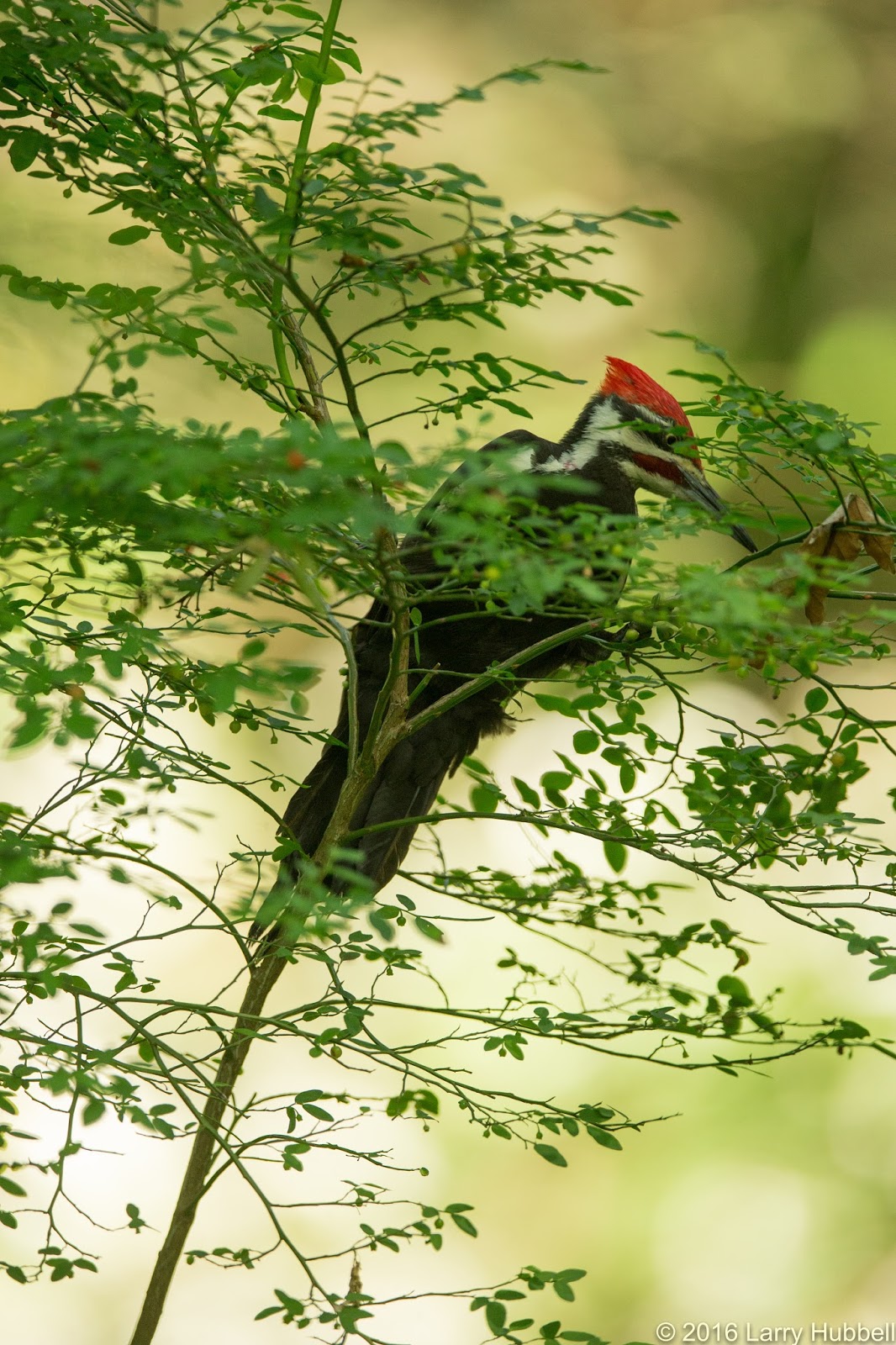
After a winter of watching and wondering, it was a pleasant surprise to find Storm and Chip consummating their relationship in early April. Storm is the female pileated woodpecker who lost her home and had to relocate twice this winter. 

The links below will bring you up-to-date, if you missed any of her winter adventures:

Storm Watch

A River Of Wood

Homeless In Seattle

The nesting process progressed in a fruitful fashion. By early May, Chip and Storm had their hands full or more precisely they had a nest full. At this point, I suspect the nestlings are around 10 days old.

The three young bird's crests are a pale pinkish-orange - strikingly different than Chip's flaming red brilliance.

There are two females and a male. The names Windy, Misty and Squall came to mind while watching them. The terms seem appropriate for the children of Storm. Fittingly, Squall is the bird on the bottom with his mouth open wide.

Although it can be hard to see, Squall has a reddish forehead, somewhat similar to Chip. Females have black foreheads and the they lack the red malar stripe which is visible on Chip's cheek.

Thirteen days later, Squall's crest is visibly brighter and the red coloring of his malar stripe is becoming obvious.

If you look closely you can see how his reddish crest comes all the way down to his beak, compared to the black, visible on his sister's forehead.

Even though the coloring of the nestlings has grown richer, there is still a subtle difference between their crests and that of their parents.

The feeding process involves at least four eyes and the sharp tips of at least two bills - more if you include the other young birds who are also striving to be fed. It sure looks like a dangerous proposition. Somehow the parents and the young all survive with their eyesight intact.

As the young prepare to leave the nest they spend more and more time looking out into the wonders of the world.

Last weekend, at approximately four weeks of age, Squall and his sisters left the nest. Please note how his claws easily grasp the bark of the big-leaf maple.

The parents still bring them food, even though the young have left the nest and learned to fly e.g. fledged. 

Chip's approach is careful and cautious...

 ...but he delivers the goods.

Afterwords, the begging continues.

The young also observe the parents and hopefully are starting to think about feeding themselves.

Squall lands near one of his sisters.

You can almost hear her say, "What do you want?"

Squall leans in, mouth open, hoping for a handout.

It appears his sister gives him a peck on the cheek, but not the food he desired. Squall left in a hurry.

Another surprising feeding attempt occurred when Chip landed in a three foot high, red huckleberry bush.

Keeping his body in virtually the same spot, he twisted and turned and picked almost all the berries off the plant. Maybe the berries were dessert - a nice compliment to his usual diet of carpenter ants.

The funnest sight of all was Squall landing on a paved walkway. The horizontal landing completely confused him. He had no idea what to do with his claws. When he lands on the vertical surface of a

tree his claws instinctively find crevices to grasp and he stops rather elegantly. On the asphalt he fluttered down, wings spread and ended up landing on his chest and belly. With a little awkward shuffling he folded his wings, pulled his feet underneath him and pushed himself up to this less embarrassing pose.

These innocent young birds clearly do not understand all the dangers they face. Last year a young pileated woodpecker, of almost exactly this age, was found on the downhill side of 24th Avenue, just below East Interlaken Blvd. Most likely it was hit by a car. Spring is a wonderful time with new life all around. It is also a good time to watch the speed of our vehicles and a great time to keep our dogs close to our sides.

Congratulations to Storm! She survived the loss of her roost(s), found a mate, laid eggs and then raised three healthy young pileated fledglings. The last eight months of her life have been very eventful. Not only did she survive, she thrived. 

Have a great day on Union Bay...where pileated woodpeckers raise young in the city!

Larry