

You can see the nest building process in the post, New Neighbors.
You can also read about the parents who built the nest in the post, Monty, Marsha and...
... and you can read the initial post regarding the eaglet who fell in, Eaglet Troubles.
The latest update from PAWS regarding the fallen eaglet was forwarded by a kind and concerned reader, T. L. Stokes.
'The juvenile Bald Eagle has a fractured pelvis. We are continuing to care for the eagle to help him/her recover. This eagle is being housed with another juvenile Bald Eagle, and they get along great.'
A communication from the PAWS volunteer who retrieved the young eagle stated,
'Radiographs indicated that the eagle has a fractured pelvis near the joint. That means it has a super guarded prognosis. Fractures near joints often don't heal well. We will continue to monitor how the pelvis heals to determine if the eagle will recover his range of motion. We are cautiously optimistic but the nestling has a tough road to full recovery.'

On Monday morning Lucy had moved back to the fork in the main stem of the tree. This inspired a momentary sense of relief given the sturdiness of the large supporting branches. By the way, no one knows for sure if Lucy is male or female.

A few moments later Lucy decided to return to the perch she was using the day before. It was obvious that the bulk of the nest, which was hanging from the smaller branch just 24 hours earlier, was gone. Sadly, this did not seem to impact Lucy's desire visit the site.

She slowly inched her way across the 'Sky Bridge' back towards the smaller branch. There was no indication that she could fly at this point. Her wings were wide but the feather development was incomplete. Most obvious were her missing coverts. Her coverts will ultimately cover the base of her flight feathers and unify the surfaces of her wings. This will enable her wings to function as single lift-providing units, relative to the air flow.

The white sheaths of her flight feathers, displayed on her right wing, will not be visible once the under wing coverts are fully developed.

As Lucy crawled, sidled and flapped her way across The Sky Bridge, the connecting sticks shifted and sagged beneath her weight.

As she neared the smaller branch the tension continued to build. I tried to persuade myself that even in their incomplete state her massive wings might help to break her fall. The optimistic thought did not reduce my concern.

The sigh of relief when she finally finished her sky walk was short lived. How would the parents bring her food in such a small and unstable location? Would she try to lay down and sleep there or would she just turn around and walk back? I wasn't sure I wanted to watch. Still, if she fell I wanted to be there to call PAWS as soon as possible.

When I checked back on Monday afternoon she seemed to have settled in on the far side of the Skybridge.


I think the frequency of her loud, piercing calls are indicative of the current level her hunger. I imagine that even at a distance the parents interpret the calls as, 'Feed Me, Feed Me!'

By Tuesday morning, Lucy was back on the main stem. I was relieved.

Monty brought her food and she found adequate space to eat in the fork of the tree, where the nest originally started. Notice how the sticks from the nest are almost completely gone.

Here is what the same fork in the tree looked like around the time the eggs were laid.

After she ate, they both found secure resting sites on the major branches protruding from the original fork.

I was beginning to hope that her adventures as Lucy Skywalker were over.


Her sky bridge and the nest had been reduced to the point that they no longer resemble an eagle's nest. Every time I visited the site I feared finding Lucy laying on the ground.

Luckily, on Wednesday Lucy was back on a major branch.
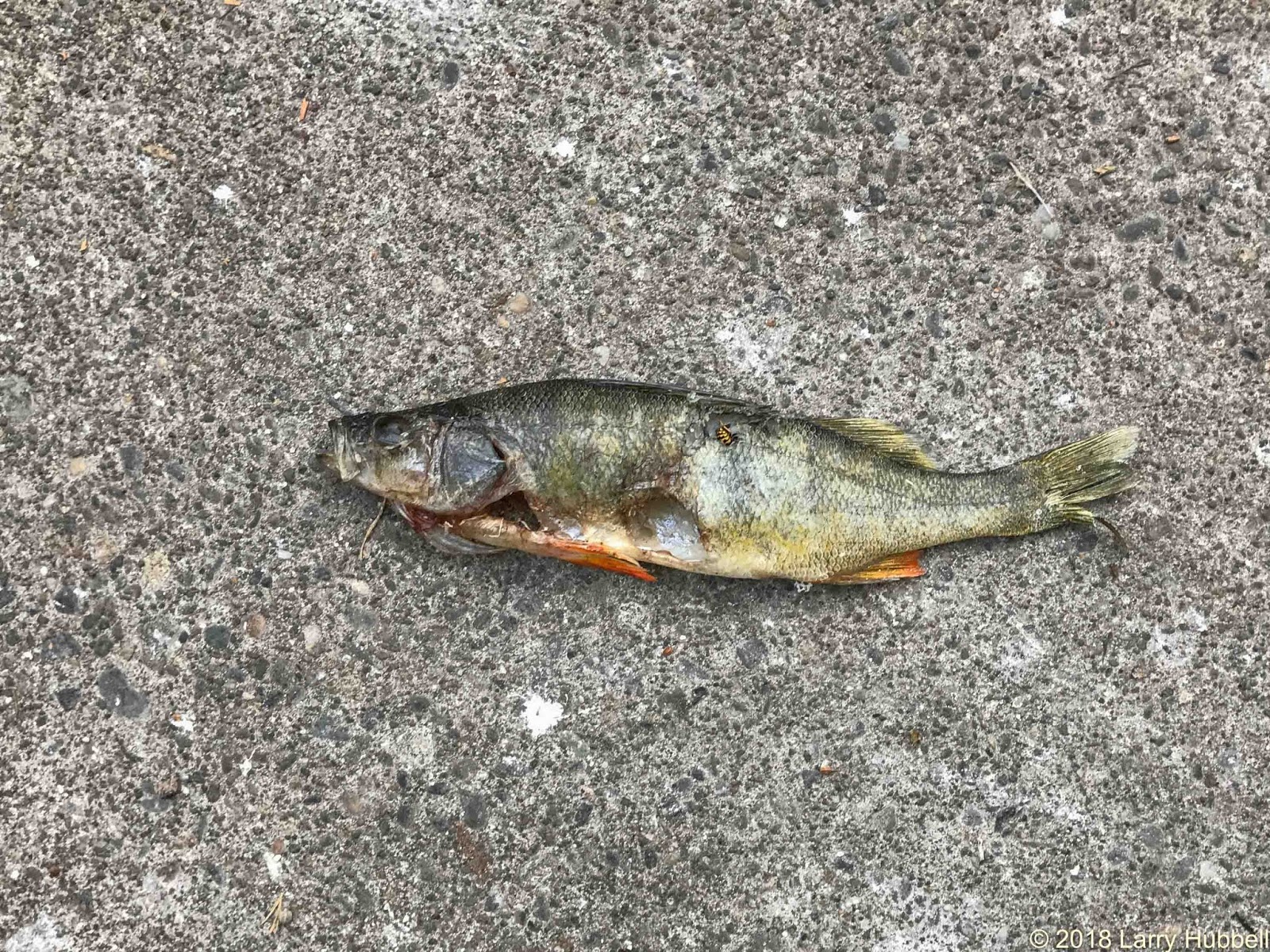
Earlier that morning, I noticed this uneaten fish on the sidewalk below the nest. Even though Lucy missed this small meal, I have seen enough feedings to know she is not starving.
 On Thursday, Lucy was still on the safe side of the sky bridge. Once again, I was starting to hope she had finally deduced that The Bridge was a death trap.
Later, I watched from a distance as one of the parents, Marsha I think, brought Lucy a rat secured from the north side of Montlake Cut.
I have met many neighbors in the area who have all been excited and welcoming to Monty and Marsha and their young. One of the questions I am often asked is, What will the parents do next year? I do not know, however, I see no reason for them to abandon a territory which appears to adequately provide for their needs. The nesting tree is still standing and at a location they like. My guess is they will rebuild the nest.
The next question which comes to my mind is, can we do anything to help the eagles succeed? Here are two suggestions.
Avoid pesticides which kill creatures like rats and bioaccumulate in predators like eagles. It is critical for eagles, owls and hawks that we do not enable poisoned pests to become available for their consumption. Wild creatures are the most sustainable and natural means of pest control. Click Here to read the very informative thoughts and recommendations of our local experts at the Urban Raptor Conservancy.
Fish are the main source of food for eagles. One of the most dangerous chemicals impacting the development of fish is motor oil. Sadly, until the southern portion of the 520 Bridge is completed, the road runoff is still flowing directly into Union Bay. My suggestion is that for the next five years if you have a choice between driving a fossil-fueled vehicle across 520 or taking a different route (or vehicle), take the alternative. Every ounce of oil we keep out of Union Bay is healthier for the fish, which are Monty and Marsha's primary food supply.

On Thursday afternoon, Lucy was still on the safe side of the Sky Bridge. My hopes were rising.

On Friday, not only was Lucy still on a large branch attached to the main part of the tree, but her behavior was also starting to change. She appears to be starting to branch. Branching is just like it sounds. It is the process through which a young eagle learns to fly. They will often sit and flap their wings to develop strength, while occasionally making short hops to other branches in the nesting tree.
So far I have not seen her hop to a new branch, however she has been moving progressively further out on one of the large sturdy branches. Plus, she is flapping her wings more and preening her feathers. If you look closely at the photo above, you can see a white downy feather floating in front of her chest. Part of flight development is maintaining and spreading out her new feathers so they are completely functional. No doubt this process includes the removal of any old nonfunctional feathers as well.
It is exciting to see Lucy making progress in her development. I suspect that sometime in the next few weeks she will learn to fly. The parents are doing their part to bring her food. Lucy is finding adequate space to sleep and appears to be proceeding with normal development. Most importantly, it appears her decision making is improving and she is no longer sidling across an eaglet's version of The Bridge to Nowhere.
Have a great day on Union Bay...where nature lives in the city!
Larry
Without a well-funded Environmental Protection Agency, it falls to each of us to be ever more vigilant in protecting our local environments. Native plants and trees encourage the largest diversity of lifeforms because of their long intertwined history with our local environment and native creatures. I have been told that even the microbes in the soil are native to each local landscape. My hope is that we can inspire ourselves, our neighbors and local businesses to respect native flora and to support native wildlife at every opportunity. I have learned that our most logical approach to native trees and plants (in order of priority) should be to:
1) Learn and leave established native flora undisturbed.
2) Remove invasive species and then wait to see if native plants begin to grow without assistance. (If natives plants start on their own, then these plants or trees are likely the most appropriate flora for the habitat.)
3) Scatter seeds from nearby native plants in a similar habitat.
4) If you feel you must add a new plant then select a native plant while considering how the plant fits with the specific habitat and understanding the plant's logical place in the normal succession of native plants.
My intention in my weekly post is to include at least one photo each week and visually challenge us to know the difference between native and non-native lifeforms.
1) Learn and leave established native flora undisturbed.
2) Remove invasive species and then wait to see if native plants begin to grow without assistance. (If natives plants start on their own, then these plants or trees are likely the most appropriate flora for the habitat.)
3) Scatter seeds from nearby native plants in a similar habitat.
4) If you feel you must add a new plant then select a native plant while considering how the plant fits with the specific habitat and understanding the plant's logical place in the normal succession of native plants.
My intention in my weekly post is to include at least one photo each week and visually challenge us to know the difference between native and non-native lifeforms.

Is the bee (in the lower right part of the photo) native to the Pacific Northwest? What species is it?

For bonus points identify the plant, which was close to 18 inches high and growing in area which was disturbed during the last year.
***************
Scroll down for the answer
***************
I believe this bee is a male native Agapostemon Texanus. Click on the highlighted name to download the source pdf behind my conclusion. See bee number two.
My best guess, is that the plant is Trifolium Arvense. If I am correct it is of European origin and invasive. Click on the highlighted name for more information.
***************
The Email Challenge:
Over the years I have had many readers tell me that Google is no longer sending them email announcements regarding my posts. Even more frustrating when they go to 're-sign-up', hoping that will enable them to once again start receiving the announcements, they get a message which says 'Sorry, you are already signed up.' Google has not responded to my requests for help with this issue.
My functional work around is to setup my own email list and each week I manually send out a new post announcement. If you are experiencing the issue and would like to be added to my personal email list please send me an email requesting to be added. Thank you for your patience!
My email address is LDHubbell@comcast.net
*********************


