Mission: To promote the appreciation of wildlife and increase harmony between humanity and nature.

On Instagram: @unionbaywatch

Monday, June 12, 2023

New Life

In this photo, Monty and Marsha are clearly focused on someone new in their Montlake Cut nest. This photo was taken a week ago Sunday. May 21st. The evening before, I received two emails alerting me to new life in the nest. My friend, Susan, was the first to break the news. Thank you, Susan! That was followed by my friend, Alejandro, sending video and stills that helped document the situation. 

The young eaglet is a little hard to notice but if you look straight down from Monty's neck the eaglet's upper head and one eye are barely visible below the horizontal "X" of small branches. 

Moments later, the eaglet stands out a bit more against the dark feathers on Marsha's chest. 

This is also a good chance to compare the shadows around Monty and Marsha's eyes. My perception is, that Monty generally has just a tiny shadow in front of his eyes. On the other hand, Marsha generally seems to have smudges behind and below her eyes as well. I think they make her look somewhat tired and irritable, while to me Monty always looks rested and ready. Obviously, my perception of their emotions has nothing to do with their real feelings. However, even these imperfect perceptions are helpful as little hints of recognition. Knowing which one is which makes watching them and the roles they play very interesting.

This is the sixth Spring with Monty and Marsha nesting next to Montlake Cut. Before building their first nest they spent time just north of the Waterfront Activities Center (WAC) which is their most frequent hunting spot.  About the same time as they began taking over the southwest portion of Union Bay, they also acquired Montlake Cut, Marsh Island, and Portage Bay, as parts of their territory. Each year, they have nested in the same centrally-located tree. Although not always in the same nest.  Supporting branches have broken, the nests have shifted under the weight of growing eaglets and the nests have fallen more than once.  At least three of their young have also fallen, before they could fly, and ended up at the Progressive Animal Welfare Society i.e. PAWS. However, thanks to PAWS, all the young healed up and were released with a new lease on life. 

City birds face challenges that country birds seldom encounter. For example, each year on the Opening Day of boating season boats parade through Montlake Cut. They go back and forth all day long.  Music blares. Motors roar and horns honk. It's a party! Amazingly, Marsha and Monty appear to have adapted. This is especially obvious because their young apparently hatch out right around the same time.  Maybe we should teach Seattleites that Opening Day should also be a celebration of new life hatching out, i.e. eggs opening, in Monty and Marsha's nest. 

Speaking of which, just hours after Susan's email, my friend, Alejandro, sent in this frame from a video he took on the same day.  This is the very first proof I saw of young in this year's nest. A special Thank You to Alejandro Mallea!

 
Here is a small portion of Alejandro's video that shows two young in the nest. Right at the beginning the first eaglet puts its head down and we are thinking a second one promptly raises his head just a little further to the right. 

Last Sunday, Alejandro also caught the adults having what looks like a parental discussion. I wonder if they discuss whose turn it is to hunt and who gets to sit at the nest?

On May 30th, Marsha put her head back and called while Monty was away from the nest. Shortly after, she left the nest. A few minutes later, Monty appeared. He came and sat on a branch just above the nest. It seemed obvious to me that she had called for him to come and watch out for the young.

Sadly, since then we have not seen a second eaglet. The lone eaglet we have seen is now a week older in this photo (Thank you, Alejandro!). You can faintly see the yellow outline of its bill and the feathers on its head look more gray than white.

Alejandro even caught the moment when the adult was putting food in the youngster's mouth. (Very nicely done!)

If you would like to see more of Alejandro's incredible photography and video work.  You can enjoy it at:


The next day, I caught a few more photos of the young one in the nest. 

The eaglet is holding its head high and looking larger by the day.

This photo feels like an optical illusion. The eaglet has its back to us. The bright yellow bill belongs to the adult even though it looks like it could be sticking out of the eaglet's head. The young bird's bill is mostly black, particularly near the tip, and it is pointed down on the right side of its head. It may take a moment to get the perspective. 

What is most interesting here is seeing  the two pillow-like structures below the young bird's head and shoulders. I suspect these are partially-developed and half-folded wings. The gray downy feathers covering its body look almost like fur rather than feathers.

Later, I caught this photo which confirmed the state of the young eaglet's wings, on May 31st. The primary feathers are just barely visible and they have a lot of growing to do. These tiny inch long nubbins will ending up being primary feathers a foot and half long before the end of July. 

At the moment this photo was taken the wind was blowing briskly through the leaves and both adults were facing into the wind. The wind provides extra lift if they choose to take off and it helps to keep their feather properly in place so usually adult birds find a way to face into the wind. I was very surprised me when the young bird, with its useless little wings, also turned into the wind and began lifting its wings. Even though its first flight is probably a month or more away the eaglet already knows to face into the wind and it has the innate drive to begin working and strengthening its wings.


During the next month or so we will have many opportunities to watch the young bird being fed and to see the parents hunting on Union Bay. 

On the 31st, while the young one was out of sight, apparently sleeping, I went looking for Monty. I was hoping I might see him hunting. Just when I gave up and started for home Monty passed me heading north.

He stopped on a low snag and actively watched in every direction. After a few moments, he sprung off the branch and dipped out sight toward the water. 

He was immediately escorted back in my direction by an irate crow. I would not be surprised if the crow had young of its own in the area.

Monty seemed irritated by the crow plus he might have been disappointed that he missed out on the food he was after. He perched for a moment and then once the crow flew away he made a second pass at the water.

This time he came up with a fish.

Currently, when the adults bring food to the eaglet they remove small morsels and feed it one little piece at a time. Before long that extra effort will come to an end. By July, the parents will just stop and drop the food. The young one will have to do all the meal preparation. Which is one step towards independence. Later, another step along the way will be jumping, hopping and flapping from branch to branch - called branching. This will help it gain the strength (and confidence) to fly.

Actually, flying is one more step in the process of independence. By Winter, the young bird will also need to hunt for itself and will most likely be totally on its own. Curiously, for eagles independence and maturity are not the same thing. They are independent before they are one year old, but it can take as long as five years before they mature. Only then do they get the white heads and tails that signal to prospective partners that they are ready to mate, defend a territory, and raise young. 

Given that humans mature even more slowly than eagles I wonder why it is that we do not have a convention that separates independence and maturity. 

During the years after independence and before maturity one of the things eagles often do is fight over food. Click Here to read about what was most likely a food fight earlier this year.

During the next few weeks, it will be fun to watch the growth of the young bird as well as the roles the parents play in the process.

Monty leaving the nest.

Have a great day on Union Bay...where nature lives in the city and Black Birders are welcome!

Sincerely,
Larry


Going Native:

Each of us, who breathes the air, drinks water, and eats food should be helping to protect our environment. Local efforts are most effective and sustainable. Native plants and trees encourage the largest diversity of lifeforms because of their long intertwined history with our local environment and native creatures. Even the microbes in the soil are native to each local landscape. 

I hope we can inspire ourselves, our neighbors, and local businesses to respect native flora and support native wildlife at every opportunity. I have learned that our most logical approach to native trees and plants (in order of priority) should be to:

1) Learn and leave established native flora undisturbed.
2) Remove invasive species and then wait to see if native plants begin to grow without assistance. (When native plants start on their own, then these plants or trees are likely the most appropriate flora for the habitat.)
3) Scatter seeds from nearby native plants in a similar habitat.
4) If you feel you must add a new plant then select a native plant while considering how the plant fits with the specific habitat and understanding the plant's logical place in the normal succession of native plants. 

*************** 

My friend Elaine Chuang shared several resources (that were new to me) from the January 2022 Washington Ornithological Society meeting. By the way, Elaine credits Vicki King for researching and supplying this information. Keystone native plants are an important new idea. Douglas Tallamy in the book "Nature's Best Hope " explains that caterpillars supply more energy to birds than any other plant eater. He also mentions that 14% of our native plants, i.e. Keystone Plants, provide food for 90% of our caterpillars. This unique subset of native plants and trees enables critical moths, butterflies, and caterpillars that in turn provide food for the great majority of birds, especially during the breeding season. 

Here are some relevant links.

A video all about native keystone plants for wildlife:

https://www.youtube.com/watch?v=O5cXccWx030

Resources for adding keystone native plants to your yard. 

https://wos.org/wos-wp/wp-content/uploads/2022/10/Native-Plant-Resources-10-7-22.pdf

This updated collection includes a variety of new and different books, perspectives, and interactions between plants, birds, and insects. Thank you to Vicki King for continuing to collect all of these exceptionally helpful works. Also, thank you to each of the individuals who contributed.


***************


In the area below it is my intention to display at least one photo each week to help challenge us to know the difference between native and non-native lifeforms. 


Is this flower native to our area?


Scroll down for the answer.


******************


Yellow Flag Iris: No, it is not native. It out-competes many native plants and is a Class C noxious weed. Killing it with chemicals maybe the easiest approach, but the chemicals may also be most detrimental to native life forms as well.


*****************


The Email Challenge:


Over the years, I have had many readers tell me that Google is no longer sending them email announcements. As of 2021,
 Google has discontinued the service.

In response, I have set up my own email list. With each post, I will manually send out an announcement. If you would like to be added to my personal email list please send me an email requesting to be added. Something like:

                Larry, Please add me to your personal email list. 

My email address is:  

                     LDHubbell@comcast.net

Thank you!


*******************


The Comment Challenge:

Another common issue is losing your input while attempting to leave a comment on this blog. Often everything functions fine, however, sometimes people are unable to make it past the 
robot-detection challenge or maybe it is the lack of a Google account. I am uncertain about the precise issue. Sadly, a person can lose their comment with no recovery recourse. 

Bottom Line: 

If you write a long comment, please, copy it before hitting enter. Then, if the comment function fails to record your information, you can send the comment directly to me using email.
My email address is:  

                     LDHubbell@comcast.net

Sincerely,
Larry


A Final Photo:

As of yesterday, the eaglet is looking decidedly larger. I am guessing its primary feathers are growing almost a half an inch a day.


Sunday, April 30, 2023

Boundaries

Given the preponderance of crows in Seattle, the average park visitor in the Arboretum might understandably assume that a distant blackbird, sitting on an upper branch in a Douglas Fir tree, is an adult American Crow.
 
In this case, a closer look reveals a small pink stripe on the inner portion of the bird's bill, which indicates it is actually a young bird. The long heavy bill and the nearly non-existent crown of the head inform us that it is not an American Crow but rather an immature Common Raven. 

To the best of my knowledge, this is only the fourth Spring since Ravens have returned and resumed raising young in and around the Arboretum. I have seen no information that indicates Ravens nested in the area, before 2020, in either the 21st or the 20th centuries. I suspect their previous nearby nesting efforts occurred before the logging of old-growth timber in the later part of the 19th century. 

During the last one hundred and twenty years many native trees flourished among the Arboretum collections and have grown to be over hundred feet tall. The fact that the Ravens have chosen older conifers as their nest sites, for the last four years, seems to validate the idea that tall trees are important as nest sites for the Ravens.

When the young raven turned and began walking back down the branch it exposed another age-related hint.

The bright white shafts of its primary feathers were fully displayed. In adult Ravens, these are hidden by their coverts, small black feathers, that cover the base of their primary feathers and help to create a seamless functional wing. This process of walking about among the branches, while young birds practice flapping their wings, is aptly referred to as 'branching".

In this video, one or two of the three young ravens can be seen working their wings on a branch just above the distant nest.

Back on the opposite side of the trunk the sibling, that we saw walking down the northern branch, quickly turns around when an adult approaches with food. The fledgling's excitement is made visible by the young bird flapping its wings, tipping its head back, and displaying its brightly-colored and wide-open mouth. These visual clues are the equivalent of the young raven begging, "Feed me, feed me". 

Ravens are like humans in that they are omnivores. This adult may have been looking for fruit to feed to the young. In the past, I have seen them eating fruit, blossoms from Big Leaf Maple trees, meat from creatures that appeared to have been killed by Lake Washington Blvd traffic, and many other varied and unknown food sources.
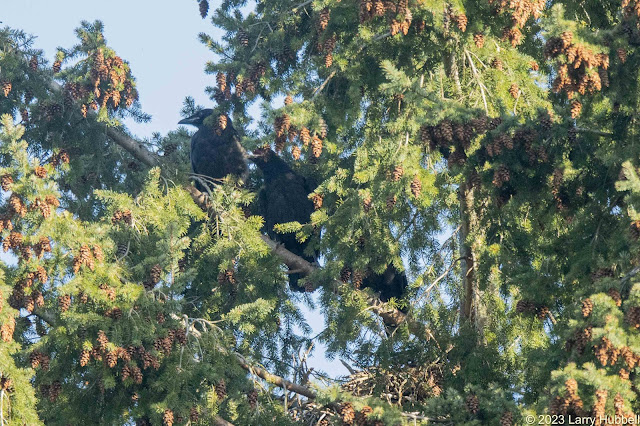
This photo focuses on the south side of the tree trunk and shows a small portion of the mostly hidden nest at the bottom. Above the nest, and slightly to the left are the partial outlines of three young ravens. They can be seen (kind of) sitting side by side. Their natural camouflage and the secretive siting of the nest are obviously effective.

None of these three have demonstrated the ability to fly, that I have seen. However, their first flights could come at any time. In fact, I would not be surprised to discover an older sibling might have already flown the coup. 

During the previous three years, I have documented that the adult Ravens had two, five, and three young, respectively. However, it is certainly possible I overlooked some additional offspring. This year, it is still early so I am cautiously stating, I think they have at least three young. 

One of the more exciting moments this last week was when the neighboring Red-tailed Hawks appeared to encroach into the Ravens' territory. The Hawks nested nearby in Broadmoor. In previous weeks a young Red-tail could be heard begging for food, also in a tall Douglas Fir, but could never be seen. I suspect that the young hawk may have accidentally flown closer to the Ravens and as a result, the parents on both sides jumped into action.

It is interesting to compare the strikingly different shapes of their heads, wings, and tails in the photo above. The color difference is also obvious but depending on the light that is not always the case. The lighter-colored Red-tailed Hawk is on the left. 

The photo below, of an American Crow, is intentionally small to provide an appropriately-sized comparison between the Raven (above on the right) and the Crow. Notice the shorter, and more rounded shape of the Crow's wings and the more wedge or diamond-shaped tail of the Raven, also the Raven's head and bill protrude more than those of the other two species.


The Raven was far more agile and dived repeatedly at the Red-tailed Hawk. The Hawk rolled over in mid-air to present its talons in defense.

Neither species was quick to leave the area.

I suspect strong parental motivation on both sides.

Here is another interesting comparison of their silhouettes. Notice the shape of the Raven's tail can change quite a bit depending on how it is held or used.

Ultimately, they decide to peacefully co-exist, which was probably a great relief for all involved.

As of today, these young ravens may have already left the nest. However, I suspect they are likely to hang around in the Arboretum for a few weeks. Most likely, they will slowly disperse to nearby places, like Interlaken Park, while spending less and less time with their parents. However, while this transition occurs they will be almost constantly begging for food and often traveling together in a small flock of siblings.

These calls were recorded in 2021. However, I anticipate if you visit the Arboretum during the next month or two you may hear similar sounds. I hope it is comforting to know these are not the sounds of people in pain or the weak cries of starving young Ravens. The volume with which they cry is the first clue to their adequate supply of food. Plus, I have heard them make the same exact sounds in between bites of food. As they mature they will learn to find their own food and learn there is value in doing so quietly. 

Have a great day on Union Bay...where nature lives in the city and Black Birders are welcome!

Sincerely,
Larry

ps:

New! Article in the Seattle Times about improving your backyard habitat! 

Going Native:

Each of us, who breathes the air, drinks water, and eats food should be helping to protect our environment. Local efforts are most effective and sustainable. Native plants and trees encourage the largest diversity of lifeforms because of their long intertwined history with our local environment and native creatures. Even the microbes in the soil are native to each local landscape. 

I hope we can inspire ourselves, our neighbors, and local businesses to respect native flora and support native wildlife at every opportunity. I have learned that our most logical approach to native trees and plants (in order of priority) should be to:

1) Learn and leave established native flora undisturbed.
2) Remove invasive species and then wait to see if native plants begin to grow without assistance. (When native plants start on their own, then these plants or trees are likely the most appropriate flora for the habitat.)
3) Scatter seeds from nearby native plants in a similar habitat.
4) If you feel you must add a new plant then select a native plant while considering how the plant fits with the specific habitat and understanding the plant's logical place in the normal succession of native plants. 

*************** 

My friend Elaine Chuang shared several resources (that were new to me) from the January 2022 Washington Ornithological Society meeting. By the way, Elaine credits Vicki King for researching and supplying this information. Keystone native plants are an important new idea. Douglas Tallamy in the book "Nature's Best Hope " explains that caterpillars supply more energy to birds than any other plant eater. He also mentions that 14% of our native plants, i.e. Keystone Plants, provide food for 90% of our caterpillars. This unique subset of native plants and trees enables critical moths, butterflies, and caterpillars that in turn provide food for the great majority of birds, especially during the breeding season. 

Here are some relevant links.

A video all about native keystone plants for wildlife:

https://www.youtube.com/watch?v=O5cXccWx030

Resources for adding keystone native plants to your yard. 

https://wos.org/wos-wp/wp-content/uploads/2022/10/Native-Plant-Resources-10-7-22.pdf

This updated collection includes a variety of new and different books, perspectives, and interactions between plants, birds, and insects. Thank you to Vicki King for continuing to collect all of these exceptionally helpful works. Also, thank you to each of the individuals who contributed.


***************


In the area below it is my intention to display at least one photo each week to help challenge us to know the difference between native and non-native lifeforms. 


This butterfly was spotted last week by a very observant participant in the Arboretum Earth Day Work Party. What species is it? Is it native?

By the way, if you thought this butterfly looks like it is upside down - you are correct. The online source, click on the name below to read more, says these butterflies often feed on the sap of trees and will do so with their heads pointed down. 


Scroll down for the answer.


******************


Mourning Cloak: Yes. It is native to both North America and Northern Eurasia. For an interesting explanation of the name Click Here. 

This butterfly, found later in the week, is holding its head up. From what I read, it is most likely not feeding, but rather waiting in the sunshine while hoping to attract a passing female.

ps: If you still need a further distraction, You can try to find me waving at you in one of the photos from the Arboretum Earth Day Work Party?


*****************


The Email Challenge:


Over the years, I have had many readers tell me that Google is no longer sending them email announcements. As of 2021,
 Google has discontinued the service.

In response, I have set up my own email list. With each post, I will manually send out an announcement. If you would like to be added to my personal email list please send me an email requesting to be added. Something like:

                Larry, Please add me to your personal email list. 

My email address is:  

                     LDHubbell@comcast.net

Thank you!


*******************


The Comment Challenge:

Another common issue is losing your input while attempting to leave a comment on this blog. Often everything functions fine, however, sometimes people are unable to make it past the 
robot-detection challenge or maybe it is the lack of a Google account. I am uncertain about the precise issue. Sadly, a person can lose their comment with no recovery recourse. 

Bottom Line: 

If you write a long comment, please, copy it before hitting enter. Then, if the comment function fails to record your information, you can send the comment directly to me using email.
My email address is:  

                     LDHubbell@comcast.net

Sincerely,
Larry


A Final Photo:


Friday, April 21, 2023

Just Right

Last Saturday, before I was fully awake, this Black-capped Chickadee was hard at work gathering moss from a tree in my front yard. The moss on the tree looks a bit raggedy because the crows have also been utilizing it to line their nest.

Just like a human carrying laundry, the Chickadee tries to save trips by carrying the largest load possible.

Nonetheless, it still made multiple trips to the tiny birdhouse outside our kitchen window. Last year, the Bewick's Wrens used the same birdhouse. (It is always good to clean out nest boxes, during the prior winter, so any unwanted pathogens will be gone before the next occupants move in.)

Black-capped Chickadees are not as stunningly beautiful as Hummingbirds. They are not as large and majestic as Bald Eagles. They do not look as cuddly and cute as Bushtits. They do not sing as elegantly as Song Sparrows. However, they are abundant, cheerful, and adaptable. I have heard coaches say, "The best ability is availability." When other bird species migrate south in the winter, or in spring when other species migrate north to breed, the Chickadees remain. They are year-round residents. A bird for all seasons.

For a creature so small, a single Chickadee weighs about the same as 10 shelled almonds, they can survive our wettest winters and more impressively then can even survive snow-covered winters in much of Alaska and Canada. For a curious comparison of our local sub-specie with those in Alaska: Click Here.

Black-capped Chickadees are particularly helpful to aspiring birders. to begin with, they say their own name i.e. "Chickadee, dee, dee". Also when they repeat the "dee" they can communicate with other bird species.  All About Birds says, "The more dee notes in a chickadee-dee-dee call the higher the threat." When listening to a Chickadee, who was watching a Merlin eat a smaller bird, the greatest number of "dees" I have heard in a row was seven. This is also good information for a birder who is interested in finding predatory birds or creatures.

Another fun benefit of watching Chickadees is that other species will often spend time in mixed flocks with Chickadees. Presumably, taking advantage of the flock's, mutual protection and alarm pact. Essentially, they can help the novice birder find other non-predatory species as well.

In addition to their need for food, Chickadees need safe nest sites, to raise their young, and they also need protected roost sites - especially during the cold of winter. Last Friday, the bird in this photo was sitting on a dead branch in the Arboretum, just north of Rhododendron Glen.

It, and its mate, entered the decaying knot hole multiple times to remove the soft inner wood and create space for a nest.
 
Afterward, usually in less than a minute, they would come shooting out of the hole with a small beakful of woody material which they carried away from the nest site. Apparently, trying to keep from advertising the nest's location.

Chickadees do not care about the species or the size of the tree. Their biggest requirement is that the wood is soft and easily removed. This nest was in a crack in the stump of a long-dead Cottonwood tree on Foster Island. By the next Spring, the stump had lost its integrity and fallen over. Kind of like the story of Goldilocks and the Three Bears, the soft dead wood has to feel "just right" to attract the Chickadees.

However, the whole tree does not have to be dead. This nest was in a living Oregon Ash, in a knot hole created when a branch died or was removed, many years before.

I suspect this birch tree was probably killed by the bronze birch borers. Luckily, the dead tree was left standing in the Arboretum and the Chickadees made good use of it last year. 

By the way, Oregon State University states that "Native birch species are the most resistant to this insect." 

On April 11th last year, this pair of  Chickadees consistently returned to the Birch tree to remove more wood and open up their nest site. 

Five days later, I found another pair doing the same type of excavation in a dead branch of a Pacific Madrone tree.

Not only did they remove the small loads of wood chips but...

...they also carried them away from the nest. This bird landed on a nearby branch and then began spreading the chips around. If you look closely, you can see two microscopically small pieces of wood flying away from the Chickadee.

Perhaps the bird grew impatient with the distribution process.

It left part of the pile on the branch and took off with a remnant still in its mouth.

The fun part of finding Chickadees' nest building is that you can return later and watch their progress as the family grows. This photo is from mid-May, 2022, and the adult bird is bringing some type of larva to the nest to feed its young.

Douglas Tallamy teaches that the larvae of butterflies and moths, i.e.caterpillars, are extremely nutritious and beneficial to the young of over 90% of terrestrial bird species in North America. With help from the National Wildlife Foundation, Doug and others have published information that tells us which genus' of native plants and trees are most beneficial to caterpillars and therefore native birds. There is more information about these special "Keystone" plants in the Going Native section below.
 
Of course, the Chickadees will also pick up spiders and any other tiny creatures that they happen to find.

Inside this nest hole, you can see the yellow gape, i.e. the inner bill, of the young bird that was begging to be fed.

After feeding the young the adult carries away the fecal pouch. Removing it helps to keep the nest clean. It also keeps it from falling to the ground where it might signal the existence of a nest overhead.

The previous photos were taken on June 3rd while this photo of a young bird out of the nest was taken on June 6th. (Notice the yellow coloring on the bill which will later turn black as the bird matures.)  

My hope is that these photos will inspire you to leave dead trees and branches in your yards, whenever you can safely do so. Hopefully, this week we will all be watching for nest building, followed in the future by the feeding of young Black-capped Chickadees in our yards or local parks. None of these types of observations will happen with the speed and ease of an internet search. However, if we invest our time outdoors watching nature, I am positive we will reap many healthy and inspiring rewards!

Have a great day on Union Bay...where nature lives in the city and Black Birders are welcome!

Larry


Going Native:

Each of us, who breathes the air, drinks water, and eats food should be helping to protect our environment. Local efforts are most effective and sustainable. Native plants and trees encourage the largest diversity of lifeforms because of their long intertwined history with our local environment and native creatures. Even the microbes in the soil are native to each local landscape. 

I hope we can inspire ourselves, our neighbors, and local businesses to respect native flora and support native wildlife at every opportunity. I have learned that our most logical approach to native trees and plants (in order of priority) should be to:

1) Learn and leave established native flora undisturbed.
2) Remove invasive species and then wait to see if native plants begin to grow without assistance. (When native plants start on their own, then these plants or trees are likely the most appropriate flora for the habitat.)
3) Scatter seeds from nearby native plants in a similar habitat.
4) If you feel you must add a new plant then select a native plant while considering how the plant fits with the specific habitat and understanding the plant's logical place in the normal succession of native plants. 

*************** 

My friend Elaine Chuang shared several resources (that were new to me) from the January 2022 Washington Ornithological Society meeting. By the way, Elaine credits Vicki King for researching and supplying this information. Keystone native plants are an important new idea. Douglas Tallamy in the book "Nature's Best Hope " explains that caterpillars supply more energy to birds than any other plant eater. He also mentions that 14% of our native plants, i.e. Keystone Plants, provide food for 90% of our caterpillars. This unique subset of native plants and trees enables critical moths, butterflies, and caterpillars that in turn provide food for the great majority of birds, especially during the breeding season. 

Here are the top two relevant links.

A video all about native keystone plants for wildlife:

https://www.youtube.com/watch?v=O5cXccWx030

New! Updated resources for adding keystone native plants to your yard. 

https://wos.org/wos-wp/wp-content/uploads/2022/10/Native-Plant-Resources-10-7-22.pdf

This updated collection includes a variety of new and different books, perspectives, and interactions between plants, birds, and insects. Thank you to Vicki King for continuing to collect all of these exceptionally helpful works. Also, thank you to each of the individuals who contributed.


***************


In the area below it is my intention to display at least one photo each week to help challenge us to know the difference between native and non-native lifeforms. 


This is a flowering native plant found in Yesler Swamp this morning. What species is it?


Scroll down for the answer.


******************


Red Elderberry: This photo was taken on April 24th, 2017. I wonder if this year's flowers will brighten up this much in the next three days or whether the rain and clouds will delay their full-fledged bloom.

This photo was taken on June 6th, 2016. It goes from flower to fruit in about six weeks. 

The fruit of this plant is appreciated by a wide variety of birds. I have seen American Crows, Band-tailed Pigeons, Pileated Woodpeckers, and even Wood Duck ducklings eating them. 


*****************


The Email Challenge:


Over the years, I have had many readers tell me that Google is no longer sending them email announcements. As of 2021,
 Google has discontinued the service.

In response, I have set up my own email list. With each post, I will manually send out an announcement. If you would like to be added to my personal email list please send me an email requesting to be added. Something like:

                Larry, Please add me to your personal email list. 

My email address is:  

                     LDHubbell@comcast.net

Thank you!


*******************


The Comment Challenge:

Another common issue is losing your input while attempting to leave a comment on this blog. Often everything functions fine, however, sometimes people are unable to make it past the 
robot-detection challenge or maybe it is the lack of a Google account. I am uncertain about the precise issue. Sadly, a person can lose their comment with no recovery recourse. 

Bottom Line: 

If you write a long comment, please, copy it before hitting enter. Then, if the comment function fails to record your information, you can send the comment directly to me using email.
My email address is:  

                     LDHubbell@comcast.net

Sincerely,
Larry