Eagles grabbing talons and cartwheeling through the air is not a common occurrence, but it does happen. This photo, from 2015, is the only time I have seen it happen near Union Bay. This pair of immature eagles ultimately let go of each other - thereby avoiding a splash-down in Montlake Cut.
My friend, Tom Cotner, pointed out that with adults cartwheeling is often part of their courtship behavior. Our three local adult pairs have been residents of Union Bay for many years. I have never seen any of them cartwheeling. I wonder if courtship is no longer required once a relationship passes a certain age.
Saturday, just before dark, I received a message from Tom. He had heard that two Bald Eagles had fallen to the ground and were still entangled near the Montlake Community Center. We assumed this was the result of them cartwheeling and then failing to disengage before hitting the ground. Tom was told that one of the two might be dead. He was wondering how and if we could help.
The only appropriate and legal way to help is to contact someone who is federally authorized and trained to handle Bald Eagles. However, I was hesitant to call for help without personally accessing the situation. Sometimes, stunned eagles can shake off a fall and simply get up and fly away. We both hurried to the site.
It was beginning to get dark, but there was still enough light to see both eagles were perfectly still. The open eye on the upper eagle did not even blink. I wondered if they were both dead. The upper eagle seemed a bit immature, given its tail and head were not quite completely covered with pure white feathers. I wondered if it initiated the cartwheel as practice for future courting. The other Bald Eagle looked mature. Although, in this case, there was some discoloration which appeared to be blood on the tail.
Tom eventually moved slightly closer to the eagles while trying to determine if they were alive. I imagine he was looking for signs of breathing. Both eagles shifted their heads to keep an eye on him. I immediately called the Seattle Animal Shelter, explained the situation, and requested help. An officer was dispatched to recover the eagles.
A few other concerned souls gathered nearby to quietly wait for the rescue. Behind us in the middle of the Montlake track, a group of people and their off-leash dogs were running around unaware of the eagles on the ground. While we waited, I explained to them that an Animal Control Officer was on the way to help with the eagles. They leashed their dogs, which was much safer for the eagles, before leaving.
Even without dogs around, if the eagles were stuck on the ground at night they would not be safe. We have coyotes, otters and raccoons in the city and I imagine any one of them might be interested in a bald eagle that is unable to fly.
Suddenly, both eagles seemed to come to life and started calling and struggling with each other. The one on top began flapping its wings and pulling to get free. They finally separated and for a moment they stood side by side. Then the younger bird spread its wings and flew away to the north. Disappearing into the dusk.
The older bird walked slowly into the surrounding foliage, something about its left wing did not look right. As darkness fell the reflection of its white head was the only clue to its location. Eventually, the Animal Control Officers arrived and captured the injured eagle. As they left the officers confirmed it was bleeding from the left wing.
Eventually, I heard that on Sunday the injured eagle was transferred to PAWs, the Progressive Animal Welfare Society in Lynnwood. The fact that the eagle lived through the night is encouraging. We will hopefully learn more about its prognosis in a few days after it is examined by a qualified specialist.
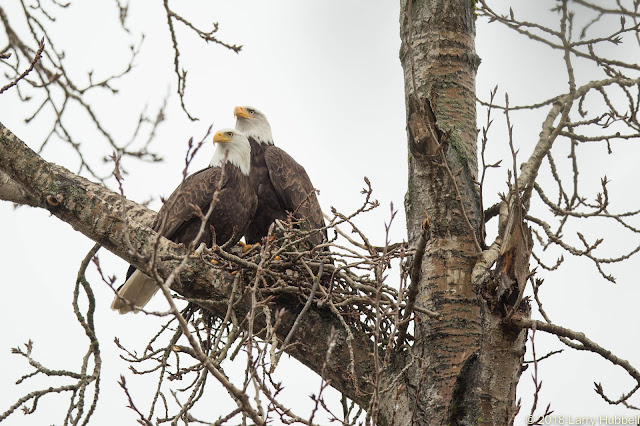 For the last five years, the area around the Montlake Community Center, just south of Portage Bay, has been part of the territory that belongs to Monty and Marsha, the Bald Eagles who nest near the southeast corner of Montlake Cut. This January 2018 photo shows Monty and Marsha at their first (partially constructed) nest.
The scenario that seemed most likely was that one of these two local adults had been defending their territory when the encounter with the younger eagle occurred. While I wondered if the injured eagle was Monty or Marsha several other questions came to mind. How long will it take to recover? Would a healthy mate, who suddenly found itself flying solo, just before nesting season, decide to take a new mate in the meantime? If the injured eagle recovered and was then released, Would it return to the territory and begin fighting with its replacement?
These were interesting questions, but I actually had no proof that the older eagle was Monty or Marsha. I decided to try to determine if both of them were still present in their usual locations.
On Sunday, I could not find either of the Montlake Cut eagles at any of their normal roosting spots.
On Monday, I found what appeared to be one of the two in their favorite cottonwood tree just north of the Waterfront Activity Center. At the time I wasn't sure whether it was Monty or Marsha, but after comparing it to other photos I believe this is a photo of Marsha.
On Tuesday, my luck improved. I saw one adult Bald Eagle chasing after a second one that had just caught food. Later, I would learn that someone closer to the situation saw the eagle eating a bird with black feathers. I suspect it was one of the wintering American Coots.
After a bit, the eagles moved again, and I lost sight of them. I could still hear them calling. I headed towards the Waterfront Activity Center. I was planning to check their favorite cottonwood tree when I ran into my friend Sarah. She had also been watching the eagles but from a greater distance and a different angle. She had seen them head back toward the nest tree.
When we circled back we noticed Marsha in the nest and Monty sitting in one of his usual protective spots just above the nest. At the same time, a third Bald Eagle was sitting a few trees to the east of the nest. Apparently, all of the noise was Monty and Marsha telling the intruder to move along.
I hurried back across the bridge and around to the south side of the nest in hopes of catching some photos with a bit better lighting. Monty had left but after a few minutes, he returned. I suspect he escorted the intruder away. In any case, if you look closely you can see that both Monty and Marsha are calling out greetings to each other.
Their faces do appear to be changing as they mature. Monty is getting more of a heavy eyebrow similar to Marsha's. However, Marsha still has a tinge of discoloration on her face immediately behind her eye. In the same area, Monty seems to be developing a small furrow running away from the "back corner" of his eye. Granted, these details can be enhanced or invisible depending on the lighting.
I am happy to know these two are still together and likely to produce young again this year. However, I am still concerned for the unknown eagle that was injured and picked up near the Montlake Community Center. I will let you know when I hear more about its prognosis.
Since that eagle was not Monty or Marsha it makes me rethink what caused the entanglement that led to its injury. I wonder if it was the one who attempted a courtship ritual. Perhaps its efforts were not well received. The wonderful thing about the mysteries of nature is there are always more questions to ask and we will never know all the answers.
Have a great day on Union Bay...where nature lives in the city and Black Birders are welcome!
Larry
ps: The Opening Night Party, Love in Bloom, will be a wonderful benefit to support the Arboretum. I hope to see you there!
|
Reserve Your Seats and Make a Date for Valentine's! |
|
Whether you’re coming to LOVE IN BLOOM with your best buddies or your main squeeze, you'll have an unforgettable time at this special celebration of the Arboretum on February 14th.
But that’s just for starters!
Get ready to be wined and dined, while enjoying a live performance by the Milo Petersen Quintet, featuring stellar jazz musicians Milo Petersen, Phil Sparks, Jay Thomas, Steve Lytle, and Michaela Miller.
You and your guests will have a chance to enter a raffle for a trip to New Orleans, including airfare, hotel stay, and botanical garden tours. Plus, you can sign up for unique experiences, such as bird tours in Arboretum, wildflower hikes with plants experts, and more.
Ticket Price Includes: FREE PARKING at the Washington State Convention Center, plus two FREE PASSES to the Garden Festival for use later in the week, and as always, an exclusive preview of the Festival gardens. |
|
Tickets are also available for purchase by phone at 206-325-4510. |
|
Proceeds support core programs at the Washington Park Arboretum and Seattle Japanese Garden. |
|
Thanks to our generous sponsors for their support of the Arboretum. |
|
|
|
|
|
|
|
Going Native:
Each of us, who breathes the air, drinks water and eats food should be helping to protect our environment. Local efforts are most effective and sustainable. Native plants and trees encourage the largest diversity of lifeforms because of their long intertwined history with our local environment and native creatures. Even the microbes in the soil are native to each local landscape.
I hope we can inspire ourselves, our neighbors, and local businesses to respect native flora and support native wildlife at every opportunity. I have learned that our most logical approach to native trees and plants (in order of priority) should be to:
1) Learn and leave established native flora undisturbed.
2) Remove invasive species and then wait to see if native plants begin to grow without assistance. (When native plants start on their own, then these plants or trees are likely the most appropriate flora for the habitat.)
3) Scatter seeds from nearby native plants in a similar habitat.
4) If you feel you must add a new plant then select a native plant while considering how the plant fits with the specific habitat and understanding the plant's logical place in the normal succession of native plants.
***************
My friend Elaine Chuang shared several resources (that were new to me) from the January 2022 Washington Ornithological Society meeting. By the way, Elaine credits Vicki King for researching and supplying this information. Keystone native plants are an important new idea. Douglas Tallamy in the book "Nature's Best Hope " explains that caterpillars supply more energy to birds than any other plant eater. He also mentions that 14% of our native plants, i.e. Keystone Plants, provide food for 90% of our caterpillars. This unique subset of native plants and trees enables critical moths, butterflies, and caterpillars that in turn provide food for the great majority of birds, especially during the breeding season.
Here are the top two relevant links.
A video all about native keystone plants for wildlife:
https://www.youtube.com/watch?v=O5cXccWx030
New! Updated resources for adding keystone native plants to your yard.
https://wos.org/wos-wp/wp-content/uploads/2022/10/Native-Plant-Resources-10-7-22.pdf
This updated collection includes a variety of new and different books, perspectives, and interactions between plants, birds, and insects. Thank you to Vicki King for continuing to collect all of these exceptionally helpful works. Also, thank you to each of the individuals who contributed.
***************
In the area below it is my intention to display at least one photo each week to help challenge us to know the difference between native and non-native lifeforms.
What plant is this? Is it native to Union Bay?
Scroll down for the answer.
******************
Common Snowberry: Yes, it is a native plant. Follow the link, on the name, to learn more about the Snowberry plant. The linked site also shows a great example of the multiple leaf shapes on a single Snowberry plant. In the Spring, when the fruit is gone, all the different leaf shapes may make identification less challenging, as long as we know to expect the variety.
(It seemed particularly fitting to use a photograph of a Snowberry plant covered in our December snow.)
*****************
The Email Challenge:
Over the years, I have had many readers tell me that Google is no longer sending them email announcements. As of 2021, Google has discontinued the service.
In response, I have set up my own email list. With each post, I will manually send out an announcement. If you would like to be added to my personal email list please send me an email requesting to be added. Something like:
Larry, Please add me to your personal email list.
My email address is:
LDHubbell@comcast.net
Thank you!
*******************
The Comment Challenge:
Another common issue is losing your input while attempting to leave a comment on this blog. Often everything functions fine, however, sometimes people are unable to make it past the robot-detection challenge or maybe it is the lack of a Google account. I am uncertain about the precise issue. Sadly, a person can lose their comment with no recovery recourse. Bottom Line: If you write a long comment, please, copy it before hitting enter. Then, if the comment function fails to record your information, you can send the comment directly to me using email.My email address is:
LDHubbell@comcast.net
Sincerely,A Final Photo:
 After they both ate, Monty and Marsha moved back to one of their favorite roosts near the top of the sequoia above the Waterfront Activities Center.


 For the last five years, the area around the Montlake Community Center, just south of Portage Bay, has been part of the territory that belongs to Monty and Marsha, the Bald Eagles who nest near the southeast corner of Montlake Cut. This January 2018 photo shows Monty and Marsha at their first (partially constructed) nest.





 After they both ate, Monty and Marsha moved back to one of their favorite roosts near the top of the sequoia above the Waterfront Activities Center.


