Yesterday, after about six weeks of great food and healing, Monty and Marsha's overly adventurous young eagle returned to Montlake. Click Here to read how this young eagle left Monty and Marsha's nest before he could fly. In the process, he sustained a cracked clavicle and a metacarpal injury. Thanks to the Progressive Animal Welfare Society (PAWS) for attending to his injuries, providing food, housing, a safe space to learn to fly, and finally the thoughtful timing of his return.
Just after dawn, Jeff Brown from PAWS carefully opened the crate and backed away. Jeff silently sat down to make himself as small as possible. His immediate goal was to allow the young eagle time to calmly and quietly acclimate to his surroundings.
The young eagle spent over five minutes on the ground before finally taking to the air.
The general location of the young eagle's release was determined by his parents and their choice of a territory - surrounding Montlake Cut. Even though the young eagle has proven he can fly, in an enclosure at PAWS, he is not yet able to catch his own food. It is critical that his parents, Monty and Marsha, welcome him back and supply food while he learns to hunt.
Earlier in the day, before his release, the parents brought food to the nest for his sibling, who is now flying with ease. Once their young learn to fly it is just a matter of time before the parents choose to feed them away from the nest and then ultimately quit feeding them altogether. This situation reinforced that releasing the young male eagle as soon as possible is his best chance of being fed by his parents, Monty and Marsha, while he learns to hunt.
 Lucky for us, the Urban Raptor Conservancy (URC), had the opportunity to band this young eagle while he was at PAWS. (Thank you, Patti!) This means if we watch closely (binoculars recommended) we will be able to identify this particular bird. The green and black band with the code 6/S is his unique ID and sightings should be reported. URC keeps the official record of their banded bird sightings. However, in this case, I would love to know when and if you see this eagle as well.
By Winter, the young need to be self-sufficient - even though they will not be fully mature for four or five years. People often ask how long the young remain around their parents. The literature I have read suggests only until Fall. With the ID band, we may be able to see if that actually happens in this case.
The specific location of his release, in front of the Waterfront Activities Center, was chosen because at the time both parents were sitting in the tallest cottonwood on Marsh Island with a clear, unobstructed view of the site. In addition, the paved area provided an open space for the young eagle to get airborne, and the trees to the south, west, and north provided safe landing sites after his initial flight.
After taking to the air the young bird flew strongly while circling fairly low overhead. Slowly, he moved out over the water.
Surprisingly, he chose to sit down in the water. He was quite some distance from shore. We became immediately concerned. Was he exhausted after the longest flight of his life? Would he be able to get lift and take off from the water? Would his feathers get waterlogged and make it even harder to take off? All the boats along the dock were locked up. There was no one else nearby and there was no obvious way to rescue the young eagle.
He partially spread his wings on top of the water. That seemed to help him stay steady and float. His parents watched from the tall cottonwood tree on Marsh Island. They had no way to help. He really was all on his own.
The young eagle seemed to drift closer to the boating channel that connects Lake Washington with Montlake Cut.
Demonstrating an incredible commitment to the young eagle - Jeff jumped in the water. His goal was to swim all the way out and around so he could approach the eagle from the east. Jeff's head is visible just above the buoy on the left. The eagle is floating opposite him on the far right and the parents are barely visible in the cottonwood.Jeff was hoping to inspire the young eagle to fly back to shore. In the worst case, if the young eagle could not fly maybe it would swim to safety. Eagles can do something similar to the breaststroke. However, it looks more like rowing to me.
In 2020, I watched Marsha, the female of this adult pair, use her wings to row to shore. See more about that by Clicking Here. Jeff was doing the dog paddle as he cautiously approached the young eagle.
Suddenly, the eagle left the water. Jeff said there was a moment when it felt like the eagle was heading directly toward him. I am sure he was wondering what would happen next. (I am positive I would not want a young Bald Eagle landing on my head while swimming.)
Luckily, the plan worked as desired and the eagle turned and headed west - towards the shore.
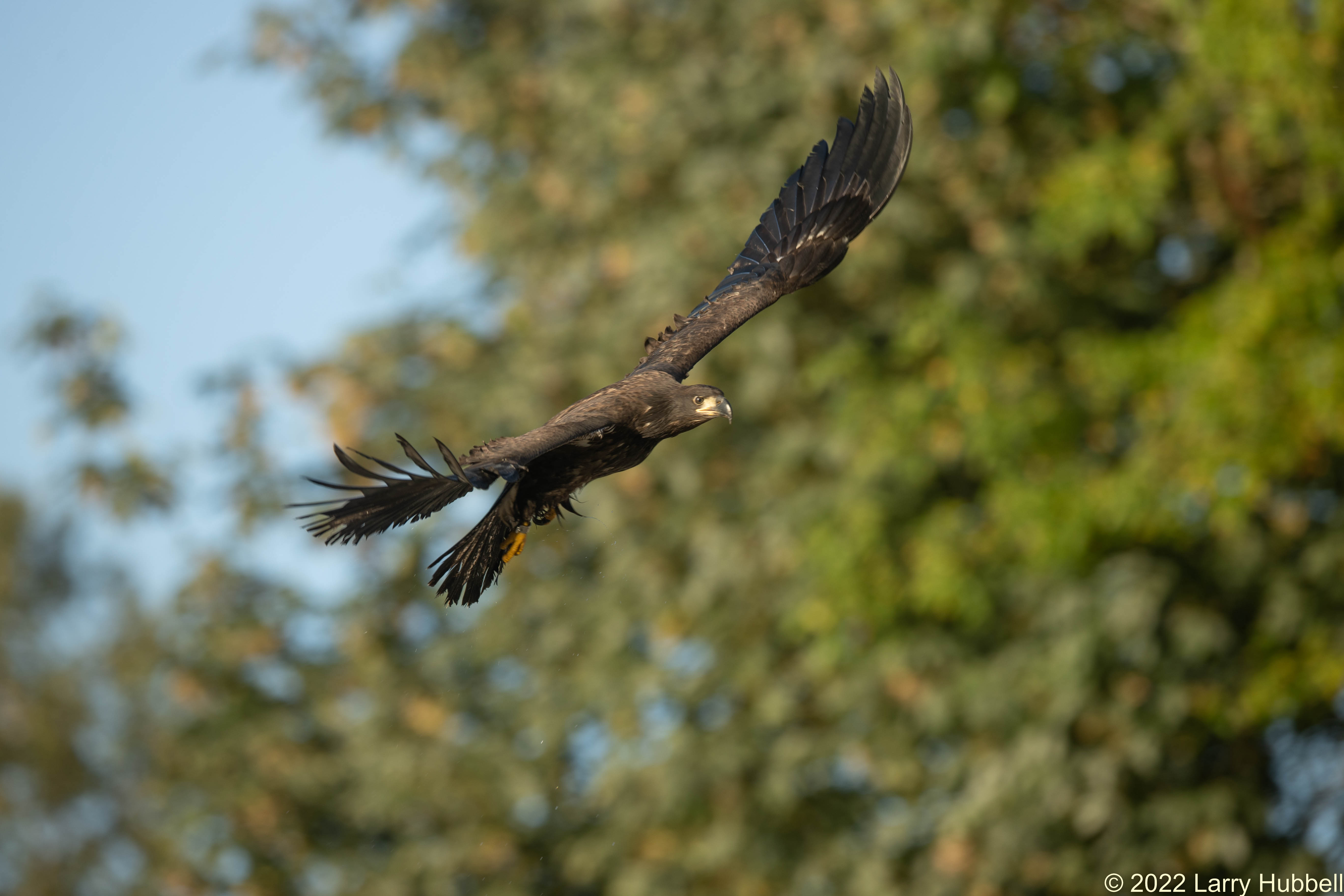
He flew to my south allowing me to catch a couple of sunlit photos.
In this one, it is easy to see how the water was absorbed into his primary feathers, toward the end of his wings. They look much darker than the dry feathers on his back and head. In another surprise, the young eagle turned and flew by me at shoulder height. There were only about three inches between my shoulder and his wing tip, when he flew by.Unfortunately, he choose to land face first, about eight feet off the ground, between the paved roadway and the dock, in a very small tree.
He sat and struggled with his footing while Jeff swam to shore. I attempted to direct runners and walkers to avoid the young eagle as much as possible.
Finally, he figured out how to turn and face the world. When a large truck passed by he chose to leave this perch and flew west - away from the water. We were unable to keep up with him.
However, later as Jeff was leaving the parking lot he spotted the young eagle being harassed by crows. After the eagle escaped the crows, he landed on a higher, and safer, perch in a tree to the south of the Husky Stadium.
After an hour or so he began climbing inward - towards the center of the tree. Some lessons can only be learned by experience.
Although, it is easy to see why young eagles do not have adult colors. Their dark coloring makes it easy for them to disappear into the shadows.
The prickly needles of the old world cedar were apparently not to his liking and soon after his inward migration, he left the tree.
Once again he flew strongly. Once again I lost him. Apparently, he settled into a tree just out of my sight.
However, I was alerted to his presence when a gull began calling and harassing him.

The final time I saw him yesterday he had escaped the gull and was heading back toward the trees to the south of the WAC.
We now know he is a strong flier and his parents are clearly aware of his return. What we do not know is whether they will choose to bring him food or whether he will find his way to the nest - where food is "currently" being served to his sibling. The day before, one of the parents headed to the nest, even though they clearly saw the sibling was north of the WAC. The sibling immediately started food begging and followed the adult to the nest. If this pattern is repeated we can hope it serves as a very clear example for our the returning young eagle i.e. food found here.
In any case, I would love to hear from you if you happen to see 6/S being supplied food by Monty or Marsha. Plus, I am sure Jeff would be greatly relieved to learn that his early morning swim contributed to a fully successful reuniting of this young eagle with its parents.
Have a great day on Union Bay...where nature lives in the city!
Larry
Going Native:
Each of us, who breathe the air and drink the local water, needs to watch and protect our local environment. Native plants and trees encourage the largest diversity of lifeforms because of their long intertwined history with our local environment and native creatures. Even the microbes in the soil are native to each local landscape.
I hope we can inspire ourselves, our neighbors, and local businesses to respect native flora and support native wildlife at every opportunity. I have learned that our most logical approach to native trees and plants (in order of priority) should be to:
1) Learn and leave established native flora undisturbed.
2) Remove invasive species and then wait to see if native plants begin to grow without assistance. (When native plants start on their own, then these plants or trees are likely the most appropriate flora for the habitat.)
3) Scatter seeds from nearby native plants in a similar habitat.
4) If you feel you must add a new plant then select a native plant while considering how the plant fits with the specific habitat and understanding the plant's logical place in the normal succession of native plants.
***************
My friend Elaine Chuang shared several resources (that were new to me) from the January 2022 Washington Ornithological Society meeting. By the way, Elaine credits Vicki King for researching and supplying this information. The major new concept is that specific keystone native plants enable critical moths and caterpillars that in turn provide food for the great majority of birds, especially during the breeding season. Here are the top two links from her list.
Native Keystone Plants for Wildlife:
https://www.youtube.com/watch?v=O5cXccWx030
Resources for adding plants to your Pacific Northwest Garden:
https://wos.org/wos-wp/wp-content/uploads/2021/12/native-plant-resources-v2.pdf
***************
In the area below it is my intention to display at least one photo each week to help challenge us to know the difference between native and non-native lifeforms.
Is this butterfly native to our area? What species is it?
Scroll down for the answer.
******************
*****************
The Email Challenge:
Over the years, I have had many readers tell me that Google is no longer sending them email announcements. As of 2021, Google has discontinued the service.
In response, I have set up my own email list. With each post, I will manually send out an announcement. If you would like to be added to my personal email list please send me an email requesting to be added. Something like:
Larry, I want to see more of nature. Please add me to your personal email list.
Thank you for your patience and interest!
My email address is:
LDHubbell@comcast.net
*******************
The Comment Challenge:
Another common issue is losing your input while attempting to leave a comment on this blog. Often everything functions fine, however, sometimes people are unable to make it past the robot-detection challenge or maybe it is the lack of a Google account. I am uncertain about the precise issue. Sadly, a person can lose their comment with no recovery recourse.
Bottom Line:
If you write a long comment, please, copy it before hitting enter. Then, if the comment function fails to record your information, you can send the comment directly to me using email.
My email address is:
LDHubbell@comcast.net
Finally, if the comment seemed to be accepted but does not show up immediately don't worry. Due to inappropriate spam, I now have to approve all comments that actually make it into my queue. My apologies.
Sincerely,
Larry


 Lucky for us, the Urban Raptor Conservancy (URC), had the opportunity to band this young eagle while he was at PAWS. (Thank you, Patti!) This means if we watch closely (binoculars recommended) we will be able to identify this particular bird. The green and black band with the code 6/S is his unique ID and sightings should be reported. URC keeps the official record of their banded bird sightings. However, in this case, I would love to know when and if you see this eagle as well.