Mission: To promote the appreciation of wildlife and increase harmony between humanity and nature.

On Instagram: @unionbaywatch

Monday, July 19, 2021

First Flight?

On May 23rd the post named, "Waiting", described two young eaglets in this nest. The nest is in the center of this photo roughly two-thirds of the way up the tree. The tree stands on the southeast corner of Montlake Cut. 

We can guess the young eagles were around a month old at that time. That post left us with several unanswered questions about the eaglets and their future. For example, might there actually be three eaglets in the nest? Would the nest stay in the tree until the young learned to fly? (In two of the three previous years, portions of the nest fell to the ground. This caused three of the five previous eaglets to land on the ground before fledging. To keep them safe from coyotes, raccoons, or even dogs, all three spent time at PAWS.) Even if neither of this year's young fall prematurely, will they learn to fly without a mishap? When will they take to the air? 

(In 2020, the first observation of Monty and Marsha's offspring flying was on July 16th.)

In early June, it was good to see both young birds as they sat in the nest.

Zooming in makes it a little easier to see the one in front. 

I can't really tell if birds have emotions. However, it does almost look like the one in the back is laughing. We can at least say they both look well fed.

On the 12th of June, one of the young was seen flapping its wings. 

By June 18th, the eaglets were continually voicing their desire for food. 

At this point, after many observations, I think it is safe to say there were only two young in the nest this year.

Their wings were and are surprisingly large.

Their cries for food did not go unheeded. Monty (I believe) dropped off food.

He stopped and checked for oncoming air traffic, before merging into the flight path. 

At this point, the young were perfectly capable of feeding themselves and also large enough to be dangerous. As a result, Monty did not linger in the nest. This behavior is similar to two years ago when the nest was used as a dining table even after the young learned to fly.

By early in July the young were starting to move out of the nest. They could often be seen on nearby limbs. This behavior is called, "Branching".

Although it is not very obvious, the more adventurous sibling is actually another six feet further out on the same branch, with its upper half hidden among the leaves.

Part of branching looks a lot like flying. They flap their wings to stay up in the air while leaping from place to place. Sometimes they even move up to a higher branch. However, I do not consider this first flight until they physically leave the tree. In this case, the bird was airborne for only a second before it landed on a nearby branch.

In this July 8th photo, the more active one is about 15 feet above the nest at the one o'clock position. By moving so high in the tree, it appeared to be demonstrating both the desire and some of the skill required to fly.

This close-up shows the bird sitting on the same branch as in the previous photo. After branching began I have not always been able to find both of the young when I first arrived at the nest tree. However if I spend long enough waiting, the second bird usually reveals itself via movement or its high-pitched food-begging calls.

You may need to turn up your volume to hear these examples.

I am assuming the second bird is the younger one, since it has been staying closer to the nest and has apparently been slower to develop. Lately, it has also been exercising its wings.

Afterward, it moved out of the nest and...

...stretched one wing and then the other.

One of the adults returned to the nest - apparently without any food.

The upper bird became very excited.

It leaped from one branch...

...to the next. 

I cannot physically tell the difference between the two young birds. However, I am willing to assume the more active bird is probably the older of the two. 

My friend Jerry suggested we call them Mountain and Lake (as in Montlake). He also suggested we use the Lushootseed words to honor the Native Americans on whose land we live. (I understand that the Duwamish people lived locally in the Montlake area and continue to live in Seattle, and are still in need of Federal Recognition.)

It seems logical to me that the more active bird should be the one we call "x̌aču?" or "Lake" since water is almost always moving. While the larger and currently more sedentary bird should be called, "sbadil" or "Mountain". 

Perhaps, the greatest challenge with these names is trying to say them properly. Luckily, Jerry noticed that the Tulalip Tribes of Washington have been kind enough to provide verbal online examples. Click on each word and then play the recording to hear the proper pronunciation.

On the 11th of July, I happened to catch both birds in one photo. This has been happening less and less as x̌aču? moves out to more distant locations in the tree. I cannot say for sure if x̌aču? has flown. I have not been present every day all day. However, during most visits, if I was patient he (or she) would reveal himself and so far has almost always been somewhere in the nest tree.

On July 16th, the same thing happened again.

Both of the young were in the nest tree and begging the adult for food.

When the adult left the area, the more active juvenile moved up towards the top of the tree.

Without any drumrolls, he (or she) simply leaped into the air and circled around the tree.

While I cannot be positive this was x̌aču? first flight, I am certain it was the first time I saw him fly.

He was confident in the air and every feather seemed properly developed and perfectly in place.

At least until the American Crow began chasing him. 

Curiously, as long as the young did not fly the crows have left them alone. On the other hand, whenever the adults come to the tree the crows will normally hassle them. Apparently, the sedentary young were not perceived as a threat. However, as soon as this young bird flew it became a target. I guess you might say the behavior of the crow reinforces the idea that this was x̌aču?'s first flight.

From what I have seen, the crow has been present in the area 24 hours a day every day. But that is a post for another day.

Have a great day on Union Bay...where nature lives in the city!

Larry

ps: The most common question I am asked about young fledgling eagles is, "How long will they stay with their parents?" My understanding is that by the first winter they are on their own. By mid-winter, the adults will begin sprucing up their nest and preparing for their next brood of young. Even though it takes the young four and a half to five years before they mature they become totally self-reliant well before they are a year old.


Going Native:

Each of us, who breathe the air and drink the local water, needs to watch and protect our local environment. Native plants and trees encourage the largest diversity of lifeforms because of their long intertwined history with our local environment and native creatures. I have been told that even the microbes in the soil are native to each local landscape. I hope we can inspire ourselves, our neighbors, and local businesses to respect native flora and to support native wildlife at every opportunity. I have learned that our most logical approach to native trees and plants (in order of priority) should be to:

1) Learn and leave established native flora undisturbed.
2) Remove invasive species and then wait to see if native plants begin to grow without assistance. (If natives plants start on their own, then these plants or trees are likely the most appropriate flora for the habitat.)
3) Scatter seeds from nearby native plants in a similar habitat.
4) If you feel you must add a new plant then select a native plant while considering how the plant fits with the specific habitat and understanding the plant's logical place in the normal succession of native plants.


My intention in my weekly post is to include at least one photo each week and visually challenge us to know the difference between native and non-native lifeforms. 

(By the way, my friend Tom Brown pointed out that the application named 'Wildflower Search' is extremely helpful. Click on the highlighted link to see for yourself.

Also, Jane Lundin has created a small package, with a lot of critical information that looks quite handy, and light, for backpacking in the mountains in Springtime. It is titled, Mountain Wildflowers of Washington.)

Another idea that integrates perfectly with living in harmony with nature is the concept of Forest Gardening. Apparently, Native Americans collected and nurtured dense multi-layered gardens of native herbs, plants, shrubs, and trees that produced food and herbal medicines. Even after 150 years of no maintenance, the gardens are essentially intact and the diversity of life remains significantly higher than in the surrounding forests. Click Here to learn more.


What species of plant is this? Is it native to Union Bay?


Scroll down for the answer.


***************


Hardhack: Also know as Douglas Spiraea, is native to Union Bay, the PNW, and the West Coast of North America and is currently blooming.


*****************


The Email Challenge:


Over the years, I have had many readers tell me that Google is no longer sending them email announcements - regarding my posts. Google never responded to my requests for help with this issue. Now, in 2021,
 the service is being discontinued.

In response, I have set up my own email list. With each post, I will manually send out an announcement. If you would like to be added to my personal email list please send me an email requesting to be added. Something like:

                Larry, I want to see more of nature. Please add me to your personal email list. 

Thank you for your patience and interest!

My email address is: LDHubbell@Comcast.Net


*******************


A final photo:
This juvenile Bald Eagle passed over Monty and Marsha's nest while both of their current young eagles were still in the nest tree. Possibly it is a young eagle in its second calendar year, e.g. just over one-year old. That might help explain why it is beginning to regrow its innermost primaries. It takes two years for Bald Eagles to replace all their feathers and they do so a few feathers at a time. 

Also, notice how the feathers on its head are much more fully developed, e.g. the head and neck look larger, as compared to the earlier photo of x̌aču? in flight.


Sunday, July 11, 2021

Hummers and Nuts


This is a female Anna's Hummingbird, sitting in her nest on March 16th, 2021. 

Last week, while watching a different nest, someone mentioned that the Hummingbird nest was about the size of a walnut. My first thought was, "No! It's bigger than that." 

Of course, I do most of my bird watching through a telephoto lens. Since it makes the birds, and their nests, appear larger than life my visual perspective is not completely trustworthy.

I decided to research the matter. On average, a walnut (as implied on Reference.com) is roughly 32mm in diameter and approximately 40mm in length. This is as compared to an average Anna's Hummingbird nest size of 38mm in diameter and 25.4mm in height. These nest measurements are the metric conversion from data listed on All About Birds. 

The Bottomline: 

The walnut analogy turns out to be quite good. If you were to hold the average walnut length-wise in front of an average Anna's nest the walnut would be about 2mm longer than the nest is wide, and about 7mm taller at the mid-point.  

Another interesting measurement is the length of a mature Anna's Hummingbird bill. In this case, it is roughly the same as the depth of the head - from front to back. I found a National Geographic listing that implies the average length of the beak, for an Anna's, is about 18mm, which is around three-quarters of an inch.

About two weeks later (on March 29th) the small yellow bill of a hatchling was barely visible against the dark background of the mother's bill. Incubation takes about 16 days according to All About Birds.

At this early stage, the nestling's bill is almost a wide as it is long.

Here is a photo from a few years back that shows a similar state of development, but a bit more clearly. At this early stage, the mother inserts her bill quite deeply inside the young bird. Her head bobs when feeding the young. The process reminds me of the needle on a sewing machine.

Birds of the World says that on the fifth day after hatching the young bird opens its eyes for the first time.

All About Birds says the nestling period, between hatching and fledging, for Anna's Hummingbirds is about 20 days. (As with everything in nature, I am sure it varies.) Here is a different nest midway through the hatchling phase. Their bills of the young are about half as long as their mother's. 

My guess, due to their size, alertness, and the length of their bills, is that these young birds are around 10 to 12 days old.

This is the same nest seven days later. The young are getting much closer to fledging.

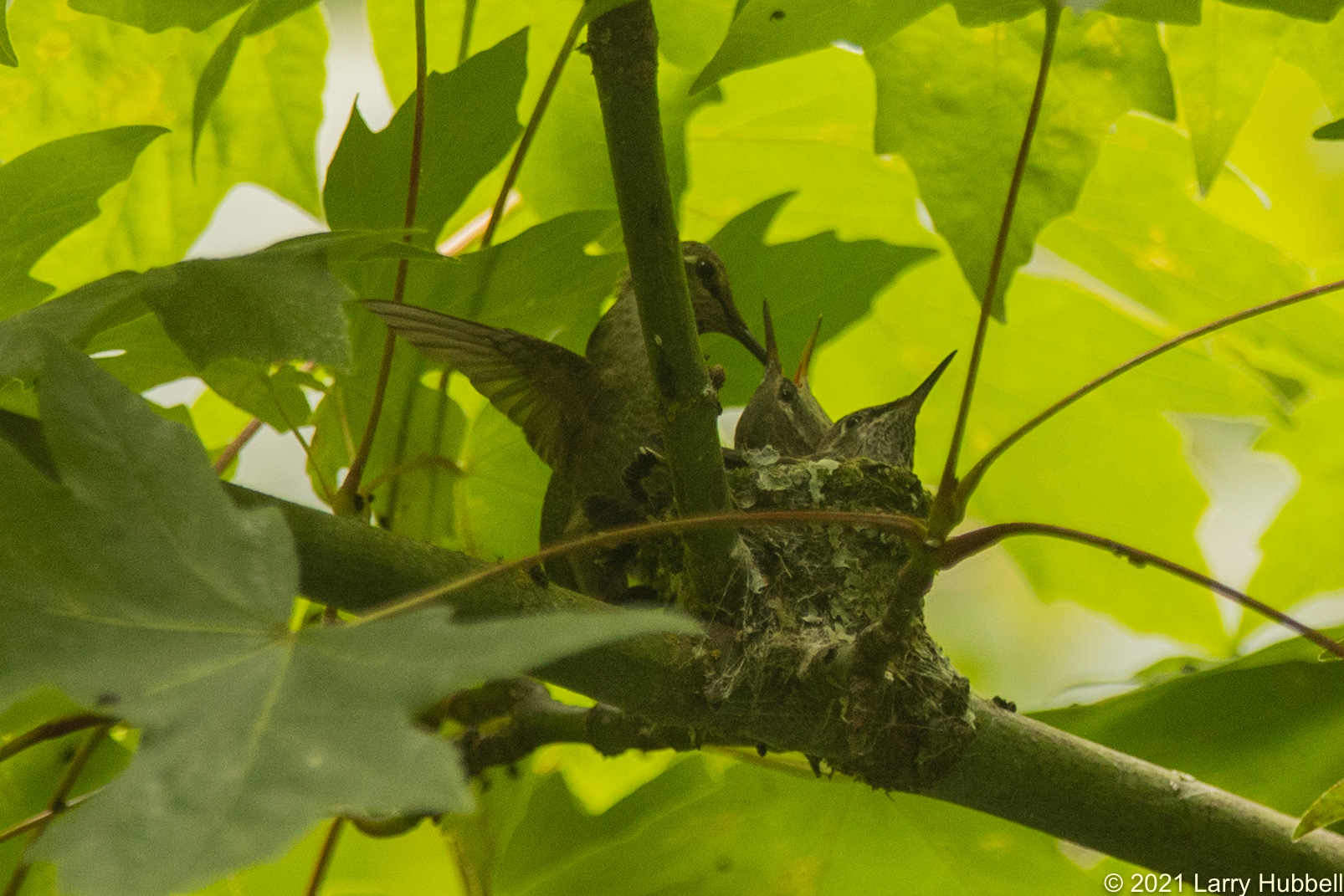
On June 30th, of this year, my friend Sally, showed me another Anna's Hummingbird nest, with two young side by side and waiting, expectantly, for their mother to bring them food. From what I have read, I suspect this is one of the last active Anna's Hummingbird nests in 2021 - but I am very open to surprises.

The next day, July 1st, I watched the mother bring food multiple times. Every time she approached the nest the young became very excited.

Parents have to watch out for their own eyes as well as those of their offspring. The spatial awareness to safely maneuver the long bill around the active and excited young must require a substantial intellectual capability. This is especially impressive for a small bird - that generally weighs less than a walnut.

If the mother's bill is about three-quarters of an inch in length then the young bird's beaks are approximately one-half an inch long, e.g. ~13mm, at this stage.

The hummingbird's feet are curiously adapted to their lifestyle. They can land, perch, and sidle sideways along a twig. However, since their legs are almost non-existent they appear unable to walk, jump or run. On the other hand, they can pretty much fly circles around almost any creature with legs and most with wings.

Each day, when I returned I was expecting to find the young had already left the nest.

When the bird in front set up and spread its wings it was hard to imagine how its sibling had room to remain in the nest. With all the activity I half expected to see the top of the nest begin to roll down like an old sock falling around one's ankle.

With its wings spread, it was obvious, this bird would not be in the nest for long

To total my surprise, on July 3rd both of the young were still present in the nest.

All though, they were twisting and turning while taking a serious interest in anything and everything outside of the nest. 

This growing external awareness seems to be consistent with all young birds, as they approach fledging. I have noticed it across the size spectrum, from the Anna's to Downy Woodpeckers, Northern Flickers, Pileated Woodpeckers, and all the way to Bald Eagles.

When the young bird lifted clear of the nest full-fledged flight was obviously imminent.

When I returned on July Fourth, there was only one of the young near the nest. Independence Day seemed like a fitting time for the older sibling to have learned to fly.

By July 5th the second sibling was showing a growing interest in the world outside the nest. The next day it too was gone from the nest. 

I have watched empty Hummingbird nests in the past. Without the mother's constant attention they begin to slowly decompose. The process is greatly accelerated the first time it rains. The nests almost seem to melt.

The challenge for all of us is trying to identify the young hummers as they visit our feeders, flowers, and water features. One hint to their immaturity is a bill that is smaller than the depth of their head. Another obvious hint would be to see them being fed by a parent. (Although I expect the free gravy train to end rather quickly.) It also seems like young birds are slightly less shy and more likely to let you take a bit of a closer look.

Have a great day on Union Bay...where nature lives in the city and Black Birders are welcome!

Sincerely,
Larry

Going Native:

Each of us, who breathe the air and drink the local water, needs to watch and protect our local environment. Native plants and trees encourage the largest diversity of lifeforms because of their long intertwined history with our local environment and native creatures. I have been told that even the microbes in the soil are native to each local landscape. I hope we can inspire ourselves, our neighbors, and local businesses to respect native flora and to support native wildlife at every opportunity. I have learned that our most logical approach to native trees and plants (in order of priority) should be to:

1) Learn and leave established native flora undisturbed.
2) Remove invasive species and then wait to see if native plants begin to grow without assistance. (If natives plants start on their own, then these plants or trees are likely the most appropriate flora for the habitat.)
3) Scatter seeds from nearby native plants in a similar habitat.
4) If you feel you must add a new plant then select a native plant while considering how the plant fits with the specific habitat and understanding the plant's logical place in the normal succession of native plants.


My intention in my weekly post is to include at least one photo each week and visually challenge us to know the difference between native and non-native lifeforms. 

(By the way, my friend Tom Brown pointed out that the application named 'Wildflower Search' is extremely helpful. Click on the highlighted link to see for yourself.

Also, Jane Lundin has created a small package, with a lot of critical information that looks quite handy, and light, for backpacking in the mountains in Springtime. It is titled, Mountain Wildflowers of Washington.)

Another idea that integrates perfectly with living in harmony with nature is the concept of Forest Gardening. Apparently, Native Americans collected and nurtured dense multi-layered gardens of native herbs, plants, shrubs, and trees that produced food and herbal medicines. Even after 150 years of no maintenance, the gardens are essentially intact and the diversity of life remains significantly higher than in the surrounding forests. Click Here to learn more.


What species of Hummingbird is this? Is it native to Union Bay?


Scroll down for the answer.


***************


Rufous Hummingbird: Yes! Rufous Hummingbirds are the native Hummingbird in our area. In fact, it is the more common Anna's Hummingbirds who have only been here for less than a century. Click Here to see a delightful Rufous Hummingbird post by three of my favorite people - Craig & Joy Johnson with assistance from Dan Pedersen!

By the way, the photo above is of a female. The males look similar but with far more of the orange, or rufous, coloring.


*****************


The Email Challenge:


Over the years, I have had many readers tell me that Google is no longer sending them email announcements - regarding my posts. Google never responded to my requests for help with this issue. Now, in 2021,
 the service is being discontinued.

In response, I have set up my own email list. With each post, I will manually send out an announcement. If you would like to be added to my personal email list please send me an email requesting to be added. Something like:

                Larry, I want to see more of nature. Please add me to your personal email list. 

Thank you for your patience and interest!

My email address is: LDHubbell@Comcast.Net


*******************


A final photo:
Thanks to Dennis Paulson and the Slater museum, this is what Anna's Hummingbird eggs look like in the nest. (Many people take vitamins that are larger.)


Recommended Citation

 Clark, C. J. and S. M. Russell (2020). Anna's Hummingbird (Calypte anna), version 1.0. In Birds of the World (A. F. Poole, Editor). Cornell Lab of Ornithology, Ithaca, NY, USA. https://doi.org/10.2173/bow.annhum.01