Mission: To promote the appreciation of wildlife and increase harmony between humanity and nature.

On Instagram: @unionbaywatch

Sunday, August 18, 2019

Purple Martins

In mid-June, David O. Wilbur sent in this exquisite photo of a female Purple Martin. He captured the photo near the osprey nesting platform at the Union Bay Natural Area (UBNA). In short order, I heard from multiple sources, that Purple Martins were nesting in Wood Duck Box #3 - just to the west of the osprey platform. 


When I visited the area, I spotted one of the Purple Martins peering out of the Wood Duck box, while a Great Blue Heron lurked overhead.

When the martin flew, the heron raised its wings, as if hoping to strike. However, the martin was gone, before the heron could execute its plan.

Foiled by the martin, the heron chose to investigate the opportunity from below, but could not find any access to the nest. To those of you who helped to build the Wood Duck boxes, Thank You! Our product has passed the Great Blue Heron test.

In July, Connie Sidles sent a message which said as far as she knew, "...this is the first nesting record of Purple Martins at the Fill..."(e.g. UBNA). None of us who built the Wood Duck boxes had the slightest clue that this box would one day become a Purple Martin nest.

The heron moved back to the top of the box and proceeded to go through a lengthy grooming process. It was quite picturesque, but that is a post for another day.

A few days later, I spotted one of the martins on the perch above the Osprey Platform. The elevated location makes a natural hunting site from which they can capture airborne insects. This particular time, the martin was interacting with a female House Finch. 

I found the size difference very interesting. Purple Martins are the largest North American swallow species. Their size can be difficult to estimate if all you see is a single martin in flight. However, since they are often chased by smaller birds, making the size comparison is easier than one might expect.

This year, sadly, the Osprey chose not to use the nesting platform and the Wood Ducks failed to use Box #3. However, since the Purple Martins are using both, it feels like a nice consolation prize.


Last May, my friend Rick Matsen sent in this photo which he captured near the Orcas Ferry Terminal. It is an excellent side-by-side comparison of a pair of Purple Martins. The male is on the right.

I have photographed males before, like this one at the Port Townsend Marina in 2018. However, so far this year, I have yet to catch a photo of a male at the UBNA. The first-year birds flying around the nest indicate that a male was here, at least long enough to fertilize eggs. I wonder if adult males head south earlier than the females and their young?

Earlier this week, I noticed the adult female on top of the nest box. Suddenly, she abandoned her perch. 

The logic of her action became clear when I saw the flash of a passing Cooper's Hawk. The female martin swiftly chased the hawk away.

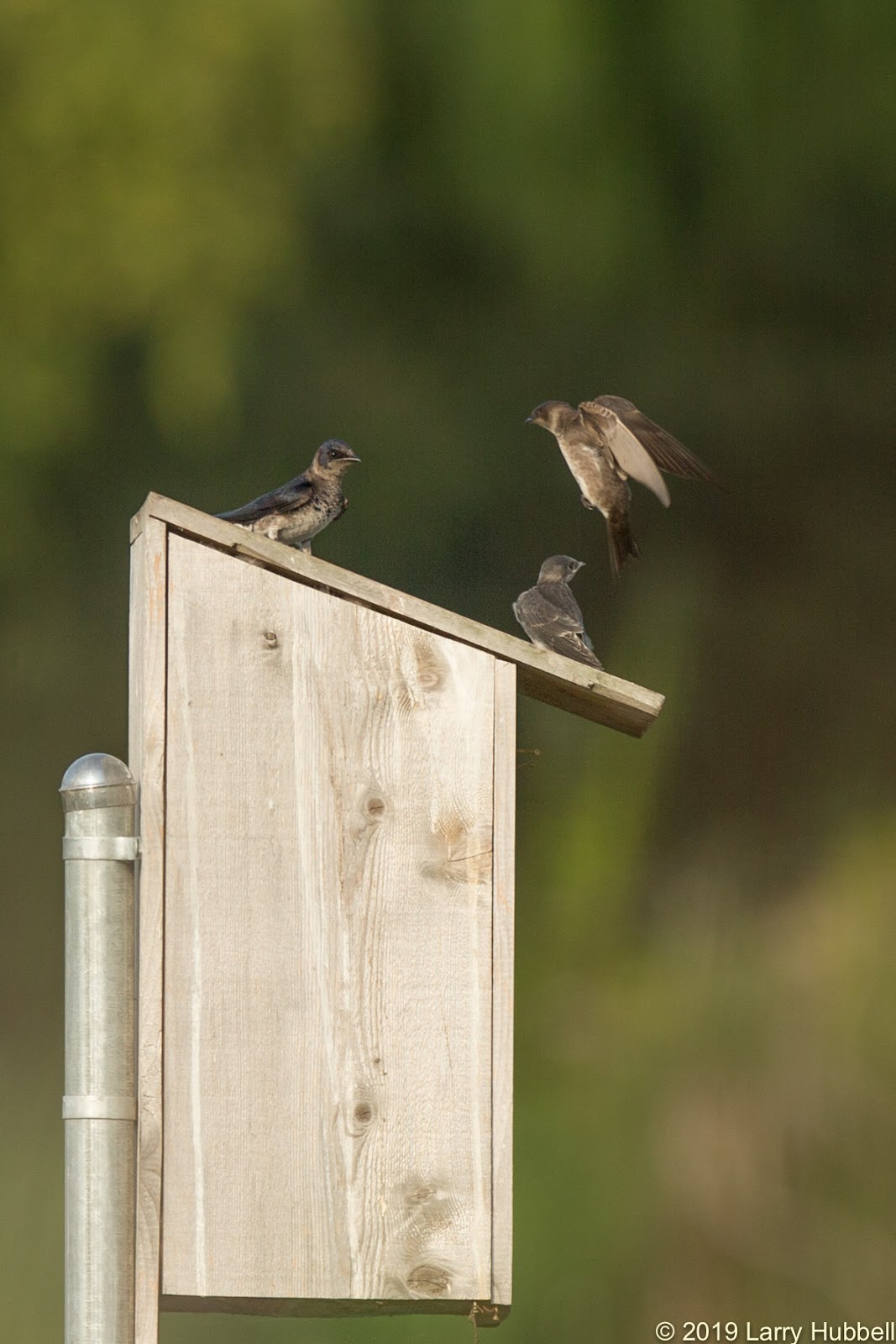
After a time, the family members returned to the nest. I soon deduced that the light grayish bird, with its wings raised, was one of the younger family members.

The older siblings tended to fly more often. I suspect they were hunting for themselves, although I was unable to capture conclusive evidence.

Every time a more mature bird landed, the youngster's mouth gaped open and provided a brilliant yellow-rimmed target. The young bird was living in the past and hoping someone would provide food.

It was willing to accept food from any passing martin. However, I never saw the young one get fed. However, I do believe I saw the adult perch at the opening to the box and provide food to an internal occupant. 

Ignoring the youngster on the roof looked like a case of tough love. While I could hear the loud, liquid calls of the martins I had no way to determine their meaning. I can imagine the adult female saying to the youngster, "Since you can fly, it is time for you to find your own food."

Later, three different martins abandoned the nest at the same time. Obviously, something was up. My friend Bill pointed out the culprit, who had just rushed the nest site.

Similar to the Great Blue Heron the young Green Heron inspected the box from below. It also failed to find a feeding opportunity. I have never seen a Green Heron eating a bird but I suspect they would not turn down a defenseless nestling.

Slowly, the hungry heron retracted its neck and seemed to shrink to a less formidable size.

Soon, the adult female flew in and sent the young heron packing. Protecting the young and defending the nest is truly a full-time job.

I have read that along the east coast Purple Martins generally nest in multi-stored nest boxes. On the west coast, they are more likely to nest in natural tree cavities or gourds provided by humans. In Port Townsend, I have also seen them utilizing small nest boxes. Often multiple nest sites are placed quite close together. Purple Martins are colony nesters. This winter, after the family has gone south, I am thinking about subdividing or adding on to Next Box #3. Next year, it would be wonderful to have a whole colony of Purple Martins nesting on Union Bay.

Have a great day on Union Bay...where nature lives in the city!

Larry


Going Native:

Without a well-funded Environmental Protection Agency, it falls to each of us to be ever more vigilant in protecting our local environments. Native plants and trees encourage the largest diversity of lifeforms because of their long intertwined history with our local environment and native creatures. I have been told that even the microbes in the soil are native to each local landscape. I hope we can inspire ourselves, our neighbors and local businesses to respect native flora and to support native wildlife at every opportunity. I have learned that our most logical approach to native trees and plants (in order of priority) should be to:

1) Learn and leave established native flora undisturbed.
2) Remove invasive species and then wait to see if native plants begin to grow without assistance. (If natives plants start on their own, then these plants or trees are likely the most appropriate flora for the habitat.)
3) Scatter seeds from nearby native plants in a similar habitat.
4) If you feel you must add a new plant then select a native plant while considering how the plant fits with the specific habitat and understanding the plant's logical place in the normal succession of native plants.

My intention in my weekly post is to include at least one photo each week and visually challenge us to know the difference between native and non-native lifeforms. 

Are the following are native to Union Bay?

A:


B:


Scroll down for the answer.


***************


Neither are native to Union Bay. As a matter of fact. they are both being sprayed for near the 520 freeway. Given the implied danger from the spray, and the fact that the plants are never eradicated, I have to wonder which is worse, the plants or "the cure".


***************


The Email Challenge:

Over the years I have had many readers tell me that Google is no longer sending them email announcements regarding my posts. Even more frustrating when they go to 're-sign-up', hoping that will enable them to once again start receiving the announcements, they get a message which says 'Sorry, you are already signed up.' Google has not responded to my requests for help with this issue. 

My functional workaround is to set up my own email list and each week I manually send out a new post announcement. If you are experiencing the issue and would like to be added to my personal email list please send me an email requesting to be added. Thank you for your patience!

My email address is LDHubbell@comcast.net


Wednesday, August 7, 2019

Cutter Thrives

Last week's post left us, and Cutter the newly released young Bald Eagle, up in the air. 

Click Here if you missed the previous post - including the fire truck - and would like to read the story chronologically. 

By the end of the post Cutter had surprised everyone with a successful upward flight. This reassuring development meant he was not dependent on his parents to locate him. 

What we did not know was whether the parents would accept Cutter back and resume feeding him. He had been gone for well over a week. Since Cutter does not yet have the skills to provide for himself the parental delivery of food is critical to Cutter's survival in the wild.

Jeff Brown from the Progressive Animal Welfare Society (PAWS) did everything in his power, along with help from Rod Smith, UWild Waterfront Manager for the University of Washington, to give Cutter and his parents the optimal chance to resume their family relationship. However, there were no guarantees. 

Last Monday, to everyone's great relief, Rod reported seeing Cutter, with the identifying silver-colored band on his leg, sitting near a parent and eating. All of the work and effort by PAWS, Jeff, Rod and concerned neighbors paid off. 

On Wednesday, I was lucky enough to see Cutter excitedly return to the nesting tree. As he landed his ankle bracelet, above the right foot, was visible. His begging implied he was hoping the adult in the tree was leaving food for him. However, after the parent left, Cutter moved to a nearby tree. This particular interaction did not include any fresh food for Cutter.

The band on his leg gives us a very special opportunity. If we watch carefully we may be able to document how long Cutter spends in his parent's territory, before leaving to make his way in the world. If we are lucky we may even be able to observe his progress as he learns to hunt.

On Wednesday, even though I did not see him eat it was obvious he was well-fed. He was highly energetic.

During the half an hour I watched, Cutter was almost constantly in motion. His curiosity was evident.


It is funny how the behavior of a young eagle seems almost inappropriate to the process of learning to hunt. The twisting and turning had to make him obvious to any potential prey. The loud begging calls, anytime he saw a parent or wished he saw a parent, also seemed counter-productive to the concept of hunting. However, the loud begging calls may be effective at motivating the parents.

The quiet inspection of a leaf demonstrated his curiosity and might have helped with developing his fine motor skills.

 At certain angles, he certainly looked the part of a future apex predator. 


At other times, he reminded me of a bored grade-school child standing in the outfield...

...with no real interest in the game being played. 

On Friday, I spotted one of the parents sitting quietly on the branch closest to the nest. I have often wondered why adult Bald Eagles have such brilliantly white heads and tails which contrast so sharply with their bodies. 

On the other hand, it seems obvious that the dark colors of the immature eagles provide camouflage which helps them avoid detection and danger. For example, when taking this photo I was slow to notice that Cutter's tail was hanging out of the nest. It was only the movement of his tail, which was constantly vibrating and shaking, as he dismantled his food which finally attracted my attention.

When I zoom in the back half of his body is a bit more obvious, to the left of the trunk.

After he finished eating, he moved out on the branch where the adult had been earlier.

A few minutes later his sibling, Bay, made a beeline for the nest. I am not sure how she realized there might be food in the nest. Maybe she saw the adult leaving the area, and concluded there might have been a food delivery.

In any case, she was right. After a few minutes of cleaning up the leftovers, she popped out on to the branch with the remnants of her snack still hanging from her bill.

A couple of days later, I finally realized why mature Bald Eagles have such sharply contrasting heads and tails. One of the Adults was sitting on their primary roost by the Waterfront Activities Center while the other was sitting at their secondary roost e.g. the tallest cottonwood on Marsh Island.

As I searched the surrounding trees and failed to locate either of the youngsters, I realized the impact of the age-related differences in plumage. Regardless, of their motion and curiosity, the dark plumage of the youngsters can be hard to spot. On the other hand, the contrasting light and dark plumage of the adults sitting in the treetops is nearly as obvious as a flag blowing in the breeze. 

In my mind, an adult's plumage, posture and location are like a flashing sign above reversible lanes which says, 'Do not enter!' It provides an obvious warning to other eagles that the territory is taken and trespassing is not worth the risk. This felt like a new idea to me, but I suspect ornithologists must have reached this conclusion long ago. 

As I turned to leave I saw a Bald Eagle approaching from the south. It looked to be about four years old. As it reached the 520 freeway, where it could see both Monty and Marsha, its forward progress stopped. It circled and drifted off to the side without getting any closer to the adults. It reinforced for me that the flashy white heads and tails help to resolve territorial claims without violence. Even if this approach is only partially successful it would be a positive, self-reinforcing trait. 


***********************


The Friends of Arboretum Creek have just applied for a King County water quality grant named:

 'Alder Creek to Arboretum Creek - 30% Design' 

This project will create a design for:
  • Removing Alder & Alley Creeks from the King County Combined Sewer,
  • Reuniting these clean, cool, year-round flows with Arboretum Creek and will
  • Lay the groundwork for complimentary capital projects which will physically reunite the streams with Arboretum Creek.
In particular, returning in excess of 40,000 gallons per day of year-round flow to Arboretum Creek will change the upper portion of the stream from stagnant pools of hot summer water to a functional ecosystem. The restored aquatic life should then attract a variety of birds and other creatures. Some of the fish-eating birds I expect to utilize a restored Arboretum Creek are:

Belted Kingfishers, 

Green Herons, 

Great Blue Herons, and someday...

...if the fish grow large enough, maybe even Bald Eagles and Osprey could find food in Arboretum Creek.

Returning this additional flow to Arboretum Creek will provide cascading benefits for King County ratepayers. Including:
  • Economical - freeing up wastewater treatment capacity,
  • Environmental - enabling a functional ecosystem in the creek & reducing sewer overflow pollution in Montlake Cut,
  • Educational - providing residents access to easily learn about native flora and fauna,
  • Health - just two hours a week with nature has positive health benefits,
  • Social Equity - having free, ADA-compliant access to nature in our most easily-accessible, centrally-located, park means the benefits can be shared by all citizens regardless of their physical or economic challenges
During the next few weeks, as the King County Council reviews water quality investment options, your letter of support for this project could make all the difference. Please email the Council Members and emphasize the wisdom of this investment based on which of the cascading benefits are important to you. The Council Member's email addresses are:

larry.gossett@kingcounty.gov,
rod.dembowski@kingcounty.gov
kathy.lambert@kingcounty.gov
jeanne.kohl-welles@kingcounty.gov
dave.upthegrove@kingcounty.gov
claudia.balducci@kingcounty.gov
pete.vonreichbauer@kingcounty.gov
joe.mcdermott@kingcounty.gov
reagan.dunn@kingcounty.gov

Restoring nature is a fundamental step to a thriving human society. Thank you in advance for doing what you can. 


Friends of Arboretum Creek work in partnership with:


***************


Have a great day on Union Bay...where nature lives in the city!

Larry


Going Native:

Without a well-funded Environmental Protection Agency, it falls to each of us to be ever more vigilant in protecting our local environments. Native plants and trees encourage the largest diversity of lifeforms because of their long intertwined history with our local environment and native creatures. I have been told that even the microbes in the soil are native to each local landscape. I hope we can inspire ourselves, our neighbors and local businesses to respect native flora and to support native wildlife at every opportunity. I have learned that our most logical approach to native trees and plants (in order of priority) should be to:

1) Learn and leave established native flora undisturbed.
2) Remove invasive species and then wait to see if native plants begin to grow without assistance. (If natives plants start on their own, then these plants or trees are likely the most appropriate flora for the habitat.)
3) Scatter seeds from nearby native plants in a similar habitat.
4) If you feel you must add a new plant then select a native plant while considering how the plant fits with the specific habitat and understanding the plant's logical place in the normal succession of native plants.

My intention in my weekly post is to include at least one photo each week and visually challenge us to know the difference between native and non-native lifeforms. Which of the following white flowers are native to Union Bay?

A:

B:

C:


Scroll down for the answer.


***************


None of the above are native to Union Bay!


***************


The Email Challenge:

Over the years I have had many readers tell me that Google is no longer sending them email announcements regarding my posts. Even more frustrating when they go to 're-sign-up', hoping that will enable them to once again start receiving the announcements, they get a message which says 'Sorry, you are already signed up.' Google has not responded to my requests for help with this issue. 

My functional workaround is to set up my own email list and each week I manually send out a new post announcement. If you are experiencing the issue and would like to be added to my personal email list please send me an email requesting to be added. Thank you for your patience!

My email address is LDHubbell@comcast.net