

This week, I visited the Union Bay Natural Area. My goal was to photograph these two new little osprey in Chester and Lacey's nest. Given the size differential I am thinking we should call them Hugo and Tiny. The larger bird in this photo is creating an optical illusion. It appears to be closer than it is.

Here is proof that Hugo is significantly larger and almost certainly the older bird. I also suspect Hugo has been the first to the feeding trough more than once. As a matter of fact a number of osprey observers have noticed that both Chester and Lacey have been leaving the nest at the same time to go hunting. Maybe, Hugo is eating them out of house and home.
In past years, I have seen both parents leave the nest but it certainly seemed like they would wait until the young were older and more capable. I am sure the parents have better eyes than I do. I hope they are watching for the local Bald Eagles. No doubt the eagles would be quite happy to pick off a tender young osprey.

I find that nature is full of surprises. While seeing the young osprey was wonderful it was this Great Blue Heron who actually captured my attention. I watched it wade out into the water and then sit down like a duck or a goose. My first thought was to wonder if it was a young bird that had not yet learned how to hunt like an adult.

Within moments, it caught a fish and promptly brought it back to shore.

It took the heron over two minutes to manipulate the fish into position and swallow it. The delay seemed to reinforce the idea of inexperience. I wondered to myself if I would ever see anything quite like that again. I have probably photographed hundreds of herons. Only once, had I seen one sitting on the water like a big grey swan. I had never seen one catch anything from a floating position.
My attention returned to the osprey and then a moment later I glanced back at the heron...
 ...it was floating on the water, again!
It quickly caught a second fish, which it dispatched much more rapidly. Then it took off, apparently looking for a private place in the sun to digest its breakfast.
When I asked a birder friend, Jim, if he had ever seen anything like it, he said, 'No'. He also wondered if the bird was young. Jim mentioned some tips on the characteristics of young Great Blue Herons. This inspired me to look through my photos and see what I might find and learn about Seattle's Official Bird.

I decided to segregate the photos by month. I remember Dennis Paulson mentioning that their bills change color during the year and I wanted to watch for that as well as any obvious age differences.
This photo was taken in September and initially I would have thought it looked like a pretty average shot of an adult. Then I started to wonder about the absence of plumes on this bird. Could the absense imply the bird is young?

Here is another September photo which shows an obviously mature bird with extensive plumes on the chest and back. In case you did not notice, it was hoping to catch that dragonfly which was hovering just out of reach.

Here is an October photo. The lower mandible is yellow while the upper one is grey-blue. I suspect the piece of feather on the tip of the bill may be powder down. Herons use powdery pieces of feathers to absorb fish slime and other contaminates that might otherwise reduce feather functionality.

The tip of their longest toe has a pectinate comb which helps the herons with cleaning their feathers.

Here is an October photo showing at least modest plumes on the chest and back. As well as a dragonfly. For a related post, Click Here.

In this November photo we can see fairly long gray plumes on the chest of this bird.

In this December photo, this bird's chest plumes are even more obvious. The mandible does not appear to have changed much.

These two are doing a 'reflective' mating dance in January. They pranced about in shallow water mimicking each other's every move. We can clearly see the plumes on their backs as well as on their chests. During the mating dance they hold both types of plumes erect. Their upper mandibles may be a bit lighter.

In this February photo, we see a heron who's bill is almost completely orangish-yellow. If you look close, you can faintly see a third type of plume. These plumes grow out of the dark blue stripes above and behind their eyes.

The two 'head' plumes are much more obvious in this March photo. The brilliant color of the bill is quite striking.

Just to show that nature can do whatever it pleases, here is another March photo with a heron who is still displaying a dark upper mandible.
If you have never seen this posture before it may be a bit surprising. I do not think this is part of the mating game. I believe this bird is allowing the sunlight to warm its wings and make life more difficult for any small creatures who may be trying to inhabit its feathers.

Here, the April winds are blowing the plumes on both the head and the chest of this bird.
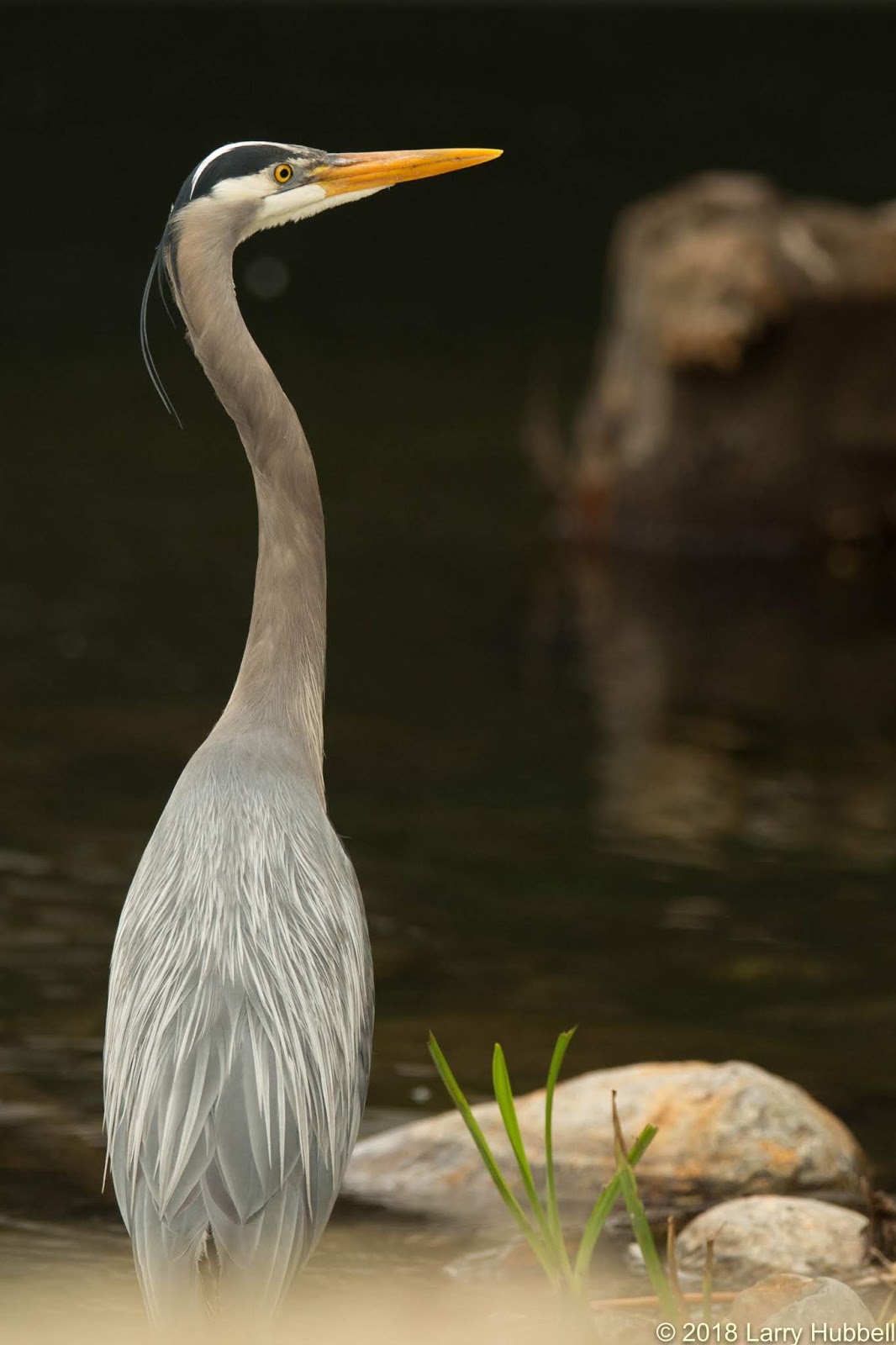
In May this adult did not show any surprising changes, however...

...this May photo of a young bird shows a number of remarkable differences. One of the most obvious is the lack of the dark blue and bright white head stripes. The plumes are limited, and the chest and belly are missing the dark feathers most easily seen in the April photo above. Also, the bill is not brilliantly colored like most of the adults.

In this June photo we see an adult whose bill is apparently reverting back to its post breeding colors.

Here is a June photo which shows a parent and two young in the nest. If you look closely you can see a hint of a pinkish-red on the tips of the feathers of the nestlings.

In this June photo (and the next) you can see more of the rusty-pink feather tips which indicate these birds are young.

Here are two siblings with nothing better to do than squabble At this point they were still following an adult around and being fed on demand. The lack of mature stripes and plumes on their heads is obvious.

Here is a July photo of an adult with obvious long plumes on its back and with yellow only on the lower mandible.

In this August photo, an adult (on the left) displays its plumes in the presence of a young bird. The young bird assumes a reflective pose but its plumes are negligible and many of its feathers are still tipped in rusty-pink. I am guessing this is a territorial display, in part because the young bird was wise enough to move on.

Here is one final photo of a first year bird in August. By now the list of age-related tips relevant to this bird should leap to your mind. We can see the lack of stripes on the head, the lack of all three types of plumes, the mottled grey on the neck (which was not mentioned before) and the rusty-pink feather tips which are all clues to this bird's youth.
Clearly, the floating bird at the beginning of this post does not look like it hatched lately. It has the stripes on its head like an adult, however its plumes are still fairly short. We know that birds fresh out of the nest lack plumes. The question on my mind is whether mature adults annually lose their plumes in the process of replacing their feathers. I do not know for sure. However, this post contains photos of adults with plumes in every month of the year. So I doubt that they ever lose all of their plumes after reaching the full adult plumage.
This makes me suspect that our floating bird is a young adult who has gained much of its adult coloring but is still growing its first set of plumes. Also, its behavior makes me think it is young.
I have found one reference and a few images of Great Blue Herons floating. Clearly, it happens. Given the relative quick hunting success of our Union Bay bird, I am surprised that it does not happen more often.
In any case, for the rest of the summer I hope this post inspires you do a double take whenever you see Seattle's Official city bird. Is it young or old? Is it wading or is it playing, 'Duck, Duck, Heron' with our local waterfowl?
Have a great day on Union Bay...where nature lives in the city!
Larry
Going Native:
Without a well-funded Environmental Protection Agency, it falls to each of us to be ever more vigilant in protecting our local environments. Native plants and trees encourage the largest diversity of lifeforms because of their long intertwined history with our local environment and native creatures. I have been told that even the microbes in the soil are native to each local landscape. My hope is that we can inspire ourselves, our neighbors and local businesses to respect native flora and to support native wildlife at every opportunity. I have learned that our most logical approach to native trees and plants (in order of priority) should be to:
1) Learn and leave established native flora undisturbed.
2) Remove invasive species and then wait to see if native plants begin to grow without assistance. (If natives plants start on their own, then these plants or trees are likely the most appropriate flora for the habitat.)
3) Scatter seeds from nearby native plants in a similar habitat.
4) If you feel you must add a new plant then select a native plant while considering how the plant fits with the specific habitat and understanding the plant's logical place in the normal succession of native plants.
My intention in my weekly post is to include at least one photo each week and visually challenge us to know the difference between native and non-native lifeforms.
1) Learn and leave established native flora undisturbed.
2) Remove invasive species and then wait to see if native plants begin to grow without assistance. (If natives plants start on their own, then these plants or trees are likely the most appropriate flora for the habitat.)
3) Scatter seeds from nearby native plants in a similar habitat.
4) If you feel you must add a new plant then select a native plant while considering how the plant fits with the specific habitat and understanding the plant's logical place in the normal succession of native plants.
My intention in my weekly post is to include at least one photo each week and visually challenge us to know the difference between native and non-native lifeforms.

Is this butterfly native to the Pacific Northwest? What species is it?
***************
Scroll down for the answer
***************
This species is not native to North America and is actually a significant pest. Follow the link to read more.
***************
The Email Challenge:
Over the years I have had many readers tell me that Google is no longer sending them email announcements regarding my posts. Even more frustrating when they go to 're-sign-up', hoping that will enable them to once again start receiving the announcements, they get a message which says 'Sorry, you are already signed up.' Google has not responded to my requests for help with this issue.
My functional work around is to setup my own email list and each week I manually send out a new post announcement. If you are experiencing the issue and would like to be added to my personal email list please send me an email requesting to be added. Thank you for your patience!
My email address is LDHubbell@comcast.net
*********************


