Mission: To promote the appreciation of wildlife and increase harmony between humanity and nature.

On Instagram: @unionbaywatch

Saturday, October 24, 2015

Trick or Treat


Do you see a trick or a treat when you look at this photo? I can see beauty in the shape of the crow's wings and the wide fan of the tail feathers. However, somewhat hidden in this photo is evidence of a darker side of crows.

This week I was attracted by the loudest cacaphony of crow calls I have ever heard. It was not the usual sound of a dozen of crows harassing a perched predator. Nor was it the peaceful sound of crows gathering to roost for the night. The pine trees in the Arboretum were full of forty or fifty crows, calling chaotically. The noise was almost deafening.

From a distance they seemed oddly focused on the ground. As I approached, I noticed a crow on the grass. Initially, I wondered if I was observing a crow funeral.

Taking a closer look I realized there were actually two crows rolling around in the pine needles. 

As the birds shifted and struggled, it became obvious they were fighting.

 I had never before seen crows in combat.  

Ironically, a few days earlier I had just responded to a reader who asked, "Is nature cruel or is it just the crows?" This was after crows had consumed a robin's eggs out of a nest in her backyard. The essence of my response was,

... From the crow’s perspective, they simply found food when they were hungry. Still, I am sure, the experience was painful for the mother robin. If she could talk she would no doubt call the crows cruel. I do not believe the crows ate the eggs in order to take pleasure in her pain. I suspect eating the robin’s eggs felt similar to a human having a ham and egg breakfast...

...If the robins had no predators they would reproduce without end until they ran out of food, mostly worms, insects and small fruit. The next generation of eggs might hatch, but lacking food most of the nestlings would slowly starve to death. Then the few who were lucky enough to survive would simply cause the cycle to repeat, endlessly. This would not be pleasant. Predators keep the population under control by eating the individuals, or their eggs, that are easiest to consume. This causes the prey species to become more intelligent about hiding themselves or in this case, their nests. The mother robin’s pain should motivate her to build her next nest, in a more hidden location. We are just beginning to learn that the knowledge from these types of experiences can be passed from a parent to an unborn offspring for multiple generations, as a result of epigenetic changes. Over millions of years this same type of encounter has been repeated over and over. The prey creatures that were smart enough to find better and better hiding spots have survived. This pruning of the ancestral tree of life is what has caused intelligence to evolve, in the form of crows, ravens and especially humans...

I was stunned to see crows at each other's throats. Clearly, they were trying to do each other harm. I had no way to tell if they were intending to be cruel. I do not even know why they were fighting. Was this a mating competition, a territorial dispute or a response to some sort of insult, like road rage fallen from the sky?

It appeared to me that the other crows were trying to persuade them to stop, as opposed to cheering on the fighting. Still I can't be sure if I was truly understanding the crows intentions or projecting my own thoughts and feelings. 

A few crows gathered closer.

The intensity of their concern seemed evident, although their interest in the well-being of the brawlers appeared to be offset by fear.

The birds on the ground were totally absorbed in their struggle. They ignored everything around them. 

My attention was also consumed by their struggle. I had no idea that a gardener was approaching from the opposite direction.

The battle continued.

Finally, one of the surrounding crows made a physical attempt to intervene.

The intervening crow pulled on one of the combatants.

The effort failed to stop the fighting.

At this point the gardner threw something in the direction of the crows. The pair took to the air and the whole flock dispersed. Clearly, nature has two sides. Nature provides both sunshine and darkness, sickness and health, life and death and in this case both competition and compassion. 

Only by fully understanding the complexities of nature can we be sure that our actions are harmonious, positive contributions to the future of life on earth.

*************

More Crow Stories:

Two week's ago I asked readers to share their experiences with crows and the foods they eat. I hope you enjoy reading the responses as much as I did.


From Bill Anderson, Edmonds:

...I once saw a crow flying off with a garter snake in its bill. 


From Susan,

Just read the latest Union Bay blog about crows. There's a really wonderful essay by Ian Frazier on crows from a few years back that you should find and read (if you haven't already)...


From Brenda Burnett,

I've also seen crows scavenging on the beach, flying up and dropping a shelled treat to break it open like gulls do. I appreciated the info on crows picking up dead sticklebacks off the water. I saw that on Union Bay a couple of years ago and wondered if that was unusual at all--wondered what had killed the fish, especially. Sounds like an annual event...


From Jackie in Sammamish:


I have 4 crows who live and dine in my yard next to a wetland in the Sammamish Plateau.  The first pair bred in 2013 and now the 4 crows have become bullies in my yard.  They have become a nuisance at my suet feeder which I have used for 12 years to feed flickers, downey woodpeckers and pilated woodpeckers (whose families have grown and come back to learn to eat every year).

I have attached 3 squirrel baffles surrounding the suet feed on a high hooked pole.  One baffle is directly below it, the second is attached at a side angle with masking tape to the pole, and the 3rd baffle is hung upside down below the suet feeder.  The crows have learned to fly aside the baffles to peck at the suet so they and their crew can feed below.

I have 2 bird baths which are cleaned every day because the crows drink, bathe and wet their suet lumps in them.  The crows are very smart and seem to defeat every suet protection I create.  (By the way, duct tape will not stick to plastic baffles - you have to use plain old masking tape in vast amounts.)

The 4 crows sit on my upper roof gutter and wait until they see me in the kitchen early in the morning, and then they bang the gutters with their beaks, waiting for me to refill the suet feeder as well as toss out apples for 2 orphaned fawns who graze in dry and cracked ground in the wetland due to the drought this year. .  They also peck at the apples.

My flickers, downey and pirated woodpeckers attempt to feed at the hung suet feeder but the crows attack them immediately.  I have several generations of each of these magnificent woodpeckers/flickers and am sorry they have stopped coming to my feeder.

I have tried many things to get them to move on, fearing that next year there will be 6 crows.  This family of 4 doesn’t seem to belong to any larger group of crows in the area which I hear in the woods.  They even have figured out how to land on the blue recycling bins on trash day and peck at the slit below the usually cracked lids of my neighbors bins  to access any tidbits they can drag down the street and eat any scraps.  They love pizza boxes which end up on the street where the 4 congregate to feast on the smears on the lids.

The crows constant noise annoys my husband and next door neighbors but I am intrigued with them, as much as I wish they would move on.

The crows also peck at the rabbits who dine on our organic lawn and especially when the rabbits have discovered apples thrown in the wetlands for the orphaned fawns.

Good luck with your crows.

*********************

Happy Halloween! Hopefully, we will all experience more treats than tricks.

Have a great day on Union Bay...where nature lives in the city!

Larry


What Bird Am I?
Can you determine what type of bird this is? The answer will be in next week's post.

Last week's bird was a great blue heron.


Sunday, October 18, 2015

A Fall Feud

When the leaves turn golden and the birds begin wearing their new fall colors we know autumn has arrived.


Sometimes golden isn't good enough. For a brief moment, between the golden and the brown, this non-native maple turned a brilliant shade of red.

Some birds almost seem to imitate the leaves.

I suspect orb spiders are the same color all year round, however in the fall they and their golden color seem a bit more obvious. As the spiders prepare to lay their eggs their size and hunger must both be increasing. 

Last week, I came across Rod Crawford's spider site. Mr. Crawford is the Curator of Arachnids at the Burke Museum. His information is fascinating. Do you know how orb spiders consistently space the strands in their webs? They measure with their legs. Did you know that every night they destroy their webs and each morning they build a new one? Certainly the most entertaining part of Mr. Crawford's work is his myth busting. If you have a fear of spiders, or need a smile, you should read his responses under Spider Myths.

Flickers sometimes have some golden color on their backs and heads. However, what caught my eye this morning, was how the bubbles of sap in the tree bark and the spots on the flicker look so similar.

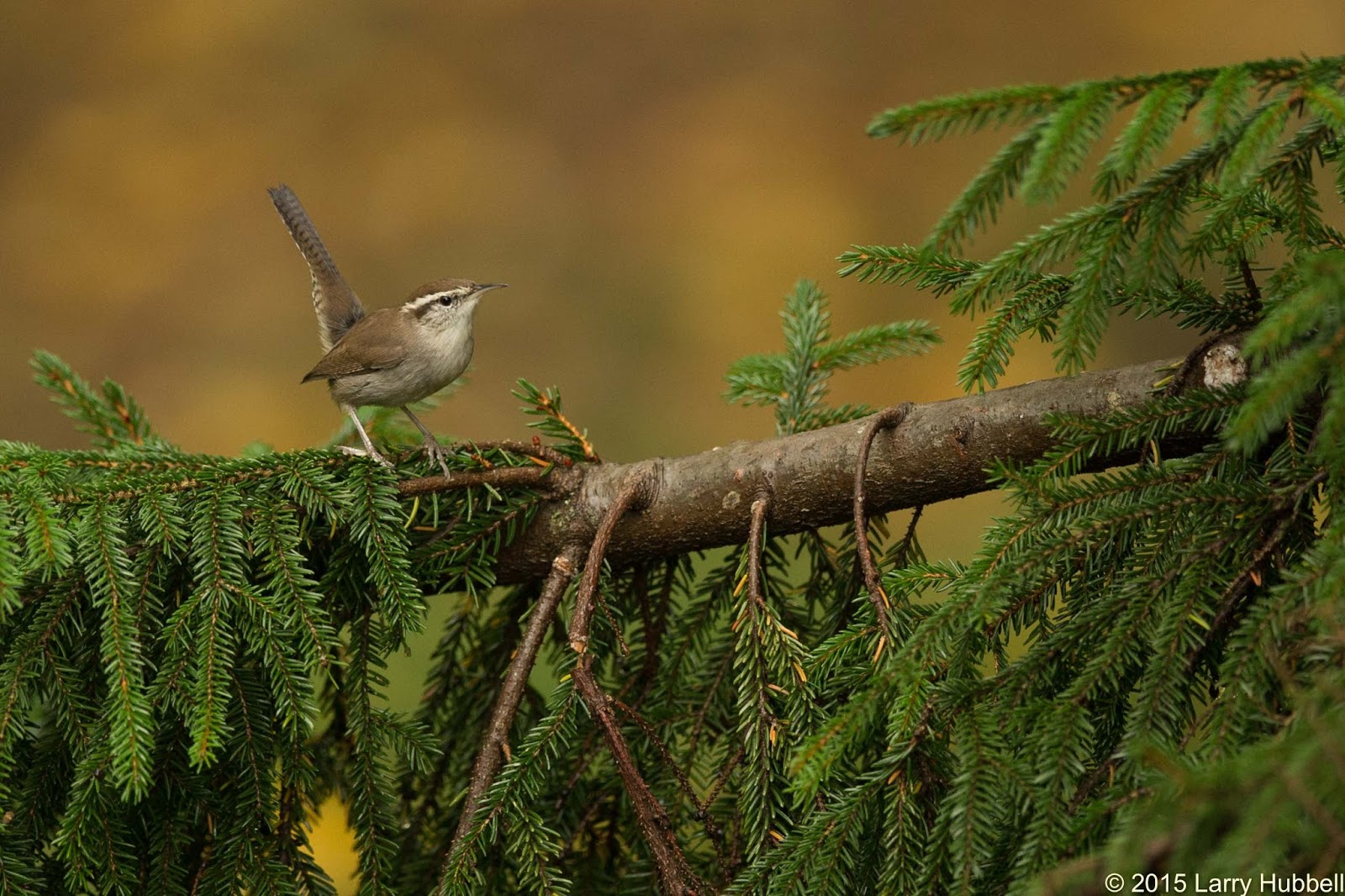
The stars of this week's post are the Bewick's wrens. When these little birds break into song the whole world listens. I suspect, ounce for ounce, they might be the loudest creatures on earth. The last song on All About Birds sounds the most similar to what I heard this week.

In spite of their vocal capabilities they usually work quietly in the shadows.

However, when they venture out they carry themselves with a sense of pride. Maybe it was a Bewick's wren that invented the concept of real estate and property ownership.

This week, I watched two of them carry on a lengthy discussion regarding the exact location of their mutual property line.

One bird clearly believed it owned this caucasian spruce.

The other thought it retained the deed to this crab-apple tree. There is only six or seven feet between the edges of two trees in the Arboretum.

When the spruce owner wandered too far away, his neighbor would sneak over and land in the lower branches of the spruce tree.

If this did not induce an immediate response the intruder would begin to sing. I presume it was something about possession being nine tenths of the law.

This would drive the spruce owner out of his wits. He would come blitzing down tree and chase his neighbor into the grassy no-man's-land between the trees.

At one point the bird in the crab-apple tree seemed to get a bit choked up. I am not sure if it was something he ate or something his neighbor said, but in any case he survived to sing again.

The process was repeated over and over with neither bird giving an inch. After twenty minutes I was beginning to think it would never end. Finally, something in a white-barked birch tree distracted the crab-apple owner. He flew away. I am sure the truce is only temporary. If I could identify them as individuals, I would call them Hatfield and McCoy.

*************

Thank you to all the reader's who responded this week with their personal crow stories. The response has been varied and wonderful. I will be transcribing and publishing the responses as time allows during the next week. Thanks again!

*************

Have a great day on Union Bay...where the feuding never ends!

Larry

What Bird Am I?

Can you determine what type of bird this is? The answer will be in next week's post.

Last week's bird was a double-crested cormorant.


Saturday, October 10, 2015

Zen and the Art of Feather Maintenance

Last week's photos of cedar waxwings were taken primarily on the west side of the Union Bay Natural Area. After looking at the photos, some of my readers wanted to know, "In what type of trees were the birds feeding?" This week I went back to take a closer look.  After looking at the shape and distribution of the leaves, size of the fruit and the color of the bark, my best guess is some variety of the genus malus, commonly called crabapples. 

This time I did not see any waxwings in the fruit trees, but I did spot a cooper's hawk in a nearby willow tree. It might even have been the same bird that chased the waxwings out of the crabapples, last week. The vertical stripes on this hawk's chest and the light color of its irises tell us that this is a young bird. However there is another factor that makes me think this bird is a cooper's hawk, instead of the very similar sharp-shinned hawk. Can you pick out the distinctive feature?

Just after taking this photo, an instructor with a class of students approached the same area. I showed them the the cooper's hawk photo and listened for a few minutes as the instructor pointed out birds and their distinctive features. It turned out that the instructor was John Marzluff. He is the University of Washington scientist who researches, teaches and writes about crows, birds and urban ecology. His classes sound fascinating.

As I headed home I came across this crow sitting in the sunlight. After announcing our presence to the world, the crow quickly quieted down. It did not seem at all intimidated by me or by my daughter's dog. The lighting was very nice and the yellow cottonwood leaves provided a complementary background, so Ginger and I decided to stay and share a little sunlight with the crow.

The crow calmly surveyed Union Bay.

Not being one to waste time, the crow began to groom itself. 

As with all birds, keeping their feathers clean is critical to their survival.

I know from reading about Professor Marzluff's research, that crows are very intelligent. In an alternate universe, without a human society, I would bet on the evolution of the crows. It does not seem like much of a stretch to imagine a crow writing, "Zen and the Art of Feather Maintenance."

It is also easy to conceive of crows doing yoga.

After awhile, something attracted the crows attention. I suspect it had to do with food.

It might even have been this dragonfly. Thinking of crows and food reminded me of the wide variety of things that crows will eat. Their broad selection of food sources is no doubt indicative of their intelligence. 

In the winter they will search for food in the moss on big-leaf maples.

In the spring crows will eat elderberries.

Also in the spring, red-winged blackbirds will chase crows away from their nests. Which implies that if given the chance crows will eat nestlings or eggs. We have all seen crows eating worms in our yards, side by side with the robins. We have seen them looking for food in overflowing garbage cans. Clouds of crows are especially obvious searching through the litter after a Husky game. Crows will systematically turn over the leaves in the gutters of both houses and streets, looking for food. Plus, we have all seen them eating roadkill beside our highways. 

This week while kayaking, my wife and I watched them catching insects in flight, like oversized and slightly inept swallows. I have also watched a crow eating pieces of dried bread, probably stolen from people feeding ducks. Most surprising for me, was watching the crow dipping the dry bread in the water to soften it up before swallowing it. Finally, I have watched crows fly out over the bay, drop down to the surface and pick up the bodies of small fish. Each spring, sticklebacks returns to Union Bay to spawn and die and I am fairly certain they are the source of this added protein in the crows' diet. 

If you have watched crows finding food in other ways and would like to share your experiences, feel free to email me (ldhubbell@comcast.net) or to add your stories in the comments section below.

Have a great day on Union Bay...where nature lives in the city!

Larry

PS: The key identifying feature on the cooper's hawk was the rounded tip of the tail. According to multiple sources, the tails of sharp-shinned hawks are much more squared in shape.

What Bird Am I?

I am thinking about adding one bird silhouette to each week's post to help you test your skills at identifying birds. Can you determine what type of bird this is? The answer will be in next week's post.


Sunday, October 4, 2015

A Waxwing Tale

Last week, while paddling into the mouth of Ravenna Creek, I noticed a few shadowy shapes darting between the tree tops. Their stop-and-go maneuvers indicated they were catching tiny insects which were invisible to me. I soon realized that the trees were filled with cedar waxwings. I paddled north and left the kayak. Circling around on foot I ended up with the sun at my back and a fluttering flock of avian delight in front of me. 

It turned out the insects were simply a side dish. The waxwings were far more focused on fruit. There were so many, so close together they could have inspired the saying, "Birds of a feather stick together."

The waxwings were varying their diet further by shifting back and forth between trees with red and yellow fruit.

Juveniles waxwings lose their chest stripes as they mature. 

Apparently, it also takes time to grow their stylish little top knots that stick out behind their heads.

The most obvious sign of an adult is the uniform light brown chest that subtly shifts to yellow. Watching adults provide guidance to their youth can also be indicative of their maturity.

Occasionally, young birds have to be taught the proper proximity. For instance, an accidental wing in the face will definitely inspire a teachable moment.

Some of the yellow berries did seem to be getting a bit past their prime.

This bird is looking towards the more plentiful red berries. Colorful berries contain carotenoids which provide the red and yellow pigments that add the most vibrant colors to a waxwing's feathers.

This photo, taken just before breeding season, shows the red waxy tips of the secondary wing feathers. These provide the inspiration for the name, waxwing. It may be that the birds with the brightest red wing tips are the ones which will be the healthiest mates.

When the bird in the earlier photo turns to face the red fruit tree, he reveals the state of his rectrices or tail feathers. Rectrices derives from Latin, like the word rector which is a leader in a church or university.

This makes sense because tail feathers help to guide and control birds in flight.

Looking more closely at the waxwing's tail, we see a staggered growth process. The yellow feather tips highlight the different lengths of the tail feathers. If the bird lost all of its tail feathers at once it would be difficult to change direction while flying. By replacing the feathers a few at a time, the bird is never out of control.

In this example, we see why the new feathers are needed. The yellow tip of the older feather on the left has completely worn away. You can also see the faint beginnings of the red waxy wing tips. During the next few months the waxwings will completely replace their feathers so they can be ready for the rites of spring.

Suddenly, the waxwings took to the air en masse. It was time to head back to the kayak. As I paddled away I took one last hopeful look at the fruit trees. A shadowy figure hidden among the lower branches had the size, shape and long tail of a cooper's hawk. Like a light going on in the dark, I realized what inspired the mass exit. 

I found I was both happy for the waxwings and sad for the hawk. It reminded me that nature requires a balance. I hope we are able to balance our desires with the needs of the natural world.

Danny Westneat's column in today's Seattle Times provides an example of how Senator Henry Jackson inspired Congress to balance our needs with nature. Sadly, congress needs to be inspired once more. Below are links to our current Senators. I hope you will let them know we need to continue what Senator Jackson began.

For Danny's Column - Click Here

To email Senator Cantwell - Click Here

To email Senator Murray - Click Here

Please feel free to forward a link to this column to others who may share our sentiments.

Have a great day on Union Bay...in the city we share with the waxwings!

Larry