Mission: To promote the appreciation of wildlife and increase harmony between humanity and nature.

On Instagram: @unionbaywatch

Saturday, December 16, 2017

Vegans

One of the benefits of winter is the lack of leaves, which reveals the hidden beauty of birds and branches. 

I find the white barring and delicate edging on the wings of the American Goldfinch very appealing. 

By the way, do you happen to see any hints regarding the gender of this bird?

On Thursday, I photographed this flock bathing in pools of sunshine and water near the newly opened Loop Trail, in the Washington Park Arboretum.

I felt rather lucky, when they moved to a less distracting location.

Bathing included tail flicking, wing splashing and swiftly-turning, head-down facial rotations. 

Still photography does not display movement, although, it can document the range of motion. This photo indicates a potential head rotation of more than 200 degrees. I suspect we might break our necks if we attempted to clean our faces with a similar side-to-side, head-thrashing maneuver.

A moment later, the finch assumed a rather nonchalant, business-as-normal attitude.

The clumping of the wet feathers reminds me of a dog after a bath. 

The finch generally seem to take turns bathing. I am not sure if this is a way to avoid catching a wing in the face or if the standing birds are keeping watch for predators. I guess, it could be some of both.

For a moment, the attraction of the water on a sunny day is just too much, and both birds give in to the urge to bath.

Among our local finches, the bright white patch of the underwing covert is unique to the American Goldfinch.

This summer photo from Port Townsend, also displays a white 'armpit'. This photo provides a visual introduction to another unique characteristic of the American Goldfinch. They are the only local finches which molt twice a year, which is why this summer male looks so different from winter males.

My understanding is that the dark spots on this winter bird's forehead may be the last of its summer feathers to be replaced with its subtle winter plumage. If so, then the tiny markings, just above the eye, indicate this bird is male.

Its golden, summer color has been nearly replaced and its bill is turning dark as well.

Female goldfinches lack black on their heads, in both summer and winter.

This is especially obvious when compared to the summer, or breeding, plumage of the male birds. Could it be that the extra effort to produce two plumages delays goldfinch reproduction? Unlike many other birds, American Goldfinch wait until June or even July to nest. All About Birds implies the delay is related to the timing and production of thistle and milkweed seeds. It is amazing how each species is uniquely adapted to fit into its particular intersection in the web of life.

In winter, I find the gender of American Goldfinches to be nearly impossible to determine.

Although, I wonder if these might be female birds searching for calcium or some other mineral which they will need to produce healthy eggs come Spring.

Another unique, and possibly rather appropriate, characteristic of our state bird is that they are vegans. In the summer they love the seeds of thistles, and in the winter I often see them in tops of local deciduous trees extracting alder or birch seeds, depending on the type of tree. 

Any insects or creatures which they consume, are thought to be unintentionally caught in the crossfire.

Given their no-holds-barred...

...voracious appetite for thistle seeds, it is quite understandable how accidental insect consumption might happen.

I used to think of thistles as useless weeds, but after watching the beauty of the goldfinch feeding, I am beginning to see the prickly plants in a whole new light.

Have a great day on Union Bay...where nature lives in the city!

Larry


Going Native:

Without a well-funded Environmental Protection Agency, it falls to each of us to be ever more vigilant in protecting our local environments. Native plants and trees encourage the largest diversity of lifeforms because of their long intertwined history with local, native creatures. I have been told that even the microbes in the soil are native to each local landscape. My hope is that we can inspire ourselves, our neighbors and local businesses to plant native flora and to support native wildlife at every opportunity. My intention is to include at least one photo each week and visually challenge us to know the difference between native and non-native lifeforms. 

Can you identify the the bird in the background, e.g. the one bird in the photo which is not a goldfinch? Is it native to Union Bay?


************

Scroll down for the answers


*************


This is one of our native Dark-eyed Juncos. Since the head and hood are black, instead of grey, it is a male of the species. 


***************


The Email Challenge:

Over the years I have had many readers tell me that Google is no longer sending them email announcements regarding my posts. Even more frustrating when they go to 're-sign-up', hoping that will enable them to once again start receiving the announcements, they get a message which says 'Sorry, you are already signed up.' Google has not responded to my requests for help with this issue. 

My functional work around is to setup my own email list and each week I manually send out a new post announcement. If you are experiencing the issue and would like to be added to my personal email list please send me an email requesting to be added. Thank you for your patience!

My email address is LDHubbell@comcast.net


*************** 


Sunday, December 10, 2017

A Pirate's Bounty

Our local bald eagles enjoy sitting in the tree tops just north of the Waterfront Activity Center (WAC). They spend hours gazing out across Union Bay.

On Friday, two different people asked me if the eagles were nesting near the WAC. I think the question is a good one. It most likely indicates that the eagles are being seen consistently in the area. It might even imply that the observer has noticed that the eagles are mature birds, sitting side-by-side and apparently a mated pair. (The fully white heads and tails only appear when bald eagles are mature enough to take a mate, build a nest and raise young.) Actually, seeing a mated pair consistently in the same area probably does indicate that the eagles are nesting nearby. The question is, What is your definition of nearby?


Of course, mature eagles are not the only ones that can be seen near the WAC. Friday afternoon, I spotted this third-year bird hiding among the cottonwood branches. Click Here if you would like to learn more about estimating the age of an eagle.

However, four fully mature bald eagles often hang out near the WAC. This photo shows the northern pair which prefer this deciduous tree. The southern pair (in the first photo) are consistently found in the same coniferous tree between the dock and the WAC parking lot.

In August, I watched the northern pair get excited and start calling. Surprisingly, I have even watched them call out to the southern pair of eagles when they come in off the bay. I have saw no signs of malice between the two pairs. Their calls did not sound defensive or argumentative. They actually sounded like greetings.

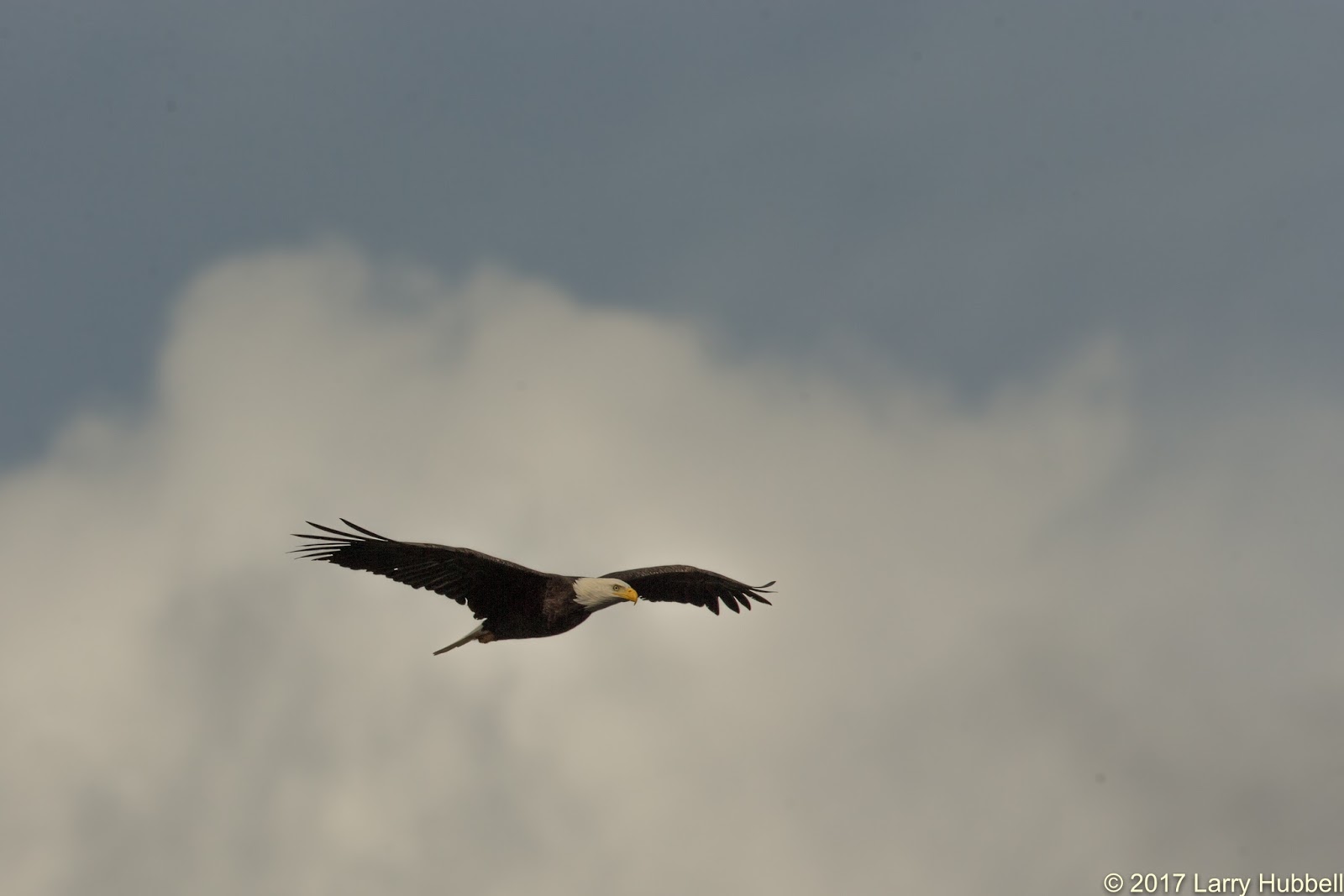
Occasionally, one of the mature eagles will do a solo flight.

When a eagle glides over the bay the coots and wigeons scatter and fly. The smaller birds appear to open a path across the water in front of the eagle. It reminds me of a servant rolling out a red carpet for royalty. In reality, this behavior appears to be motivated by self-preservation and a grudging respect for sharp talons.

If one mate is already at the WAC they almost always call out a greeting. I find their melodic calls sound to like a slightly syncopated descending melody to me. If I wrote music to accompany cartoons, an eagle's call would fit nicely with a happy-go-lucky buffoon tumbling down a hillside. If you would like to form your own opinion regarding the musical skills of bald eagles, Click Here, and then scroll down.

Still, it is most common to see them visiting the WAC as a pair.

They can sit surprisingly close, especially given the size and sharpness of their talons.

Occasionally, they give each other a little breathing room.

Since they mate for life, which can extend over decades, they appear to develop a very strong bond. I wonder if we will ever find a scientific way to determine whether mated eagles feel something similar to what we call love. 

Both pairs of bald eagles nest next to Union Bay. Neither nest is visible from the WAC. However, from the eagles' perspective their respective nests are just a short flight away.

The southern pair (Eva and Albert) raise their young above the Broadmoor Golf Course - in this rather extensive nest. From what I have seen, most eagle's nests are made primarily of cottonwood branches. I suspect this nest may exceed two thousand pounds in weight. To give you an idea of the size, remember that the wingspan of a bald eagle is approximately six feet. I suspect the average human could sit and probably even lay down inside this nest. Although, I suspect the olfactory sensation might be less than desired - eagles love fish.

The nest of the northern pair is in a cottonwood tree on the north side of Union Bay. I find this nest difficult to view in the winter and virtually impossible to see when it is active - due to the profusion of cottonwood leaves come Spring.

Since the eagles do not nest in the immediate vicinity of the WAC you may be wondering what are they doing there?

Historically, I always thought the eagles were watching the coots, wigeons and other ducks. I suspected they were looking for careless waterfowl to consume. I imagined ducks so focused on securing their own food, that they allowed the eagles to occasionally swoop down and grab lunch. Over time, I have come to the conclusion that the bald eagles may be even more interested in the double-crested cormorants. With a dozen buoys in the water in front of the WAC, and a cormorant on nearly everyone, the eagles have plenty to watch.

Sometimes the buoys won't even hold all the cormorants. I admit that the cormorants are fairly large, cantankerous birds and I have never seen an eagle catch or eat one. I suspect the relationship between to species is slightly more complex. The eagles love fish and the cormorants are the best fishers on Union Bay.

Readers who have been following my blog for a while might ask, What about the osprey? Our local osprey are incredibly effective at catching fish, but I believe if you calculated the time spent per pound of fish caught the cormorants would win. They are a dark bird that dives down to the bottom and goes after the fish in its own element. They do not have to wait for a fish to wander close to the surface, as the osprey must.

Surprisingly, I believe the eagles are less effective at fishing than both the osprey and the cormorants. None the less, I think the eagles secure fish with less effort than either of the other two species.  

A few years ago I watched a bald eagle fly over my head, circle low just above the empty bay and then settle down into the water.

The actions were similar to what we see in this photo. After a moment, a cormorant broke the surface, just behind the eagle and flew away. The eagle slowly shook off the water and pulled itself back into the air. Eagles do not dive and are unable to reach down to where the bottom fish live, but when the eagle flew away it was carrying a large bottom fish - with obvious whiskers for feeling around in the muck. I believe, that as the cormorant approached the surface it was essentially given a choice. With an eagle waiting over head the question was, 'Your fish or your life?' At which point the cormorant choose life. 

Multiple times I have found the meatless remains of large bottom fish under the trees, where the eagles sit, next to the WAC. Given that there are plenty of fish and dozens of highly skilled cormorants on Union Bay the tax rate for each individual cormorant does not appear to be too burdensome.

Now that the football season is nearly over, and the Husky fans will no longer be visiting by boat, the buoys will be removed. This will lowered the number of perches for the cormorants, which may in turn lower the number of opportunities for the bald eagles to steal fish. I wonder if we will begin seeing less of the bald eagles in the immediate vicinity of the WAC.

Last week, I watched a third year eagle (which looked a lot like the bird I saw yesterday at the WAC) devour a fish at the Union Bay Natural Area. It makes me wonder at what age eagles learn to become pirates or is it simply in their genes. I have no doubt that bald eagles occasionally catch their own food - I have seen it happen. However, given the proximity to the cormorants and the amount of time our local eagles spend at the WAC I suspect that, at least during football season, their pirate's bounty is a major portion of their diet.

Have a great day on Union Bay...where nature lives in the city!

Larry


On Harmony:

I believe learning to live in harmony with nature requires that we pay close attention to the unintended consequences of our actions. Actions as different as putting out buoys during football season and driving to work in the morning. This article (Click Here to Read) mentions the toxicity of the runoff from the old 520 bridge, as related to coho salmon. The good news is that the new 520 bridge no longer allows runoff to fall into Lake Washington. I am hoping that we, and the bald eagles, cormorants and osprey, will begin to notice coho in Union Bay in the coming years.


Going Native:

Without a well-funded Environmental Protection Agency, it falls to each of us to be ever more vigilant in protecting our local environments. Native plants and trees encourage the largest diversity of lifeforms because of their long intertwined history with local, native creatures. I have been told that even the microbes in the soil are native to each local landscape. My hope is that we can inspire ourselves, our neighbors and local businesses to plant native flora and to support native wildlife at every opportunity. My intention is to include at least one photo each week and visually challenge us to know the difference between native and non-native lifeforms. Can you identify these trees?  Are they native to Union Bay?

A)


B)


************

Scroll down for the answers


*************


A. I am fairly confident that this tree is an old world cedar tree and it is not native to Union Bay. There are three different trees that it might be. They are:

- Cedar of Lebanon
- Atlas (from Morocco and Algeria)
- Deodar (from the Himalayans)

I do not think the tree has the shape of a Cedar of Lebanon. In addition I believe most of the Atlas trees in Seattle are probably of the blue-green variety. So, I am guessing, but I suspect this is a Deodar cedar.


***************


The Email Challenge:

Over the years I have had many readers tell me that Google is no longer sending them email announcements regarding my posts. Even more frustrating when they go to 're-sign-up', hoping that will enable them to once again start receiving the announcements, they get a message which says 'Sorry, you are already signed up.' Google has not responded to my requests for help with this issue. 

My functional work around is to setup my own email list and each week I manually send out a new post announcement. If you are experiencing the issue and would like to be added to my personal email list please send me an email requesting to be added. Thank you for your patience!

My email address is LDHubbell@comcast.net


*************** 


Friday, December 1, 2017

Angel Wings

When I see great white birds in flight, I think of snow. In this case it seems very appropriate because these are Snow Geese. The black wing tips are an obvious clue in their identification.

On Wednesday, for the very first time, I saw Snow Geese on Union Bay. This photo was taken while looking east from the Union Bay Natural Area (UBNA)

They were flying with a flock of Canada Geese. I had read that someone saw Snow Geese feeding on the University of Washington (UW) lawn on Tuesday. I went up and checked twice on Wednesday, without any luck. I was certainly delighted when I hiked down to the UBNA and saw the Snow Geese.

On Thursday, I heard that an egret was seen on Portage Bay. I looked for the great white bird without any luck. However, I could not resist posting these photos of the Great Egret which visited Portage Bay in 2016. I just love its intense focus on the fly.

Not matter where the fly went the egret tracked it. In this photo, I particularly like the way its long narrow bill points almost precisely at the fly.

Clearly the fly got too close for comfort.

The Great Egret reminded me of these Snowy Egrets I saw near Savannah, Georgia later in 2016. Snowy Egrets weigh less than a pound while Great Egrets weigh close to two pounds. Another obvious difference is the color of their bills. In addition, Snowy Egrets have bright yellow feet, unlike the black feet of their larger relatives.

I also saw Trumpeter Swans on Union Bay on Wednesday. The bird on the far left is using its long neck to search for food below the surface; the middle bird has some vegetation in its mouth and the swan on the right is calling out. I suppose we could say it is 'trumpeting' although I do not remember the sound as being all that loud. It seemed more like a contact call to me or at best a squeaky, half-hearted trumpeting. There were a total of ten swans on The Bay, eight adults and two young.

The two gray swans are the first year birds. It is interesting to me how small the Double-crested Cormorant, and the Gadwalls, look compared to the swans. I did not notice any Tundra Swans among the Trumpeters. By the way, Trumpeter Swans can weigh more the ten times what a Great Egret weighs.

In this 2016 photo, of a Trumpeter Swan on Union Bay, gives an even better idea of the size of the bird. The wings of a Trumpeter and a large Bald Eagle are nearly identical in length, but since the swans can weigh nearly twice as much I suspect their wings are much larger in width. When visiting the Slater Museum with Dennis Paulson, as part of our Master Birder Class, he showed us a collection of Trumpeter wings. I remember he called them, 'Angel's Wings'. That most certainly looked the part. It makes me wonder if swans inspired the whole idea of angels?

I cannot write about large, white, snow-like birds, without mentioning a Snowy Owl. I saw this particular bird at Ocean Shores in 2012. Later in the year, I saw one on Capital Hill and a few in Ballard. The Snowy Owl populations can vary dramatically depending on their summer food supply.  When one of these irruptions (a nearly explosive growth of a natural population) occurs, it may inspire the younger, less experienced Snowy Owls to head south when winter comes. It is starting to sound like this may be one of those years. Learn more about Snowy Owls at Project SNOWstorm.

Obviously, not all of these species visit Union Bay and some not every year. On the other hand, I have seen four of the five species within walking distance of Union Bay during the last six years. While researching this post I became interested in learning more about where these birds normally reside. The following is a gentle quiz regarding the southern most extent of their ranges. Can you match the appropriate ranges to each species?

The species are:

1. Snow Goose
2. Great Egret
3. Snowy Egret
4. Trumpeter Swan
5. Snowy Owl

The usuall southern extent of their summer (or breeding) range is:

A. Labrador, Canada
B. Ontario, Canada
C. Nevada, United States
D. Los Lagos, Chile
E. Santa Cruz, Argentina

The normal southern extent of their winter range is:

V. Wyoming, United States
W. Oklahoma, United States
X. Veracruz, Mexico
Y. Chubut, Argentina
Z. Santa Cruz, Argentina

Of course, there are always exceptions. Some individuals birds may travel where the wind or whim takes them. Also, not all members of a species migrate to the same extent or locations and also irruptions happen. 

I utilized the range maps from All About Birds because they display both North and South America and they are freely accessible. Given that the range maps do not explicitly display states and territories I estimated as best I could. 

For those who love symbols the answers are:

1. = B, X 
2. = D, Y 
3. = E, Z 
4. = C, V 
5. = A, W 

For the rest of us, in season, each of these species can usually be found as far south as:

Snow Goose
    Summer = Ontario, Canada, 
    Winter = Veracruz, Mexico

Great Egret
    Summer = Los Lagos, Chile, 
    Winter = Chubut, Argentina

Snowy Egret
    Summer = Santa Cruz, Argentina, 
    Winter = Santa Cruz, Argentina

Trumpeter Swan
    Summer = Nevada, United States, 
    Winter = Wyoming, United States

Snowy Owl
    Summer = Labrador, Canada, 
    Winter = Oklahoma, United States

I was really surprised to learn that Snow Geese winter as far south as Mexico. Also, apparently some Trumpeter Swans breed farther south (Nevada) than they winter (Wyoming). Apparently, egrets stay in South America all year round. When they spend our winter months in South America they are experiencing summer and during our summer they experience winter. It is obvious and also confusing, but it does imply that they must not mind cold weather. It turns out that the Snowy Owls are the only one of these species which behave pretty much as I would have expected, although during irruption years they have been seen in Florida.

Have a great day on Union Bay...were nature lives in the city!

Larry

Going Native:

Without a well-funded Environmental Protection Agency, it falls to each of us to be ever more vigilant in protecting our local environments. Native plants and trees encourage the largest diversity of lifeforms because of their long intertwined history with local, native creatures. I have been told that even the microbes in the soil are native to each local landscape. My hope is that we can inspire ourselves, our neighbors and local businesses to plant native flora and to support native wildlife at every opportunity. My intention is to include at least one photo each week and visually challenge us to know the difference between native and non-native lifeforms. Can you identify these plants?  Are they native to Union Bay?

A)


B)


************

Scroll down for the answers


*************


Both of these plants are Northwest natives which have been planted extensively as part of the remediation effort in the Union Bay Natural Area (UBNA). Enjoy the view while you can. In a few years, the ninebark will grow to be over 10 feet tall and in time the cottonwoods will exceed 150 feet. As this happens, the UBNA may begin to feel like a cottonwood forest.

Plant A = Pacific Ninebark
Plant B = Black Cottonwood

The cottonwood leaves in the photo look exceptionally narrow. As cottonwoods get older their leaves get wider - just like my waist.


***************


The Email Challenge:

Over the years I have had many readers tell me that Google is no longer sending them email announcements regarding my posts. Even more frustrating when they go to 're-sign-up', hoping that will enable them to once again start receiving the announcements, they get a message which says 'Sorry, you are already signed up.' Google has not responded to my requests for help with this issue. 

My functional work around is to setup my own email list and each week I manually send out a new post announcement. If you are experiencing the issue and would like to be added to my personal email list please send me an email requesting to be added. Thank you for your patience!

My email address is LDHubbell@comcast.net


***************