Mission: To promote the appreciation of wildlife and increase harmony between humanity and nature.

On Instagram: @unionbaywatch

Saturday, March 22, 2014

Bobby Socks to Buffleheads

Yesterday morning this Steller's Jay landed at the edge of the street to gather material for its nest. Cornell says they will use sticks, stems and moss to build their nests and that they are the only jay in North America that will also use mud to help hold it all together. Cornell also says, surprisingly, that they can live as long as 16 years.


It also sounds like there is a fair amount of variation in their coloring. In some areas the crests are blue instead of black and sometimes the markings above the beak are less obvious, this maybe due to the angle of the light. Birdweb says they maintain long-term, monogamous relationships with their mates.

It was amazing to watch how much nesting material this bird could hold.

As you can see, this jay got a full load before heading back to the nesting tree. But the most surprising thing about this encounter was the white color around the feet. Particularly in the first three photos it looks like this bird is wearing bobby socks.

I have no clue what is happening to this bird's legs. It reminds me of calcium build up that might happen from water running over a stone. When I google Steller's Jays, and even birds in general, I cannot find any similar examples. If you can shed light on this subject I would love to hear from you.

In the Arboretum there were other signs of spring, in addition to nest building, there are…
…Magnolia blossoms...

…ferns preparing to un-fiddle their heads…

…Oregon Grape getting some color….

…the flowering of this beautiful bush….

…it is unknown to me, but it was worth a close up.

At Duck Bay there were high speed landings and…

…a male Bufflehead….

…sunbathing….

….preening….

…grooming…

…and just enjoying Spring.

At dawn, Elvis and his mate headed north as they left Interlaken Park. (The previous day they headed to the southeast. If they have a pattern it is not yet obvious.) It was late morning before I caught up to them on Foster Island. One bird circled as far east as Beaver Lodge Sanctuary before turning back. 

The Sanctuary is just north of Eva and Albert's Broadmoor nest where Eva has been spending a lot of time for the last couple of weeks. This is good news for those of us looking forward to eaglets in early June. By the way, she is not always obvious and often all that can be seen is just a spot of white from the top of her head.

Elvis and his mate spent 10 minutes mostly hidden, high in the dead cottonwoods just south of the southwest bridge to Foster Island. This was particularly delightful for a busload of young grade school children who yelled and pointed excitedly when for a brief moment the birds both landed mid-way down the trunk of the same tree. The woodpeckers looked like they were headed back towards Interlaken around lunch time.

Near the mouth of Arboretum Creek Skunk Cabbage were seeking the light and

…this tiny Creeper searched the moss…


….and the bark for food…

…while defying gravity in almost every way possible.
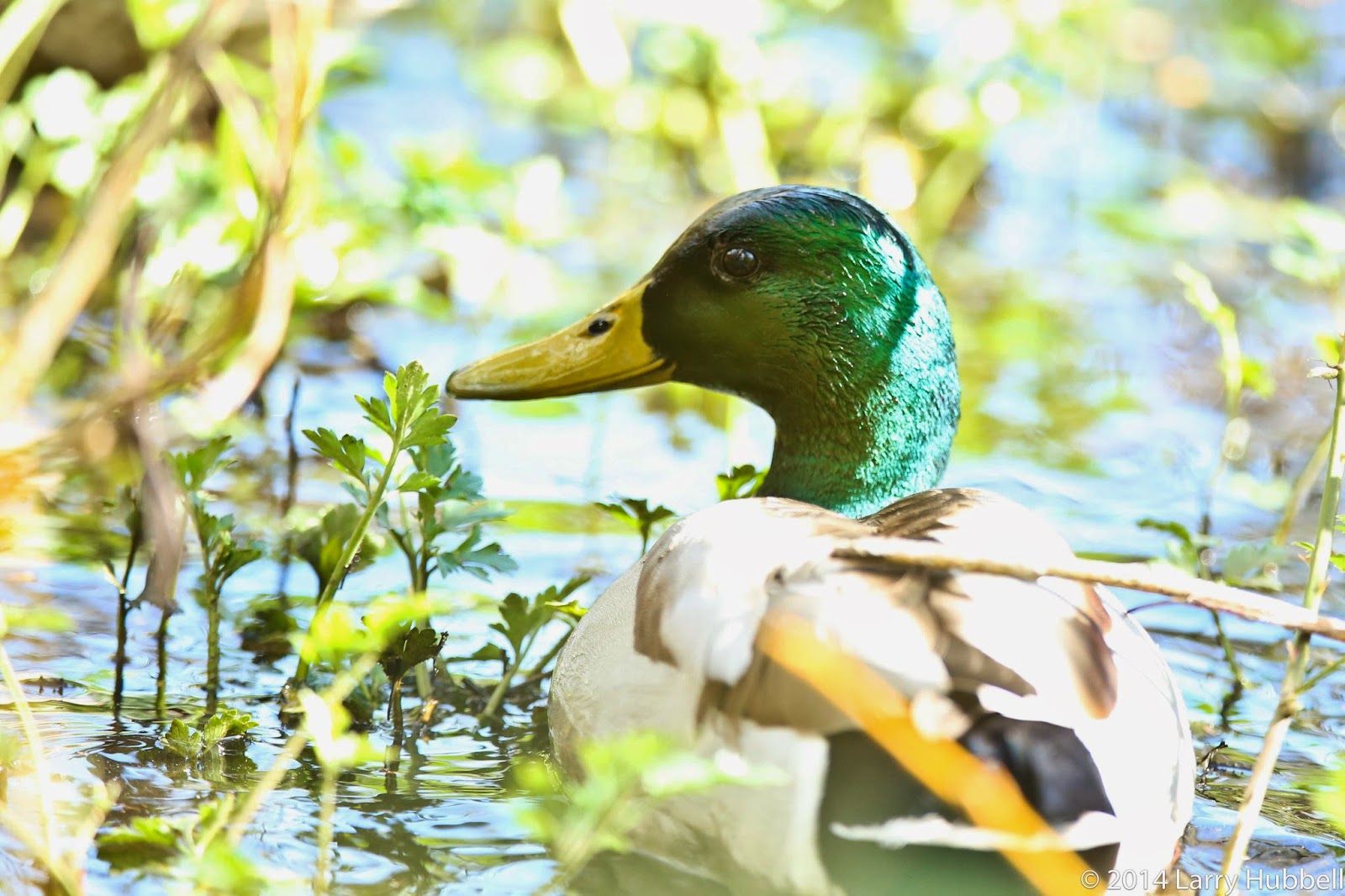
Nearby a male Mallard allowed this parting shot.

Have a great day on Union Bay…where nature lives in the city!

Larry


Sunday, March 16, 2014

Flit, Flicker & Flash

Spring is in the air! 

The flowers and the leaves on this Indian Plum are springing to life. All around us buds are growing and leaves are beginning to pop in existence. These are the last prime-time moments before the leaves hide most of the flit, flickering flash of the LBBs.

Little brown bird (LBB) is the term my friend uses to describe any small little bird that flickers and flits at the edge of perception before disappearing into the leaves. They don't even have to be brown to qualify for the term.

Here is a partial shot of one such bird.
Can you tell what type of bird it is?

These small, little birds may not be the fastest birds on earth but they are amazingly quick and very hard to track with your eye or camera. It seems like they can change direction not just in mid-air but in mid-thought as well.  

Sometimes they will even look you square in the eye, for the briefest of moments.

Here is a bit more of a hint.

This little bird is a Ruby-crowned Kinglet

It is easily distinguished from its relative the Golden-crowned KingletNote: By clicking on the bird names you can go to All About Birds where you can listen to their distinctive calls. 

Other LBBs have the annoying (and wonderful) habit of singing loudly from just a few feet away while often remaining completely invisible. Here are three types of wrens all photographed in the last month or so. One was found in the Arboretum, one was found in Interlaken Park and one in the Union Bay Natural Area. They are the Marsh Wren, the Pacific Wren and the Bewick's Wren. Can you tell which is which?


The wrens all have slightly downturned beaks and twitching tails that they usually hold upright. The Marsh Wren and the Bewick's Wren both have white eye stripes but the Bewick's has a longer tail and the Marsh Wren has black and white coloring on its back. The Pacific Wren has a darker chest and tummy than the other two. This makes the first bird the Bewick's Wren, the second the Marsh Wren and the last the Pacific Wren. Note: The Pacific Wren was formerly called the Winter Wren.

This LBB has a downturned beak like the wrens but its tail and its behavior are very different.   If you look closely you can see that the tail feathers are showing a lot of wear, similar to the tail feathers of a woodpecker. This bird flies from tree to tree. It usually lands on the trunk, instead of a branch, and creeps up the tree searching for food. The tail is used like a third leg to stablize its vertical position. Not surprisingly it is called a Brown Creeper.

Here are two more LBBs. They are both chickadees with black and white heads but they are not the same type of bird.


How are they different? The first is a Chestnut-backed Chickadee while the second is the more commonly seen Black-capped Chickadee. The CBC is more likely to be seen higher in the trees while the BCC can often be found a bit closer to eye level.

Last but not least in our display of flickering fast little birds is the Red-breasted Nuthatch.
If the sun breaks through this is a great time to go searching for the flit, flickering and flash of these little "brown" birds.

Have a great day on Union Bay...where nature lives in the city!

Larry

Here is one more parting shot. Which LBB is it?


Saturday, March 8, 2014

Humming In The Rain

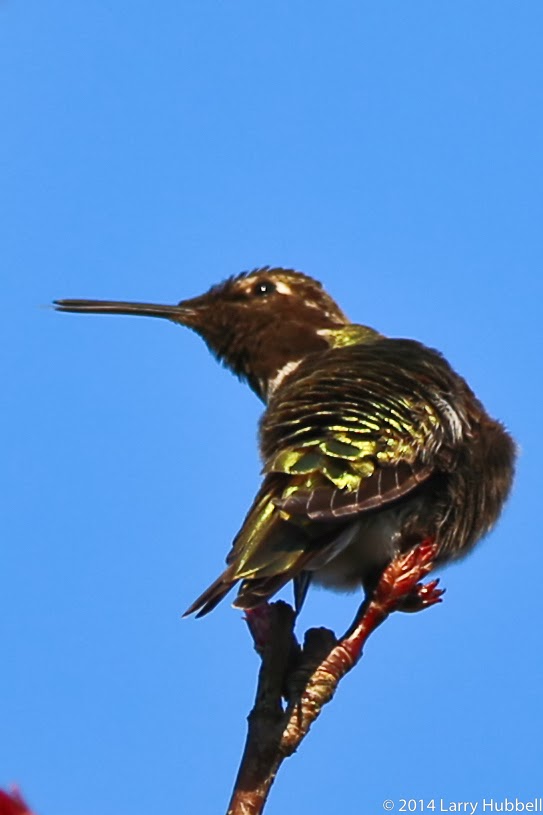
Most likely this Anna's hummingbird has been faithfully defending this same territory for a couple of years.

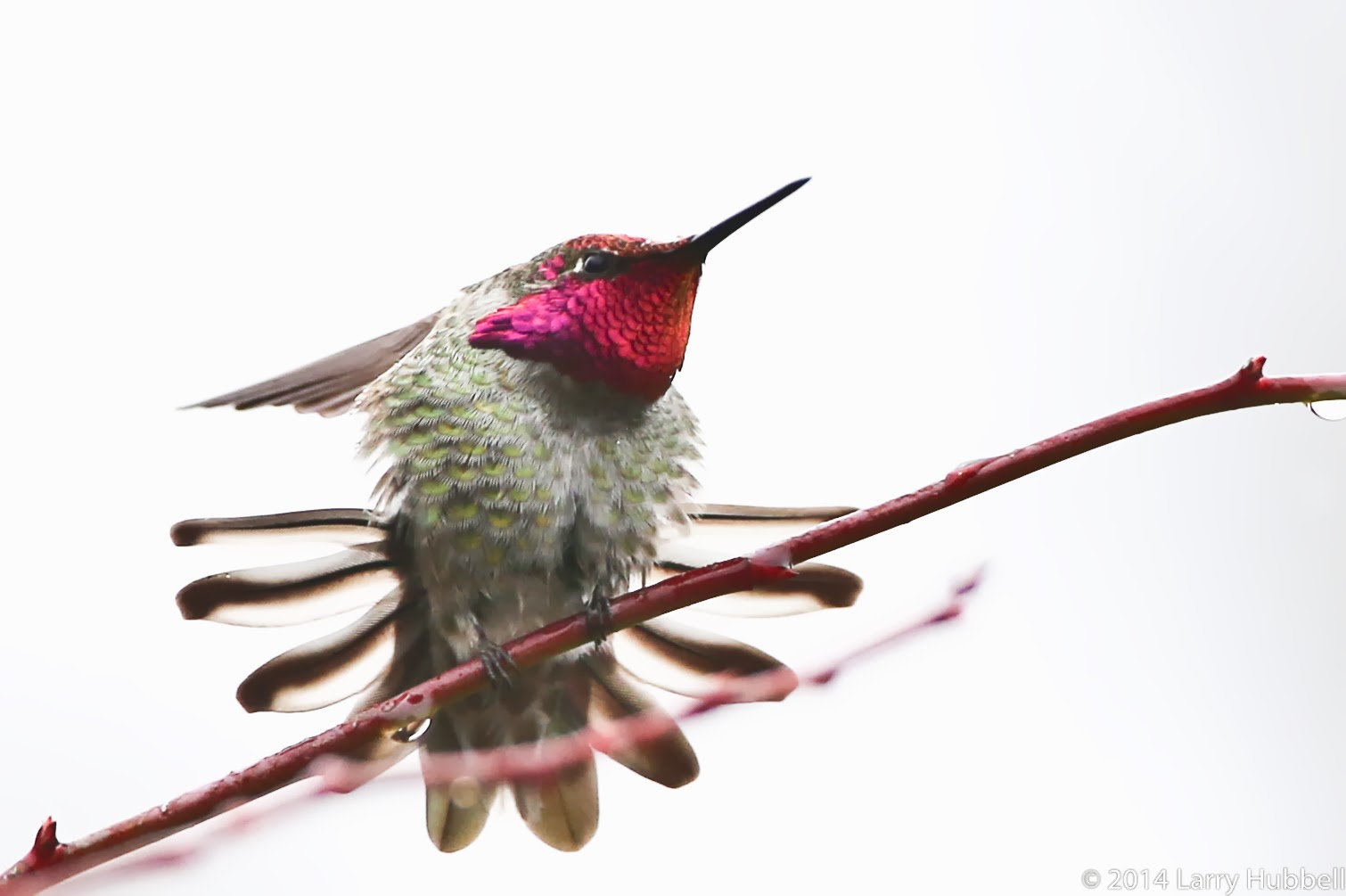
In spite of the rain, every morning last week he was in almost exactly the same spot. He sits facing the trail to Foster Island with his face reflecting the "sunlight". Maybe we should call him Foster.
This week Foster's only concession to the weather was on the one morning when the rain was particularly hard, he moved down from the tip-top most windblown branch, to one about 4 feet lower that was slightly more protected.


Looking back at the last 3 photos it is interesting to note the color changes in his iridescence as Foster changes the angle of his head. 

A quarter mile away near the WSDOT peninsula, another male is nearly as regular in protecting his territory. In his case he almost always sits with his back to the sun, which does not allow the iridescence to reflect the brilliant red colors. It makes one wonder if this is a difference in the sensitivity of their eyes, a difference in their personalities or maybe it is because the closest trail to the second bird passes to the north and both birds are simply being careful in their sentry duty.

 Foster watches everything. He looks to the left…


 …he looks up…


 …and he looks right at you. He is not nearly as skittish as the WSDOT bird. It is funny but I cannot imagine the WSDOT bird attacking a human. On the other hand, I would not be surprised at all to see Foster come flying straight at an intruder who ventured too close. It really does seem like each bird has its own personality. Before you proceed, did you happen to notice anything a little odd in the photo above?


Foster was using his right foot to scratch around his right eye. This is another case where you do not want to try this at home. It hurts just thinking about it.


In this photo you can see the tip of Foster's tongue. He can stick it out so that it is twice as long as the tip of his beak. He stuck it out rapidly four or five times while he was just sitting on the branch. There did not seem to be anything nearby in the air. Maybe he was catching something too small for my eyes to see.

WSDOT stretches when the sun comes out...

…and Foster stretches when the rain lets up a bit.


If you have the courage to go out in the rain and look Foster in the eye, here is where you want to go. Start in the Arboretum north of the Don Graham Visitor's Center. Where Arboretum Dr intersects N.E. Foster Island Rd, follow the trail towards Foster Island for a couple hundred feet. At the overlook, e.g. the first bench, take a seat. With your binoculars carefully scan the top of the brush (willows I believe) just fifteen feet in front of you.

This week not only has Foster been there on a regular basis, but on Friday he provided audio to go along with the view. When the sun came out a bit he started singing. His song was similar to the second song on Cornell. To hear it, click here.

Later he was diving straight down and doing his "J" hook turn at the bottom. As he made the turn he used his tail feathers to make a loud chirping or squeaking sound. If you have never seen and heard the display it is impressive. It is also interesting to read about how this sound was determined to not be a vocalization. To read all about it, click here.

Have a great day on Union Bay…where nature lives in the city!

Larry


Saturday, March 1, 2014

Picidae, Picidae, What do you see?

What kind of bird is this? 

Seen yesterday on Foster Island this is most likely Elvis the pileated woodpecker. He has his beak tucked under his wing while he is doing a little grooming. It makes for an interesting angle with the peak of his head pointed at the ground. 

If you look at the photo from a distance and maybe blur your eyes a bit you can almost think of the peak as a beak and he starts to look like a one-of-kind, red-faced bufflehead. O.K., maybe that is over doing the creative angle a bit. :-)

How about this one?

Also seen yesterday on Foster Island, this is obviously a flicker. But take a moment and compare this bird with two seen on Wednesday morning.


The lighting is different so the first bird has a nice golden tone that the other two lack, however that is not one of the differences between the birds. Two of the three flickers (and Elvis) have a marking that indicates they are male woodpeckers. It is the red malar stripe on their cheeks. The female does not have any red on her face.

The last two birds also have orange feathers showing on the underside of their tails. Along with the red malar stripe on the male this indicates they belong to the red-shafted, western branch of the northern flicker family. The males of the yellow-shafted (or eastern portion) of the northern flicker family have black malar stripes, yellow under their tails & wings and a red marking on the nape of the neck.

Surprisingly our first flicker has the red cheeks of a red-shafted and also red on the back of the neck. My best guess is that this fellow had ancestors from both the east and the west.  In the Sibley guide he says, "Intergrades occur frequently..." but he does not mention or show this particular combination of markings.

So next time you take a walk in the park be sure to look closely at the flickers you meet. It can be fun to figure out their gender and even some of their family history with just a glance. 
If you would like to check out a few more variations on the flicker theme click here.

Here are a few more shots from yesterday on Foster Island.

It is interesting how sometimes his crest is more upright. It certainly gives him a surprised look.


How close were you looking?

Are the two pileated woodpeckers in this photo a surprise? Did you notice that one of the previous photos was not a male, but actually a female. If you click on the photo for a larger view you can even see that the iris of her eye is a bit more orange while his is yellow.

To prove that the color difference is not just the angle of the light. Here are two photos from the same location, however one photo is of the male and one of the female. Can you see the difference?


Have a great day on Union Bay...where natures lives in the city!

Larry