Mission: To promote the appreciation of wildlife and increase harmony between humanity and nature.

On Instagram: @unionbaywatch

Sunday, May 5, 2019

Beyond The Bay

The northeast corner of the Olympic Peninsula provides a dramatically different habitat than Union Bay. The most striking difference is the natural state of affairs, e.g. the lack of human improvements where the water meets the land. The surf slowly eroding the headlands is another obvious difference. Logs accumulate along the shore and provide physical proof of the sea's relentless effort. The unseen salt in the water may be the most subtle, and yet one of the most critical, differences between the two habitats.

The only visible sign of the wind striking the headland were eagles using the upwelling pressure to soar above the shore.

Finding food in this habitat must be easy. The young birds had plenty of energy to play 'king of the mountain' on an overhanging branch, while a mature Bald Eagle calmly sat and ignored their antics.

 Nearby, mature gulls quietly searched the sea for feeding opportunities.

Onshore, Whimbrels strolled across the sand searching for signs of sustenance. Their long bills enable them to find and feed on small buried invertebrates, like young crabs.

The bird highlighted against the rock is fairly obvious, however, the one on the left nearly disappears against a busier background.

Even though Whimbrels are one of the largest shorebirds to visit Washington, it does not make them easy to see. Here, they are standing in the sunlight and pretty much in focus, and yet even with the photo I find it hard to count this flock of more than a dozen Whimbrels. 

Whimbrels are long distant migrates. Those passing through Washington may have spent the winter in the coastal areas of South America. Most of them breed in Alaska. So finding healthy shoreline habitat with plenty of food is critical, as they travel north. 

Closely related races, also exist in and around Europe, Asia, Africa, and Australia.

The most similar shorebird I have seen around Union Bay is a Wilson's Snipe. A snipe has a straighter bill and generally weighs less than a quarter of a pound. Whimbrels weigh almost four times as much.

Whimbrels are easily flushed by larger creatures - like gulls, eagles, humans, and dogs. 

Two days after I took the earlier photos, I watched a gull scare the Whimbrels away. The gull did not have long to search the shore for food.

A young eagle, who had been watching from a nearby tree, soon arrived to take over the investigation.

The eagle found and fed on the remains of a large crab while crows darted in and out.

Ultimately, one of the crows escaped with a scrap, this at least seemed fairly similar to life on Union Bay.

Perhaps the eagle was distracted by the activities further down the shore...

...two river otters were frolicking in the surf, just prior to mating.

What makes Union Bay special is the surprising variety of functional wildlife habitats, interwoven between the houses, seawalls, docks, and roads. Spending time in a less impacted habitat helps us to see opportunities for further improvements. One example would be to work on recreating natural shorelines around Union Bay. Who knows what varieties of shorebirds, native fish and other creatures might return and flourish.

Have a great day on Union Bay...where nature lives in the city!

Larry


Going Native:

Without a well-funded Environmental Protection Agency, it falls to each of us to be ever more vigilant in protecting our local environments. Native plants and trees encourage the largest diversity of lifeforms because of their long intertwined history with our local environment and native creatures. I have been told that even the microbes in the soil are native to each local landscape. My hope is that we can inspire ourselves, our neighbors and local businesses to respect native flora and to support native wildlife at every opportunity. I have learned that our most logical approach to native trees and plants (in order of priority) should be to:

1) Learn and leave established native flora undisturbed.
2) Remove invasive species and then wait to see if native plants begin to grow without assistance. (If natives plants start on their own, then these plants or trees are likely the most appropriate flora for the habitat.)
3) Scatter seeds from nearby native plants in a similar habitat.
4) If you feel you must add a new plant then select a native plant while considering how the plant fits with the specific habitat and understanding the plant's logical place in the normal succession of native plants.

My intention in my weekly post is to include at least one photo each week and visually challenge us to know the difference between native and non-native lifeforms.


Is this a native or non-native squirrel? What is the name of this species?


Scroll down for the answer.


***************


Douglas Squirrel: Is definitively native to western Washington and no doubt lived around Union Bay before the surrounding forest was cut.


On the other hand, the Eastern Gray Squirrel, which we see every day around Union Bay, is an invasive species that has overrun and chased off the native squirrels.


***************


The Email Challenge:

Over the years I have had many readers tell me that Google is no longer sending them email announcements regarding my posts. Even more frustrating when they go to 're-sign-up', hoping that will enable them to once again start receiving the announcements, they get a message which says 'Sorry, you are already signed up.' Google has not responded to my requests for help with this issue. 

My functional workaround is to set up my own email list and each week I manually send out a new post announcement. If you are experiencing the issue and would like to be added to my personal email list please send me an email requesting to be added. Thank you for your patience!


My email address is LDHubbell@comcast.net


Saturday, April 27, 2019

Growing Up Fast

Cooper's Hawks are both deadly and beautiful. Last week, I happened to spot this young male in Yesler Swamp. The canopy of fresh Spring leaves surrounded us both. Brilliant sunlight found the blanket of green nearly impenetrable. The result was a yellow-green glow which evidently supplied the hawk with a sense of security. The young bird felt safe enough to close his eyes while rubbing his head on his shoulder.

I found myself totally mesmerized by the bird's beauty. Moments like these feel like an indisputable argument for living in harmony with nature. Thank you to the Friends of Yesler Swamp for removing invasive plants, restoring the native flora and inspiring us all.

The dampness of the central feathers on the hawk's chest may indicate he had just finished bathing. Personally, I have yet to see a Cooper's Hawk take a bath, but Martin Muller from the Urban Raptor Conservancy says, It happens. 

(Update: The URC website is currently unavailable. From what I saw previously it will be well worth it to try again in a few days. Larry)

Martin and his partners, Ed Deal and Patti Loesche are the primary forces behind the Conservancy. In the early morning moonlight, just before the sun rises, they can often be seen searching Seattle treetops for subtle signs which indicate the nesting intent of our local Cooper's Hawks. 

Ed, Martin and Patti apply bands to the legs of Cooper's Hawks. Ed explained that the goal of the banding is, 'To study the density and productivity of Cooper's Hawks in Seattle'. All indications show a steadily growing population. The bands also allow us to get to know and follow individual birds. 

(The URC team applies purple bands on the left legs of male birds and orange bands on the right legs of females.) 

In this particular instance, the '2 over 4' code indicates this is Percy. The same young hawk who was the star of the November post entitled, Persistence. He has survived the winter and apparently considers the Union Bay Natural Area his territory.

I suspect wet, heavy feathers clump together and make flight more difficult. Part of Percy's preening process included squeezing out the water and realigning the tiny velcro-inspiring, hooks and loops of his feather barbules.

Pulling a tail feather through the beak may be the most obvious example of this behavior.

A Cooper's Hawk's long tail enables it to twist and turn between branches inside the forest canopy. The tail works like a highly flexible sail which can caress, catch and thrust against the air. The result is a high degree of maneuverability which strikes fear into the hearts of juncos, sparrows, rats, rabbits, squirrels and of course pigeons. In last November's post, we got to know Percy the Pigeon Eater.

The vertical stripes on a Cooper's Hawk's chest indicate its youth. Percy is close to one year old, but since he is in his second calendar year, he is referred to as a Second Year bird. Earlier this week Martin mentioned that the vertical stripes also inform adult Cooper's Hawks that the bird is young and not a threat.

Yesterday, Ed explained that adult Cooper's Hawks chase away other adults, but generally only those of the same gender, e.g. the competition. Adults of the opposite gender are evidently considered less threatening and more of a potential, secondary mating opportunity. 

Sometimes, immature birds are allowed to hang around an active nest site. Apparently, the resident adults, do not consider them competition. Ed calls them, 'Helpers'.

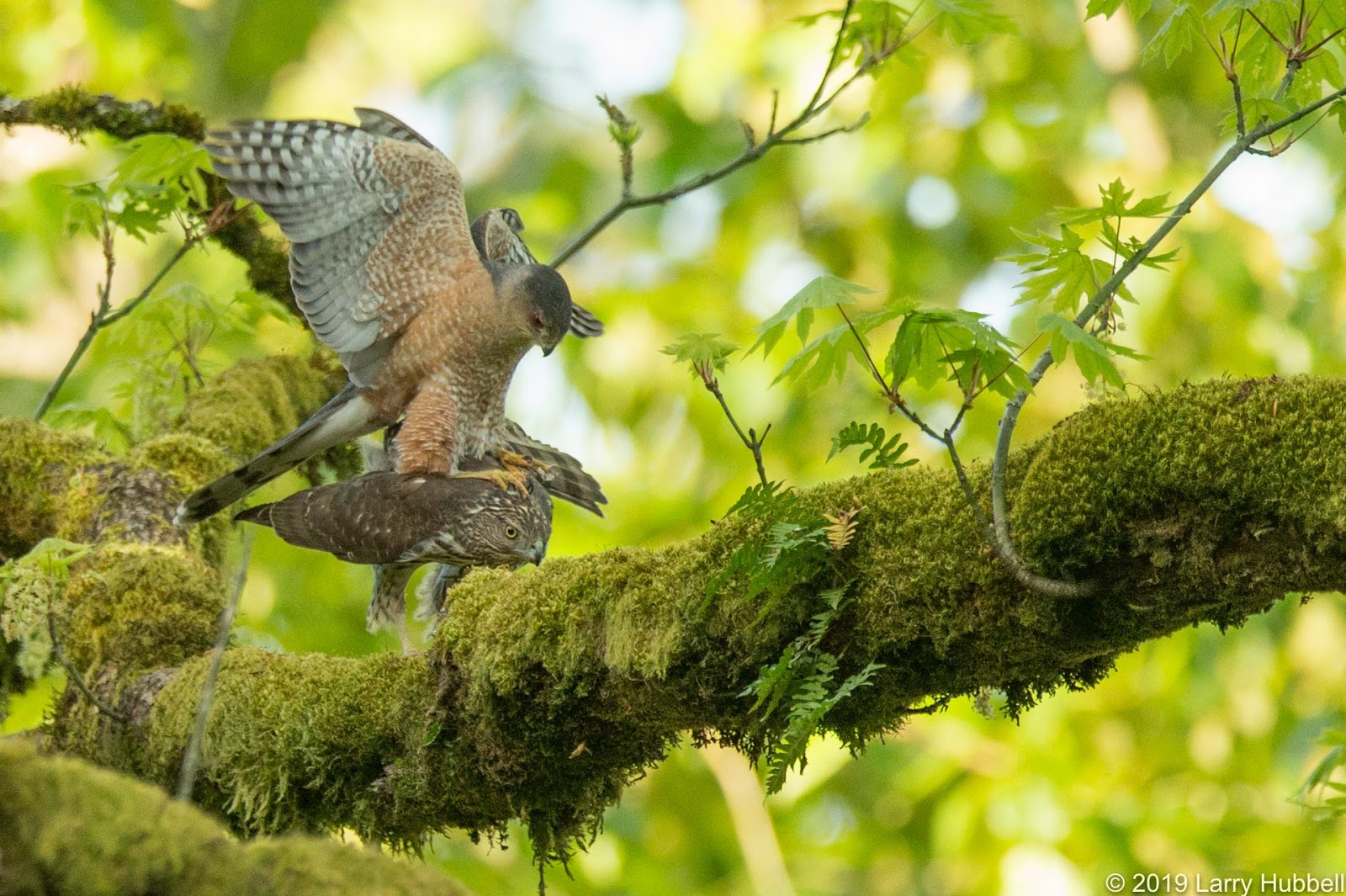
In some cases, immature birds become more than helpers. Young females, like this one, can be mature enough to lay eggs and occasionally take on the role of an adult female. 

Yesterday, on the south side of Union Bay, Ed, his wife Gerry and I, were lucky enough to see this young, un-banded female eating food supplied by her new mate. 

The male has the subtle orange chest-bars of an adult Cooper's Hawk. Ed also mentioned how young hawks have yellow irises and as they mature the irises turn orange and then ultimately they can even turn red.

Ed pointed out that the adult male's role is significantly more complicated than the female's. The male does not simply impregnate the female and leave - like a male Anna's Hummingbird.

Initially, the male does much of the nest building, for which he is rewarded with mating opportunities. The male also supplies food to the female prior to and during nesting. After hatching, and even after the young fledge, the male continues to supply food to the young birds. In addition, when the female is on-eggs the male generally defends the nesting territory from other predatory birds.

In this case, after the mating was done, the young female feasted at length. Her bulging crop, just below her head, is full of undigested food which she carried away to a higher and safer location. 

Large, moss-covered, horizontal Big Leaf Maple branches, like this one, are prime locations for Cooper's Hawk meals. Feathers and fur can often be found on the ground beneath them.

After mating the male rested for a few minutes before completing at least a dozen trips to the nest with additional sticks, which are often gathered from the brittle twigs on the inner branches of a Douglas Fir tree.

Afterwards, the male took the time to clean up the scraps.

Back on the north side of the bay, one of Percy's male neighbors met his demise, by flying headfirst into a window, earlier this week. Ed and I are hoping that Percy seizes the opportunity and begins delivering food to the female. Without a steady supply of food, the female will have to abandon her eggs. No one knows if Percy is mature enough to take on adult responsibilities. However, we do know he is highly persistent.

When you are near Union Bay you can help by bringing your binoculars, watching for banded Cooper's Hawks and reporting band sightings to the Urban Raptor Conservancy. Cooper's Hawks are capable of living over two decades. Hopefully, Percy's story is just beginning.

Have a great day on Union Bay...where nature lives in the city!

Larry


Going Native:

Without a well-funded Environmental Protection Agency, it falls to each of us to be ever more vigilant in protecting our local environments. Native plants and trees encourage the largest diversity of lifeforms because of their long intertwined history with our local environment and native creatures. I have been told that even the microbes in the soil are native to each local landscape. My hope is that we can inspire ourselves, our neighbors and local businesses to respect native flora and to support native wildlife at every opportunity. I have learned that our most logical approach to native trees and plants (in order of priority) should be to:

1) Learn and leave established native flora undisturbed.
2) Remove invasive species and then wait to see if native plants begin to grow without assistance. (If natives plants start on their own, then these plants or trees are likely the most appropriate flora for the habitat.)
3) Scatter seeds from nearby native plants in a similar habitat.
4) If you feel you must add a new plant then select a native plant while considering how the plant fits with the specific habitat and understanding the plant's logical place in the normal succession of native plants.

My intention in my weekly post is to include at least one photo each week and visually challenge us to know the difference between native and non-native lifeforms.


Is this a native or non-native type of flora?


Scroll down for the answer.


***************


Sorry, to disappoint everyone but I do not have a clue what kind of flower this is. I found it growing above Montlake Cut just to the west of the old boathouse. I suspect it is not native because I cannot find it in:

'Plants of the Pacific Northwest Coast' - Pojar and Mackinnon

 or 

'Wildflowers of the Pacific Northwest' - Turner and Gustafson

I would love to hear from someone who can identify it. My email address is:

LDHubbell@comcast.net

****************

Update:

Thank you to all who responded! Dennis, Richard, Tasha, Alejandro...

The winning entry appears to be, Forsythia. From what I have read, there are multiple species but they are mostly (maybe all) from the Old World and related to olives.


****************


For more information about native plants visit the Washington Native Plant Society.


***************


The Email Challenge:

Over the years I have had many readers tell me that Google is no longer sending them email announcements regarding my posts. Even more frustrating when they go to 're-sign-up', hoping that will enable them to once again start receiving the announcements, they get a message which says 'Sorry, you are already signed up.' Google has not responded to my requests for help with this issue. 

My functional workaround is to set up my own email list and each week I manually send out a new post announcement. If you are experiencing the issue and would like to be added to my personal email list please send me an email requesting to be added. Thank you for your patience!


My email address is LDHubbell@comcast.net


Monday, April 22, 2019

The Osprey Fight On

In 2016, for the possibly the first time in one hundred years, Ospreys successfully nested near Union Bay. Although, they did have to overcome some challenges. (Sadly, in 2018 their challenges took a new twist.)

In 2016, the Ospreys put a tremendous amount of work into their initial nest site. Unfortunately, the location, above the entrance to the new University of Washington Baseball field, was not acceptable. The nest was dismantled, prior to eggs being laid. Luckily, the UW athletic department paid for a nesting platform in the Union Bay Natural Area, right next door.

To the amazement of many, the female Osprey took the hint, settled down on the new platform and laid her eggs. Due to the time pressure, the nest was fairly sparse.

In spite of the minimal nest, by late August, they had three healthy offspring. In this photo, the adult female, who I call Lacey, is on the right. Her name was inspired by her brown 'necklace' which decorates her chest. Here it is easy to notice that the three young birds have dark feathers with beautiful white tips, unlike Lacey's more uniformly dark adult feathers. 

In July of 2016, I happened to catch this photo of Lacey and her mate, Chester. Chester's name was inspired by the fact that male Ospreys generally have pure white chests. This photo, with both adults looking down, gives us a chance to view the crowns of their heads. Later, I would learn that their crowns can be uniquely patterned. In this photo, we can see that Lacey, on the left, has more dark feathers on the top of her head, as compared to Chester.

At the end of each summer the Ospreys head south to warmer weather, most likely Mexico. Whenever it is warm the fish stay closer to the surface, so migrating helps the Ospreys to catch an adequate supply of winter food.

The Ospreys returned in the Spring of 2017. Even from a distance, we can see that Chester has visibly more white on the crown of his head. Although I find the markings on their heads adequate to tell the two of them apart, I am not 100 percent positive that I could successfully use the markings to identify them from other Ospreys.

In 2017, unlike the year before, they were able to focus on their nest on the pre-built platform. As a result, they built a noticeably taller nest.

During the summer, Chester worked hard and the nest continued to grow.

He also brought plenty of food back to the nest. The Ospreys successfully raised two young in 2017.

In 2018, they returned and clearly had every intention of raising young once again.

It is interesting to note that in May of 2018 the number of sticks in the nest was only half as high as in 2017. Lacey laid eggs and two young birds hatched out. Sadly, one disappeared early on and the second died later in the summer. The story of their demise was covered well in a Pacific NW Article by Glenn Nelson. If you click on the highlighted link you can read Glenn's story and you can also see that the sticks in the Osprey's nest never attained the height or depth that they did in 2017.

The experts suggest that the young birds did not get enough food. Since Bald Eagles steal fish from Ospreys, and a new third pair of Bald Eagles began nesting on Union Bay in 2018, the Eagles may very well have thrived at the expense of the young Ospreys.

However, there could have been other factors as well. For instance, what if Chester was replaced by a less-skilled male in 2018. How would we know? Last year, I could see that the male had less white on the top of his head than his mate, but was he really the same male from the prior year?

Here is a closeup of Chester in 2017.

Here is the 2018 male.

While light, shadows, angles and even the wind can change how feathers look. When I look close, the markings on the forehead and crown look different to me. Still, I am not completely positive. Ospreys mate for life and can live for a couple of decades. At the same time, a single mistake while diving headfirst after a fish could easily be fatal. 

The good news is, the Osprey pair returned last week. They were even seen mating. (Thank you, Ronda!). One way or the other, hopefully, this year's male will be a stronger and more adept provider.

In addition, a few days ago we watched Lacey chase away an adult Bald Eagle.

The Bald Eagle landed south of the Conibear Boathouse and then proceeded to chase after two immature eagles. I suspect one of the immature eagles might have been carrying a fish. 

Immediately thereafter, the adult eagle could be seen carrying a fish back towards the Talarus eagle's nest. I suspect the adult took the fish away from one of the young eagles. I believe he was the male bird, that I call Russ, because this time of year the female eagle would most likely be incubating eggs at mid-day.

Even though Russ was not an immediate threat, Lacey decided to let him know he was passing too close for her comfort. 

Given that she is probably half his weight her mid-air attack was quite impressive.

For good measure, she also chased off the two immature Bald Eagles.

A couple of days later there were a few more sticks on the platform. It may be the tiniest of encouraging signs. Still, the Ospreys have returned, as opposed to relocating to a new nesting site. Plus, Lacey is showing her tenacity and desire to retain her Union Bay nest site. At this point, it feels like all we can do is hope.

However, given that Ospreys eat fish, we can try to help the local fish population, which would indirectly benefit the Ospreys. One immediate opportunity is to minimize our usage of the 520 bridge. Currently, the runoff from that section of the bridge, directly above Union Bay, drains directly into the water. Automotive runoff is apparently unhealthy for fish. Healthier fish will reproduce more which in turn should mean easier pickings and less competition for our local, fish-eating Ospreys.

Have a great day on Union Bay...where nature competes in the city!

Larry


Going Native:

Without a well-funded Environmental Protection Agency, it falls to each of us to be ever more vigilant in protecting our local environments. Native plants and trees encourage the largest diversity of lifeforms because of their long intertwined history with our local environment and native creatures. I have been told that even the microbes in the soil are native to each local landscape. My hope is that we can inspire ourselves, our neighbors and local businesses to respect native flora and to support native wildlife at every opportunity. I have learned that our most logical approach to native trees and plants (in order of priority) should be to:

1) Learn and leave established native flora undisturbed.
2) Remove invasive species and then wait to see if native plants begin to grow without assistance. (If natives plants start on their own, then these plants or trees are likely the most appropriate flora for the habitat.)
3) Scatter seeds from nearby native plants in a similar habitat.
4) If you feel you must add a new plant then select a native plant while considering how the plant fits with the specific habitat and understanding the plant's logical place in the normal succession of native plants.

My intention in my weekly post is to include at least one photo each week and visually challenge us to know the difference between native and non-native lifeforms.


Is this a native or non-native type of flora?


Scroll down for the answer.


***************


Pink Flowering Dogwood: It is non-native, but related to the native, Pacific Dogwood


For more information about native plants visit the Washington Native Plant Society.


***************


The Email Challenge:

Over the years I have had many readers tell me that Google is no longer sending them email announcements regarding my posts. Even more frustrating when they go to 're-sign-up', hoping that will enable them to once again start receiving the announcements, they get a message which says 'Sorry, you are already signed up.' Google has not responded to my requests for help with this issue. 

My functional workaround is to set up my own email list and each week I manually send out a new post announcement. If you are experiencing the issue and would like to be added to my personal email list please send me an email requesting to be added. Thank you for your patience!


My email address is LDHubbell@comcast.net