Mission: To promote the appreciation of wildlife and increase harmony between humanity and nature.

On Instagram: @unionbaywatch

Saturday, March 8, 2014

Humming In The Rain

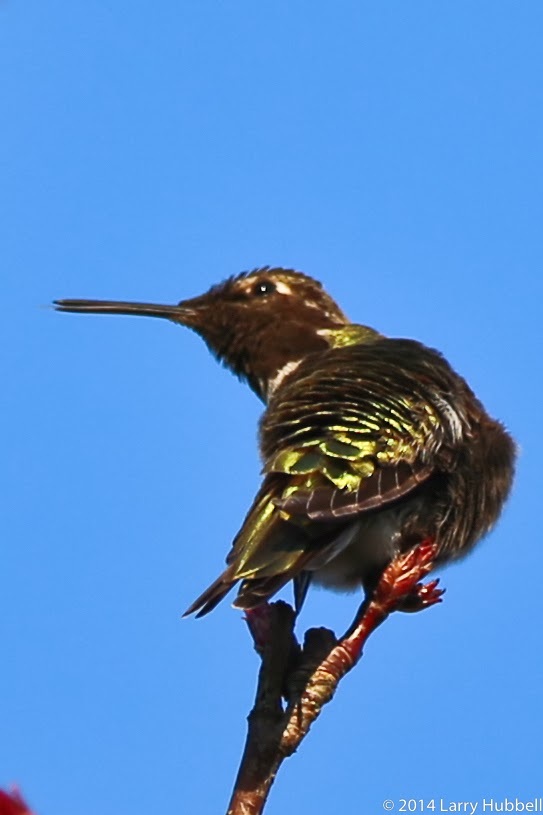
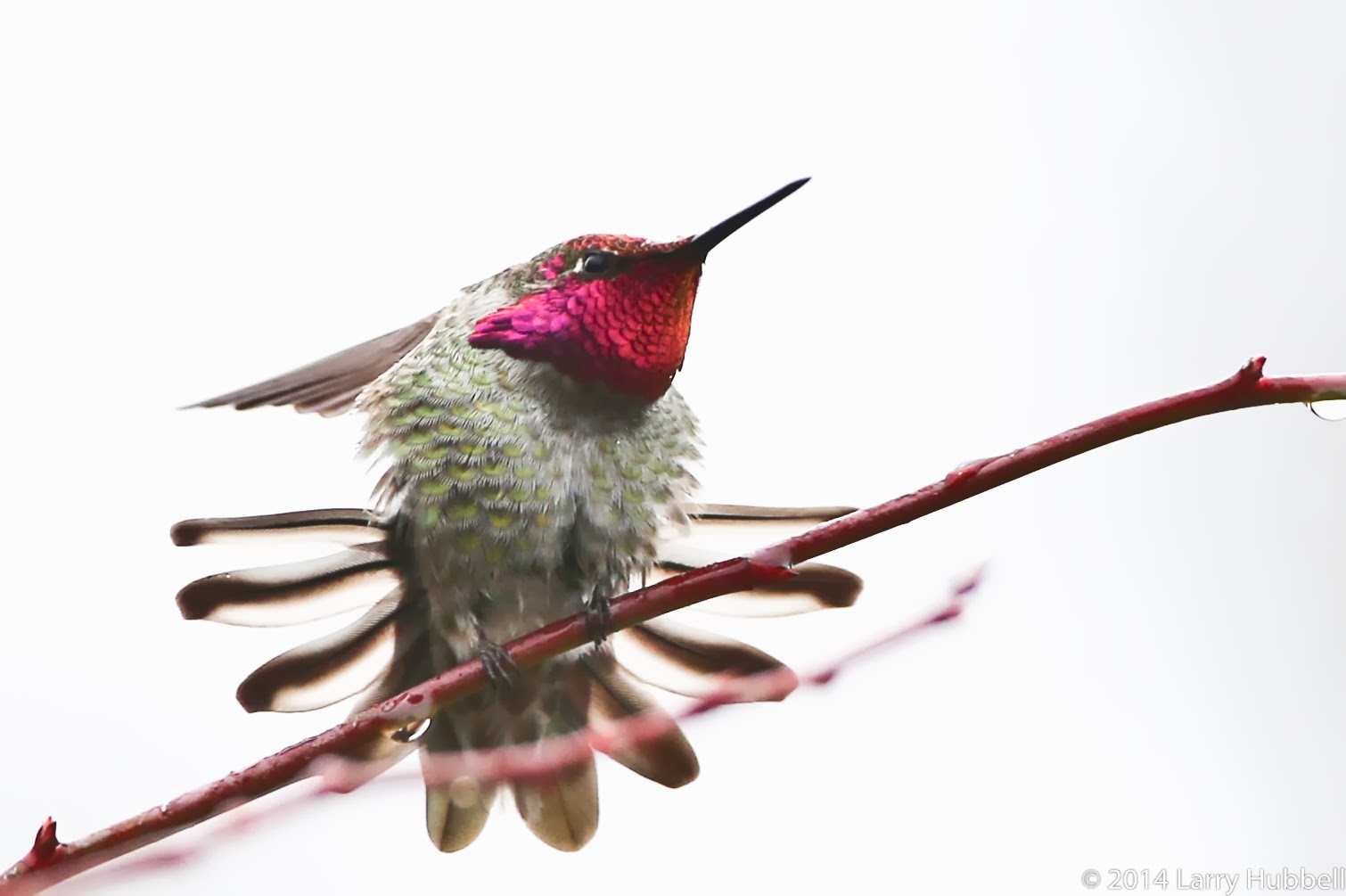
Most likely this Anna's hummingbird has been faithfully defending this same territory for a couple of years.

In spite of the rain, every morning last week he was in almost exactly the same spot. He sits facing the trail to Foster Island with his face reflecting the "sunlight". Maybe we should call him Foster.
This week Foster's only concession to the weather was on the one morning when the rain was particularly hard, he moved down from the tip-top most windblown branch, to one about 4 feet lower that was slightly more protected.


Looking back at the last 3 photos it is interesting to note the color changes in his iridescence as Foster changes the angle of his head. 

A quarter mile away near the WSDOT peninsula, another male is nearly as regular in protecting his territory. In his case he almost always sits with his back to the sun, which does not allow the iridescence to reflect the brilliant red colors. It makes one wonder if this is a difference in the sensitivity of their eyes, a difference in their personalities or maybe it is because the closest trail to the second bird passes to the north and both birds are simply being careful in their sentry duty.

 Foster watches everything. He looks to the left…


 …he looks up…


 …and he looks right at you. He is not nearly as skittish as the WSDOT bird. It is funny but I cannot imagine the WSDOT bird attacking a human. On the other hand, I would not be surprised at all to see Foster come flying straight at an intruder who ventured too close. It really does seem like each bird has its own personality. Before you proceed, did you happen to notice anything a little odd in the photo above?


Foster was using his right foot to scratch around his right eye. This is another case where you do not want to try this at home. It hurts just thinking about it.


In this photo you can see the tip of Foster's tongue. He can stick it out so that it is twice as long as the tip of his beak. He stuck it out rapidly four or five times while he was just sitting on the branch. There did not seem to be anything nearby in the air. Maybe he was catching something too small for my eyes to see.

WSDOT stretches when the sun comes out...

…and Foster stretches when the rain lets up a bit.


If you have the courage to go out in the rain and look Foster in the eye, here is where you want to go. Start in the Arboretum north of the Don Graham Visitor's Center. Where Arboretum Dr intersects N.E. Foster Island Rd, follow the trail towards Foster Island for a couple hundred feet. At the overlook, e.g. the first bench, take a seat. With your binoculars carefully scan the top of the brush (willows I believe) just fifteen feet in front of you.

This week not only has Foster been there on a regular basis, but on Friday he provided audio to go along with the view. When the sun came out a bit he started singing. His song was similar to the second song on Cornell. To hear it, click here.

Later he was diving straight down and doing his "J" hook turn at the bottom. As he made the turn he used his tail feathers to make a loud chirping or squeaking sound. If you have never seen and heard the display it is impressive. It is also interesting to read about how this sound was determined to not be a vocalization. To read all about it, click here.

Have a great day on Union Bay…where nature lives in the city!

Larry


Saturday, March 1, 2014

Picidae, Picidae, What do you see?

What kind of bird is this? 

Seen yesterday on Foster Island this is most likely Elvis the pileated woodpecker. He has his beak tucked under his wing while he is doing a little grooming. It makes for an interesting angle with the peak of his head pointed at the ground. 

If you look at the photo from a distance and maybe blur your eyes a bit you can almost think of the peak as a beak and he starts to look like a one-of-kind, red-faced bufflehead. O.K., maybe that is over doing the creative angle a bit. :-)

How about this one?

Also seen yesterday on Foster Island, this is obviously a flicker. But take a moment and compare this bird with two seen on Wednesday morning.


The lighting is different so the first bird has a nice golden tone that the other two lack, however that is not one of the differences between the birds. Two of the three flickers (and Elvis) have a marking that indicates they are male woodpeckers. It is the red malar stripe on their cheeks. The female does not have any red on her face.

The last two birds also have orange feathers showing on the underside of their tails. Along with the red malar stripe on the male this indicates they belong to the red-shafted, western branch of the northern flicker family. The males of the yellow-shafted (or eastern portion) of the northern flicker family have black malar stripes, yellow under their tails & wings and a red marking on the nape of the neck.

Surprisingly our first flicker has the red cheeks of a red-shafted and also red on the back of the neck. My best guess is that this fellow had ancestors from both the east and the west.  In the Sibley guide he says, "Intergrades occur frequently..." but he does not mention or show this particular combination of markings.

So next time you take a walk in the park be sure to look closely at the flickers you meet. It can be fun to figure out their gender and even some of their family history with just a glance. 
If you would like to check out a few more variations on the flicker theme click here.

Here are a few more shots from yesterday on Foster Island.

It is interesting how sometimes his crest is more upright. It certainly gives him a surprised look.


How close were you looking?

Are the two pileated woodpeckers in this photo a surprise? Did you notice that one of the previous photos was not a male, but actually a female. If you click on the photo for a larger view you can even see that the iris of her eye is a bit more orange while his is yellow.

To prove that the color difference is not just the angle of the light. Here are two photos from the same location, however one photo is of the male and one of the female. Can you see the difference?


Have a great day on Union Bay...where natures lives in the city!

Larry


Sunday, February 23, 2014

A Skagit Trip

Earlier this month my friend and avid birder, Marcus Roening, lead a birding trip to "The Skagit". Skagit county is about an hour north of Seattle and extends from Puget Sound to north of Lake Chelan. So a trip to "The Skagit" could have covered a lot of territory. In this case most of our birding was west of I-5 and most of these photos are from the delta area that is Fir Island.
The short-eared owls and northern harriers often seen in this area were too far away to photograph but even the relatively empty landscape was worth a photo or two.

I just realized that the railroad that was built in 1886, where the Burke-Gilman trail is today, would have been as close as possible to the level shore around Union Bay. (Prior to the lowering of Lake Washington in 1916, when the Montlake Cut was completed.) It makes one wonder if the photo above is similar to how the University Village area looked two hundred years ago. 

One of the first birds seen on our Skagit trip...

...was this trumpeter swan.

There were bald eagles, hawks, pintails, mallards and many other birds but the highlight of the trip was the snow geese.
Every time an eagle would pass, the geese would take to the air.

Trying to look closer at a huge flock of snow geese can make one somewhat dizzy. Imagine a bird of prey trying to focus on a single bird with the constant flow of motion, the sound of their honking and a thousand wings drumming against the air.

Even on the ground a single bird can be hard to pick out.

Once the danger was past they would settle down to feed.

With patience it is possible to focus on a single bird, although did you notice the bird looking up from behind the dirt?

While feeding they alternate between having their heads down and being on alert for danger.

Curiously the two birds in the middle of this photo have (tight looking) bands around their necks. The codes have been reported to the U.S. Geological Survey and it will be interesting to hear (in a few weeks) about the study in which these birds are involved.

It is also interesting to look at the migration patterns of the snow geese. Cornell shows that they winter in spots along both North American coasts and what appears to be strategic wetlands dotted across the lower half of the U.S. and Mexico. Up north, their nesting locations are as close to the arctic as they can get. Their mapped migrations appear as four distinct north and south columns. One near each coast, one that looks to be just east of the Rockies and the largest one widely centered around the Mississippi Valley.

In 1916 the hunting of Snow Geese was outlawed due to their dwindling numbers. But now they have recovered so well that around 400,000 birds are hunted annually in North America. 

Although I have never seen a Snow Goose near Union Bay there have been some sightings in the last few years. Usually just one or two birds, however in 2008 three different birders reported seeing at least 10 Snow Geese at the Union Bay Natural Area. None appear to have been reported this year. Keep your eyes open, you could be the first to see one.

Late in the day this colorful little kestral was spotted on a distant wire. The photo is a bit fuzzy but the colors are just too beautiful to keep to myself. Ebird shows no reports of kestrels near Union Bay. Wouldn't it be wonderful to have them return someday.

This week near Union Bay I have seen crows flying with nesting material. Eva was spotted sitting in her nest, most likely working on "sprucing" it up. Yesterday, green-winged teals were whistling and bowing to their mates. In spite of the grey, cold and wet these are all hints that spring is coming.

Have a great day on Union Bay...were nature lives in the city!

Larry


Sunday, February 16, 2014

Winter Warblers

These warblers were all seen this winter within walking distance of Union Bay.


They are each a different type of warbler. Can you identify them?

In the winter these birds are far more common in Mexico or Florida rather than near Union Bay. However in warmer weather they are more likely to feed on insects in flight. As a result they are often higher in the trees, darting out from the foliage and more difficult to see.
The ones that choose to winter near Union Bay are more likely to be down near the ground looking for berries or for out-of-season insects that appear on a warm winter day. This can actually make them easier to spot and photograph in the winter.

This time of year these bird's colors are more subtle and muted than in summer. The bird books tend to focus on the most colorful, springtime colors of the birds, but there are still clear distinctions between the markings of these three birds. If you do not know the names of these birds you might enjoy trying to identify them using The Cornell Lab of Ornithology online or by taking a look in a bird book.

In either case you will quickly notice there are many different types of warblers that reside in North America. Looking at 50 different types of warbler pictures can be intimidating. However, you can reduce the options fairly quickly by limiting yourself to warblers that have a geographic distribution that includes Union Bay. 

That brings the list down to:

  • Orange-Crowned Warbler
  • Yellow-Rumped Warbler
  • Black-Throated Gray Warbler
  • Townsend's Warbler
  • Yellow Warbler
  • Wilson's Warbler
To be fair only two of the three warblers in our pictures are on this list.  The third bird is vacationing out of its normal geographic area. If you want to identify these birds without any further help you should stop reading at this point.

Of the six birds listed above only two show winter ranges near Puget Sound. They are the Yellow-Rumped and the Townsend's Warblers. If you happened to read the Solstice Surprises post of December 21st you might remember that the Palm Warbler was pictured. This is our third warbler that does not normally reside around Union Bay.

By the way in that post I also mentioned seeing river otters in Union Bay for the first time. Last week I happened to be near the same location, e.g. the bridge between Foster and Marsh Island, when two Canada Geese suddenly lifted off, squawking loudly. I looked to see what startled them and there was a river otter in almost exactly the same place where I saw the otters in December. If you happen to spot a "beaver" in that area you might want to do a double-check.


 So we now know our three warblers are a:

  • Palm Warbler
  • Yellow-Rumped Warbler
  • Townsend's Warbler

but which is which?

It turns out that only the Townsend's Warbler has a dark ear patch bordered in yellow. 

Ironically, the Palm Warbler is yellow under its tail and the Yellow-Rumped Warbler is white under the tail. So in order our birds are:

  • Townsend's Warbler
  • Palm Warbler
  • Yellow-Rumped Warbler
Apparently the yellow that gives a Yellow-Rumped Warbler its name is this small yellow spot above the tail and between the wings.

Hopefully, this post has helped to make warbler identification a bit easier. However the warblers have additional tricks up their proverbially sleeves. It turns out that among Yellow-Rumped Warblers (YRW) there are two different local variations.

Especially during breeding season the male Audubon's version of the YRW has a yellow throat, while the Myrtle version has a white throat. This one seems to have both yellow and white under its throat. So which is this? 

You may have noticed that this is the same photo used in last week's post. It turns out the Evan Houston sent in the following email about this bird.

Hi Larry,

I thought you might be interested to know that the Yellow-rumped Warbler you photographed is very likely to be an intergrade "Audubon's x Myrtle".  I've been meaning to try to confidently identify one in the field for a while now, but have not felt very confident w/o getting photos that I can study.

I asked my more experienced friend, Ryan Merrill, to take a look at your photos in your latest blog post, and here's what he said
"Yeah, I would definitely call that an intergrade.  Clearly yellow in
the throat as in Audubon's, but also the white corners curling up into
the auricular, supercilium, and dark lores/partial auricular as in
Myrtle."

Was this one in the "dime lot" pond?  I may have even seen this particular bird on 2-1, and I tried to photograph it, but it was too fast for my skills with my point and shoot.

-Evan
Seattle, WA

Thank you to Evan and Ryan for pointing out that this YRW's interesting heritage.

Just for fun here are two warblers photos where the bird is a bit more difficult to pick out. Can you now find the and identify the warbler(s)?

Both of these photos are of the same bird shown at the beginning of this post.

Finally, from last week,Twink asked is this bird really a House Finch or could it be a Crossbill? What do you think?

Have a great day on Union Bay...where nature lives it the city!

Larry