Mission: To promote the appreciation of wildlife and increase harmony between humanity and nature.

On Instagram: @unionbaywatch

Sunday, May 13, 2012

Bursting at the Seams

Right now Union Bay is bursting at the seams with life. There are so many stories happening it is difficult to select one, two or even three so here are four stories wrapped into one. The stories include updates on the Osprey, FOY Goslings plus new First of the Year Duckling photos (with thoughts about their one-eyed mother) and finally photos showing the operation of a Heron's eye lid when feeding.
The photo above of the osprey and the crow was taken just north of the Arboretum at 5:30 pm one day last week. The osprey was attempting to fish the waters just S.E. of Foster Island. The crows on the other hand were returning to the area to spend the night. The osprey was initially chased away by one or two crows. He then returned a few minutes later and was chased away by a half a dozen crows. Within ten minutes he was back again and this time he was chased away by one to two dozen crows. During his time in this area he made only one dive into the water for a fish but came up empty. After flying thousands of miles to get here for the summer he is obviously hungry and persistent. The crows do not appear to be too hungry however they are most certainly persistent. The osprey now appears to be making it a habit to circle around Union Bay above the shallow waters near the land.
The good news was yesterday morning the osprey was back searching the water for fish while most of the crows were away scouring the streets of Seattle.


In the case of the goslings from the prior blog there is good news and bad news. In less than 2 weeks the goslings have nearly doubled the length of their bodies and it appears they have more than doubled their weight. You can also compare the length of the neck and legs to their photos in the prior blog.


On the other hand it appears the more curious of the siblings is gone. The total count of goslings has been reduced to three. In addition it appears that these goslings have been taught to follow boaters and beg for bread. If you feel a need to feed wild creatures please consider the consequences. If while young (and cute) the goslings do not learn to feed naturally what will happen if the weather turns cold and no boaters are available to provide them food.
Yesterday in addition to the goslings there were also nine brand new ducklings just south of Foster Island. They were learning to feed naturally. They were practically hopping across the water snipping and snapping at tiny little airborne insects. The insects were of the variety that my uncle calls, "noseeums", although these young ducklings can certainly see them.
It was virtually impossible to catch all nine ducklings in the same photo. 
The mother was attentive but clearly taxed beyond her means. Her ability was reduced because she was missing her right eye. Having seen a Cooper's Hawk (see the fifth blog) while it was in the process of removing a Wigeon's eye, a Cooper's Hawk is the most likely suspect. The additional reasoning is as follows: 1) Five minutes later a Cooper's Hawk was seen being chased away by Red-winged Blackbirds. 2) The other birds of prey seen in this area are Bald Eagles and Osprey if either got their talons into a Mallard they would have punctured the heart long before the eye was removed. 3) The Cooper's Hawk appears to have a much smaller turning radius and would find it easier to catch a Mallard. 

In any case it is amazing that this half blind Mallard recovered from such an attack and then was able hatch out nine ducklings and get them on the water and on their way to adulthood. Given this is being written on Mother's Day it seems appropriate to award this mother the first ever Union Bay Watch "Children First Award".
The last story for today's blog covers the functioning of a Great Blue Heron's upside down eye lid. This first photo appears to be just a bad photo, however the milky color of the heron's eye is not just a result of the speed with which his head plunges into the water. It is also because he has a waterproof eyelid that closes whenever his eye might get wet.
It is also interesting to note how far his neck is extended beyond the little red plant on the left side of the photo. In the next photo he retracts his neck and begins the process of tossing the fish into his mouth.
The red twig is now on the right side of the photo and his milky waterproof eyelid has been retracted.
As the fish gets closer to the eye the waterproof lid is utilized again just in case the fish throws off a bit of water in the process.
Now the eyelid covers nearly the entire eye.
Finally with the fish safely down the hatch the eyelid is once again retracted.

Happy Mother's Day to you and yours!


Larry


PS: I love you, Mom!

Sunday, April 29, 2012

Goslings - First of the Year

Today was my first siting of goslings on Union Bay in 2012. I suspect they were hatched in the last day or so.
It is interesting to see that at this young age one gosling is far more adventurous than the others. 
May be even more curious.
Does this mean more thoughtful as well?
Definitely more of a risk taker.
Particularly compared to it's siblings.
Some have to lead and some have to follow.
But it also seems to be more aware of it's surroundings as well. 
It sure seems like leaders are born not made, at least in the world of goslings.
Hopefully, the risk taking will be offset by the sense of awareness.
Still there is a time to lead and a time to follow.

I hope you have enjoyed sharing these photos.

Larry

Additional photos will be posted at:


Tuesday, April 24, 2012

Earth Day on Union Bay

Earth Day started with an incredible display of sunshine and beauty seen from the dock in the Beaver Lodge Sanctuary on the south side of Union Bay. A Pied-Billed Grebe disappeared below the surface of the bay. In a few moments his ancient, erie call echoed from the cattails, interspersed between the "ko-kang-garee" of the Red-winged Blackbirds. 


My Earth Day challenge was to (kindly and gently) photograph as many species of birds as possible between dawn and noon, in or around Union Bay. My hope was to draw attention to beauty of nature that surrounds us even in the midst of a modern city. 


started near an eagle's nest  hoping to get a photo to start my day, but the Bald Eagle was hunkered down in the nest conserving heat for herself and her egg. I did get one quick glimpse of a single eye looking hopefully toward the sun but no useable photos.


I first noticed the Union Bay Bald Eagle's sitting on their nests around April 1st. 
(Did anyone notice them sitting earlier than that?)


The first bird to make itself available for a photo was a Robin.

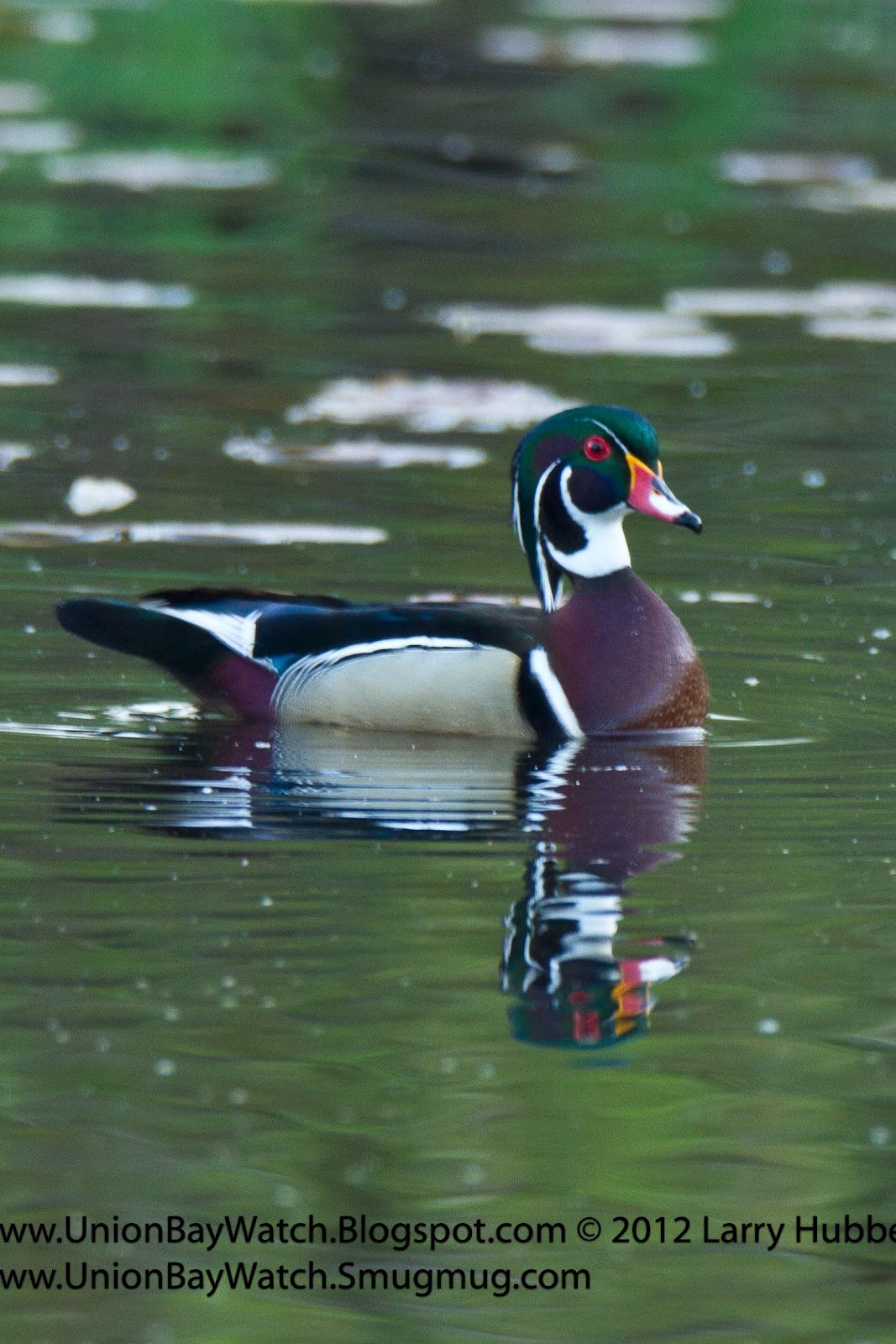
The next stop was in the Arboretum to utilize my tripod a bit more before I took to the water. Next to the southern bridge to Foster Island two pairs of Wood Ducks have become somewhat tame this winter. The Wood Ducks have been watching the Mallards being fed bread by small, giggling children. Thankfully, the Wood Ducks are still slightly more shy than their role models.

The Mallards nearly come when you call them.


An Anna's Hummingbird has also been hanging out in the area early in the morning, however I haven't seen him eating the bread. I wonder if he spends the night on these branches? 

The green of his back nearly matches the new growth of the leaves and his head only reflects red when he "mirrors" sunlight in your direction. He is easier to miss than he is to see. Luckily, he was waiting there again.

At this point it was time to get my kayak into the water. I started out just west of the Arboretum. The Bufflehead watched me carefully for a moment or two. Interesting how the Hummingbird and the Bufflehead both have reflective, iridescent displays of color.

The interesting patterns of brown and white on the breast of the Gadwall are not quite as attractive as the Hummingbird or the Bufflehead's colors but they are more functional as camouflage. 

The photo of the Ring-necked Duck actually shows a slightly red ring around the neck.
My eyes are not what they used to be so maybe it was the bright sunshine that helped me to notice the ring for the first time.

Just south of Marsh Island a couple of Starlings enjoyed the early morning sun.

Continuing in a counter-clockwise direction I began to circumnavigate around Union Bay. In the hidden little inlet that surrounds what I call "Elderberry Island" the Northern Shoveler was circling and shoveling away.
Nearby a Crow had found a piece of bread. He most likely stole it from the Mallards. Anyway the Crow hauled the piece of bread out to the island were he could eat it in peace.
On the east side of the island the Great Blue Heron waded through the shallow water in the shade of the overhanging branches, browsing for breakfast.
From high overhead came the rat-ta-tat-tat of a hungry Woodpecker briskly searching for breakfast in his own penetrating way.
The Woodpecker kept his head down and his tail feathers hidden from my view. 
He did seem rather small but he was also very high and distant in the tallest tree.
(Can anyone tell if he is a Downy or a Hairy Woodpecker?)

While passing around Foster Island and turning north under 520 a Pied-billed Grebe popped up long enough for a photo.

Cliff Swallows were circling just north of 520 and then landing upside under the bridge to make nests and feed their young.
Just north of 520 the Double-crested Cormorants were standing side by side. Occasionally one of them would spread their wings to absorb the early morning sunlight. The young seemed just as large as their parents however the white on their chests and necks made them obvious, although their hungry, expectant stares also gave them away.
Crossing to the shade of Webster Point was safe except for the 2 person rowing scull that whistled by just behind me. The experience did make me question the logic of rowing full speed ahead while facing in the opposite direction.

I can admit I might have noticed the scull sooner if I wasn't distracted by trying to photograph the gull passing over my head. My best shot of the gull still does not provide me enough information identify it. (Can anyone identify this gull?)
Closer to shore a Canada Goose was bathing in the most aggressive fashion possible. Water flying, wings flapping, head dipping and then splashing more water over it's back.
Towards the middle of the lake were a number of other bird species.  I believe at least two of the birds in this photo are Greater Scaup.
Looking back toward shore I spotted a small gull sitting on a piling. 
I believe this is a young Mew Gull.  (Can anyone tell me if this identification is correct?)

Looking back toward the middle of the lake I spotted a Common Merganser.
Approaching the Union Bay Natural Area (UBNA) I noticed a Bald Eagle sitting near the top of a cottonwood tree above Yesler Swamp. This may be the male Bald Eagle from the pair nesting on the north side of Union Bay.

During the last year I have seen Bald Eagles fly from similar perches on the north side of the bay to steal fish from both a Cormorant and an Osprey.  What is most amazing is their ability to spot a bird taking a fish from at least a quarter mile away.

Not surprisingly there were virtually no birds in the area below the eagle. As I turned south to leave I was surprised to see a large, mostly white bird flying overhead. The bird was obviously hunting and simply passed by as it worked it's way north and then east along the northern edge of Union Bay. It was my first siting this year of an Osprey on Union Bay.  Welcome back! 
Quite often last summer there were Osprey sitting or eating on top of the light poles above the UW baseball field. (Does anyone know if they nest around Union Bay?)

Proceeding west just below the UBNA I noticed a Red-winged Blackbird working on a cattail. I thought the male bird was collecting soft nesting material. However later when I enlarged the photos I did not see any material being held in his beak. There were a few pieces of cattail sticking to the sides of his head but it did not look like he was carrying them. (Does anyone know whether the RWBBs eat cattails or use them for nesting or both?)

As I turned south in front of the UW rowing facility I spotted an American Coot. After having seen thousands of them on Union Bay during the winter it was surprising to only see one on Earth Day.

Next was a Barn Swallow sitting quietly on a tree branch. Previous attempts to photograph a Barn Swallow had been when they were in flight. This generally results in photos with very pretty streaks of blue. I really appreciated this Earth Day opportunity.
Apparently the swallows had gotten together and decided today was my lucky day.  The next two birds were Tree Swallows. Including the Cliff Swallows earlier, this gave me my best photos ever of three different types of swallows. 

Both the parent and the young bird landed repeatedly on the same snag. This apparently enabled them to safely transfer food.
At this point I headed directly south crossing near the cut and around the west end of Marsh Island. I saw many birds along the way but only one additional species, the Rock Pigeon.

As I pulled the kayak home it was nearing 11am and I had one more stop to make before noon. I headed up to Interlaken Park hoping to photograph one of the Barred Owls. Luckily, the owl had found a perch with a shaft of sunlight to warm it's face.
Down to my last 20 minutes, I paced the area looking for any additional avian species. 

I found a Flicker...
a Sparrow...
and finally a Junko.

This completed my Earth Day celebration and my first Earth Day avian photo inventory.  It made me realize that we are incredibly lucky to live in a large modern city and still share Union Bay, the Union Bay Natural Area, the Arboretum and Interlaken Park with such a nice variety of birds.

However, I think Earth Day should also be a time to reflect on how we can help the earth to recover some of the diversity that has been lost. With the closing of the salmon hatchery on the other side of Montlake Cut it makes me wonder if we could ever get salmon spawning in either Ravenna Creek or the Arboretum Creek. Both of these options have many challenges including daylighting, water pollution and funding. Still salmon returning to Union Bay would add so much, not just to our lives, but to the lives of those who follow us.

Is anyone interested?

Larry