Mission: To promote the appreciation of wildlife and increase harmony between humanity and nature.

On Instagram: @unionbaywatch

Sunday, March 18, 2012

Sharp-Shinned vs Cooper's Hawk

On Friday morning (3/16/12) from Foster Island I saw two adult eagles near Yesler Swamp. By the time I got to the north side of Union Bay the eagles were gone. So I took my camera down the trail to the "Swamp" (I suppose we really should call it a wetland not a swamp. The term wetland seems more proper and respectful of it's value. I have seen a wide variety of birds in this small little corner of the Union Bay Natural Area.) In any case as I was shooting photos of a female hooded merganser I heard crows raising a racket behind me.


My first thought was may be the eagles have returned and the crows are ganging up on them. I only had 15 minutes left to take photos anyway so I decided to head back towards the car and check for the eagles. As I headed back up the trail I was switching the camera and tripod from one arm to the other and not paying too much attention to the trail in front of me. Suddenly there was a flurry of action barely 10' in front of me. One of two birds lifted off and landed just a few feet further away on a low branch of a maple tree. The other bird struggled slowly to it's feet.


The bird in the tree was a hawk, while the one standing on the ground was a wigeon.


*************************************************************************************************************
NOTE: Some of the following photos show the darker side of nature. If this is not something you want to see this would be a good time to turn back.


*************************************************************************************************************


I had accidentally interrupted a life and death struggle. I backed away from the birds wondering what would happen next. I set up my camera and waited. The hawk kept its focus on the wigeon.


The wigeon looked stunned and confused with a small amount blood on his lower chest.

I was surprised at how long they both simply waited. I did not notice until later when I was studying a photo that the wigeon's right eye was missing. I am still not sure which bird flew first.

Suddenly the action resumed. The wigeon headed south with the hawk in close pursuit. As the hawk brought the wigeon to the ground a second time the crows came out of the trees and dive-bombed the hawk. It almost seemed like they were trying to defend the wigeon.
Once again the hawk ended up in a tree, although it was an alder tree this time.
Once again the wigeon got to it's feet and this time wobbled quickly away into the undergrowth. I had to leave, but I came back on Saturday and did not find any remains. It seems the wigeon may have escaped, with the help of the crows. 

I assumed that the hawk was a Cooper's Hawk, but a neighbor who saw the photo suggested that it might have been  Sharp-Shinned Hawk. I checked my National Geographic Field Guide and it said that a large female Sharp-Shinned could be up to 14 inches and a small male Cooper's Hawk could also be 14 inches. 

The guide said the SS's tail is more square and some times notched while the CH's tail is more rounded. This hawk seemed to have a rounded and notched tail, so this did not resolve the issue for me. It also said the SS has a smaller head but when you do not have the two side by side that can be hard to judge. In the end I decided to visit the Cornell birding website where I found some very helpful information.


The most obvious difference for me was the shape of the chest, shoulders and head. To me it looks like the Sharp-Shinned is wearing shoulder pads while the Cooper's Hawk has shoulders that are more narrow than it's waist. It turns out that I happened to get some photos of a Sharp-Shinned Hawk in 2010 about 100' from where I took these photos. So here is a side by side comparison so you can see the differences.

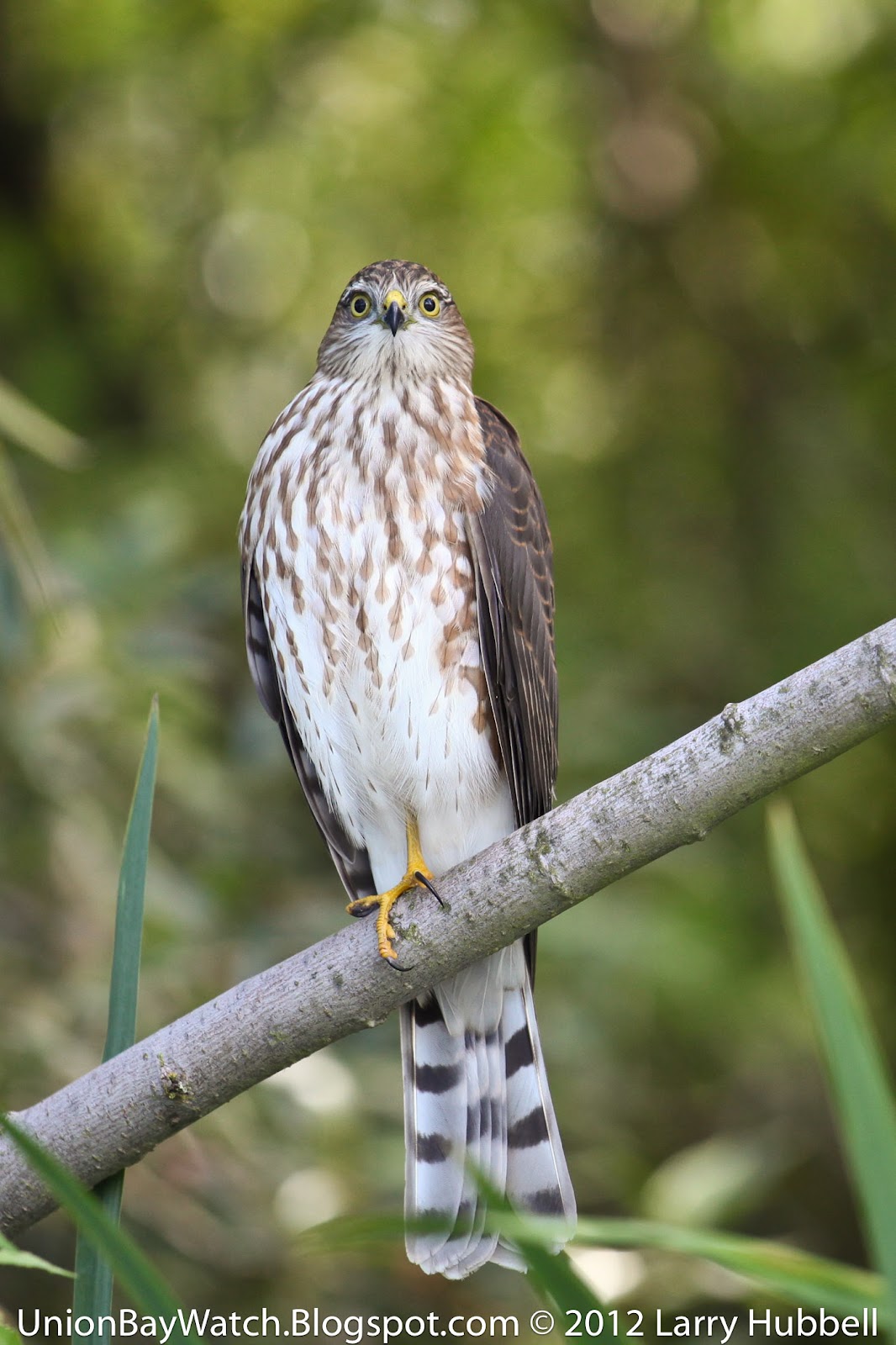
Update:

The following Cornell link shows that the Sharpie on the left is a juvenile bird because of the vertical as opposed to more horizontal striping. Very interesting!


I will be very curious to hear if anyone spots the one-eyed wigeon.


May the crows be with you!


Larry

Monday, February 13, 2012

McKay's Bunting - Feeding

Yesterday, Marcus Roening and I went in search of the McKay's Bunting. Since there have been no known sightings on Union Bay this required some travel. The McKay's Bunting is extremely rare (a few thousand birds) and they usually reside on two, small Alaskan Islands. Luckily, one bird had been sighted on Damon Point south of Ocean Shores. Having the opportunity to see a McKay's Bunting in Washington state is a very special treat.


Marcus is a good friend who also happens to be a birder with over 35 years experience.
Along the way Marcus pointed out an Emperor Goose, a Greater White-Fronted Goose, a Harlequin Duck, a Peregrine Falcon, a half-a-dozen Snowy Owls and many, many other birds as well. Thank you, Marcus!

After a two to three hour drive and a brisk morning walk to the far end of Damon Point (beyond the Snowy Owls) we found  small group of Marcus's birder friends. They were quietly observing the small, white bunting as it bounced in and out of sight among the low sandy dunes which were somewhat sparsely covered with beach grass. 
After watching the somewhat sleepy, Snowy Owls the McKay's Bunting seemed like an amazing bundle of energy. It seldom stopped moving. Usually it stayed on the ground although occasionally it would leap up to a grab a seed of grass. I do not remember seeing it fly.

Afterwords when I got home and began looking closely at the photos I was surprised to see a number of feeding behaviors that escaped me at the time.

For instance in this photo if you look closely the bunting seems to have caught a small grass-colored inch worm.

In this shot the bird appears to be pulling on the stalk of the grass. I suspect there must have been some form of food on the grass that attracted it.

In this case the bunting is pulling a seed off the head of grass. 

In this case I believe the bird is actually holding a seed in it's beak.

In this final example the bird is sitting on the head of grass to hold it down while it feeds. You can clearly see the leftover husks lay on the ground behind the bird.

In this last shot the bird does not appear to be feeding, but I do wonder what it is thinking.

What  a beautiful little bird.

Until next time,

Larry


Sunday, February 5, 2012

Tufted Duck

The Tufted duck is most generally found in Europe and Asia. For some reason a few of them choose to winter in North America. I wonder if they are simply confused or if there is a risk-taking gene.

These photos are my thanks to Connie on Tweeters List who first spotted this duck from shore at the Union Bay Natural Area. Once at the UBNA the easiest way to get close to the Tufted is by searching for a half a dozen birders shielding there eyes from the sun and all looking intently off shore.
The key identifier for this bird are the feathers sticking out behind his head, somewhat like a Wood Duck. The most common activity for this duck appears to be diving to feed. This causes the tuft to become wet and lay closer to the head which can make him more difficult to spot in a crowd of birds.
On the other hand he is smaller and different than some of his companions.
In addition to diving he did find time for a couple of other activities.
Rubbing that hard to get spot.
Drying his wings.
Watching the watchers. 
Here is one more parting shot.

It looks like another beautiful day today, so if you happen to find yourself at the Union Bay Natural Area, be sure to bring yours binoculars, scope or camera and search for the Tufted Duck.

Have a super day!

Larry

PS: After posting this blog I went out to Foster Island and spotted birders at UBNA who looked just as described above. So I could not resist posting this photo. <grin>


PSS: By the way I have larger versions of the bird photos available on Smugmug.


Sunday, January 22, 2012

Trumpeter vs Tundra Swans

For most of the last month there have been roughly 14 large white swans on Union Bay. They seem to have left earlier this week, just about the time the snow arrived. I wonder if they headed  further south to find warmer weather, it seems like a good plan to me. 

Twelve of these swans appear to be Trumpeter Swans while I believe the other two are the slightly smaller and more elegant Tundra Swans. Three of the 12 Trumpeters are juveniles. They are more of a gray color instead of white. They can be seen on the right side of the photo above. The following two photos are close ups of an adult Tundra & Trumpeter swan. Can you tell which one is which?
I have learned that the easy way to tell them apart is the small yellow mark just in front of the eye. I believe the correct name for this spot is a lore and only the Tundra Swan has this mark. The Tundra swan is also smaller then the Trumpeter Swan, but this can be difficult to see unless you happen to catch them side by side.
The middle two birds in the photo above happen to provide just such a comparison as do the two birds below.
Most days I could spot the swans from Foster Island by looking north. They are usually just small white dots floating on the water but it was very nice to know they were there. Beautiful wild birds living in the middle of a half a million people. They seemed to find plenty to eat because they spent a large portion of their time sleeping.
I seldom saw the swans take to the air. It seemed they only flew to escape humans when we approached too close. Unlike most of the other birds on Union Bay, I never noticed the swans flying away from the Bald Eagles. The swans were pretty obvious about their discomfort if someone came too close. Initially they would just turn and swim away. My thought was, "If all you can see is their backside then you are too close." In any case, I do think the swans were most beautiful in flight.

Happy new year!

Larry


Tuesday, November 29, 2011

Hooded Mergansers

For the last few weeks the Hooded Mergansers have been visiting Union Bay, just north of the Arboretum. The following photos are completely true, however the order displayed and the verbiage are pure fantasy.

"Hey Guys! Let's find some ladies and tell them how handsome we are."

"Look, over there!"

"Let's tell her all about us."

"Where did she go?"

"I think she is behind us."

"She must not heard me, maybe if I sing a little louder..."

"Actually, I prefer the strong and silent type."

"Foiled again."

I hope you enjoyed watching the mergansers via my first post on Union Bay Watch.

Happy Holidays!

Larry